All species › Passerines › Tanagers and allies › Buff-throated Saltator
Buff-throated Saltator | Saltator maximus
Bontkeelsaltator | Saltador golianteado | Tempera-viola
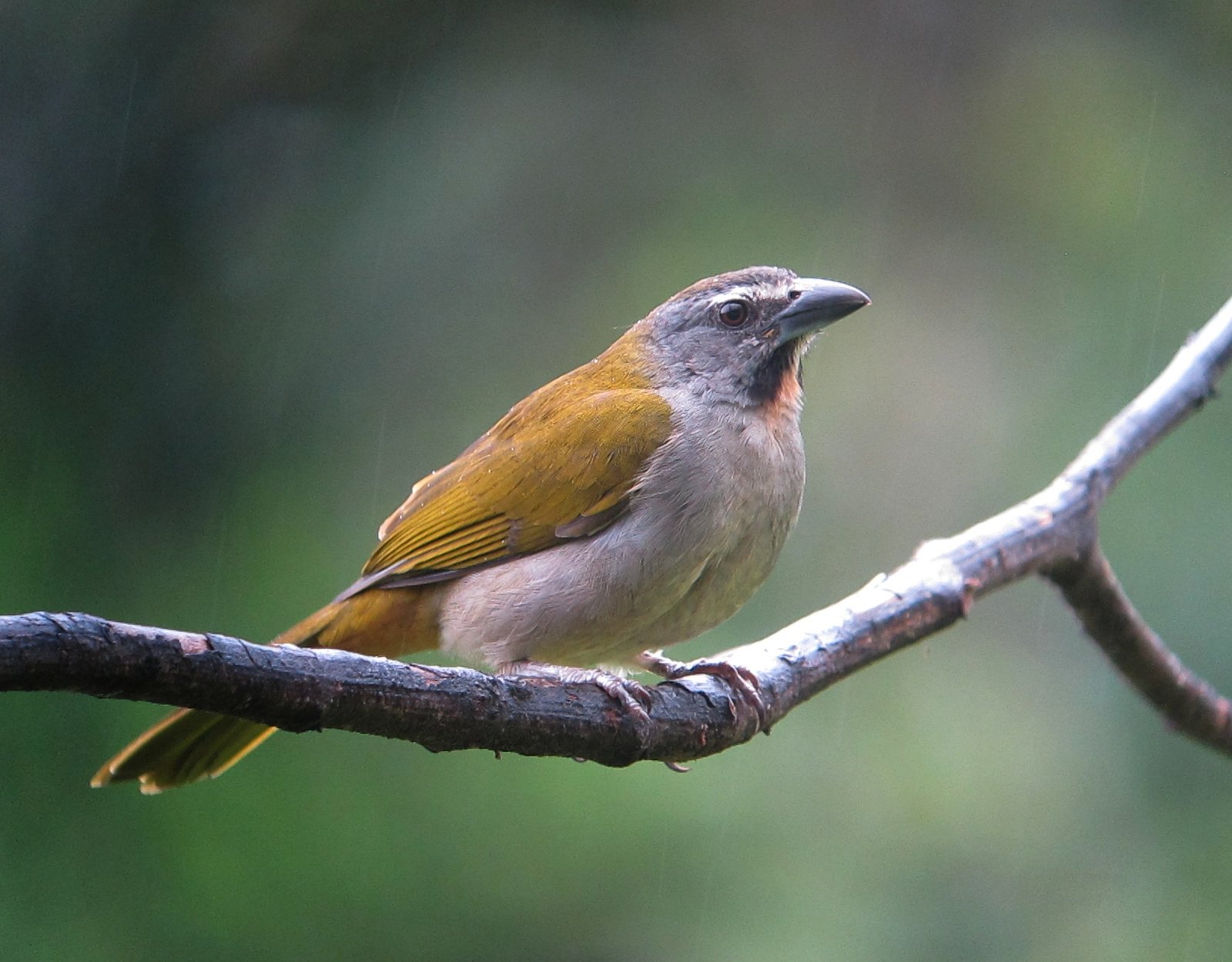
The Buff-throated Saltator is a large, olive-green saltator of forest edges and secondary forest in the tropical lowlands, with a buff throat patch between two black malar stripes. It is the most widespread saltator of the guide area, both west and east of the Andes. Its soft, whistled song often comes from dense vegetation.
Voice
The song consists of soft, melodious, whistled phrases, often long and somewhat thrush-like, and is repeated regularly. The call is a sharp chink.
Recording: JAYRSON ARAUJO DE OLIVEIRA — CC BY-NC-SA 4.0 · xeno-canto
Identification
20–21 cm, with a heavy, blackish bill. The upperparts are olive-green, the head grey, with a short white eyebrow. A black malar stripe on each side frames the throat: the chin is white, the lower throat buff. The rest of the underparts are grey, and the undertail coverts are buff. The sexes are alike. Juveniles are duller and greener, with a less distinct throat pattern.
Confusion species
Black-winged Saltator Saltator atripennis has black wings and tail and a black face with white spots, and lives higher, on the western Andean slopes. Olive-grey Saltator Saltator olivascens and Bluish-grey Saltator Saltator coerulescens have a grey, not green, back and a white throat. Green-winged Saltator Saltator similis has a grey back, green wing edges and a white throat. Streaked Saltator Saltator striatipectus is browner, with streaked underparts.
Habitat
Edges of humid lowland and foothill forest, secondary forest, clearings with trees, riverside vegetation and coffee and cacao plantations, from sea level to about 1200 m, locally higher. It forages in the middle levels and sometimes joins mixed flocks. It eats fruit, flowers, buds and insects. The nest is a loose cup in a shrub or small tree.
Where the bird is most at home, classified by the vegetation units of the Andes and the west coast.


Range and movements
In Colombia in the lowlands of the Pacific coast, the north and the Magdalena valley, and east of the Andes. In Ecuador in the western lowlands and in Amazonia. In Peru in the Amazonian lowlands and on the lower eastern slope. In Bolivia in the northern and eastern lowlands. Absent from the Galápagos. Outside the guide area from southern Mexico to Venezuela, the Guianas and Brazil.
- Resident
- dark = core range, pale = thinly spread
How and when to look
Listen for the soft, whistled song along forest edges and clearings in the lowlands. The birds often sit half hidden in the foliage, but come to fruiting trees and shrubs.
Conservation status
Least Concern. Common and resilient in an open forest landscape with secondary growth.
Scientific name
Saltator maximus | (Müller, 1776)
Müller described the species in 1776 as Tanagra maxima; because it was later moved to another genus, the author and year stand in brackets. The genus Saltator was introduced in 1816 by Vieillot. The genus name comes from Latin saltator, 'dancer'. The species name comes from Latin maximus, 'largest'. The specimen the first description was based on came from Cayenne, French Guiana.