All species › Passerines › Tanagers and allies › Black-winged Saltator
Black-winged Saltator | Saltator atripennis
Zwartvleugelsaltator | Pepitero alinegro | Trinca-ferro-de-asa-preta
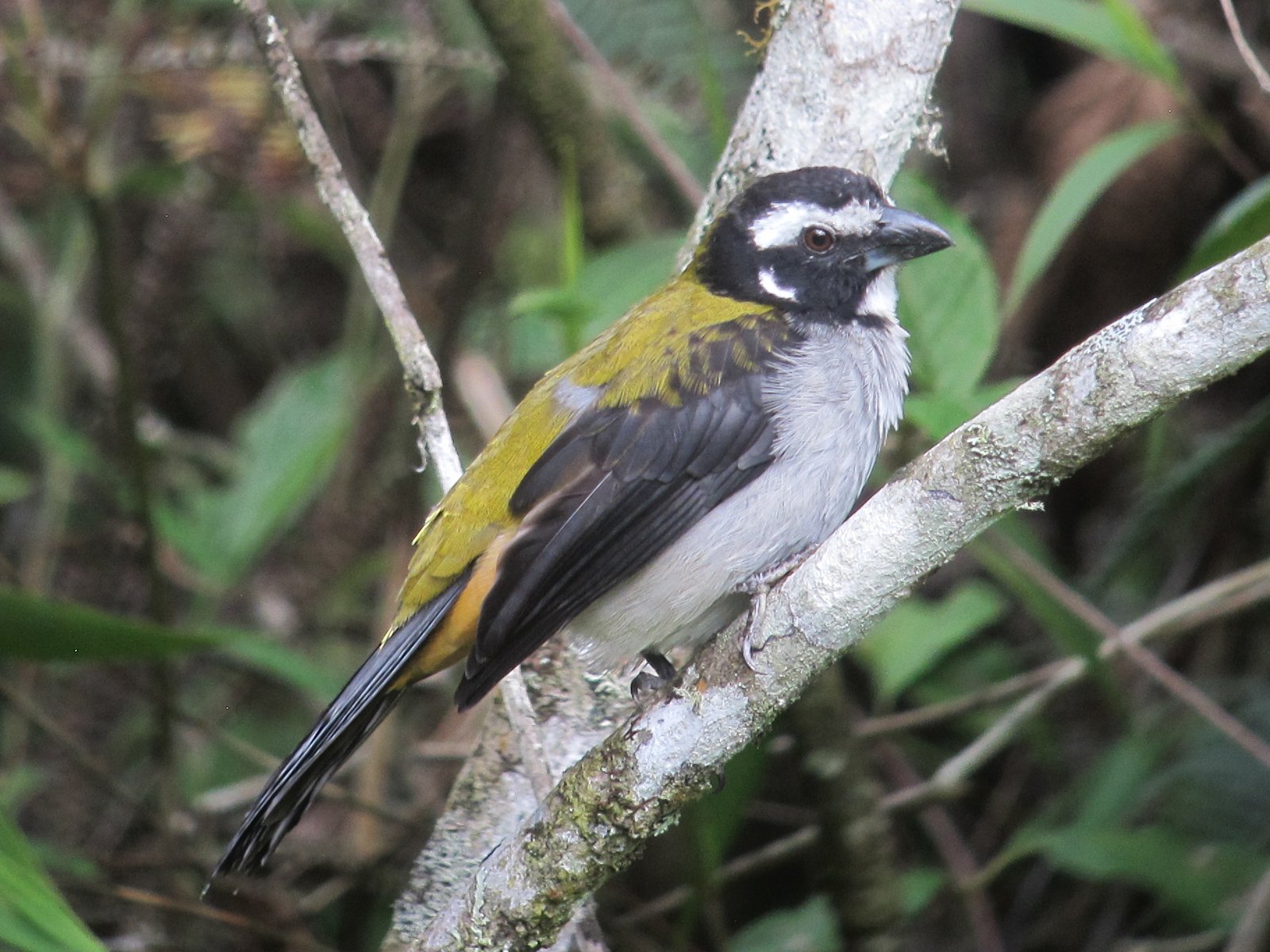
The Black-winged Saltator is a saltator of the montane forests of north-western South America, with black wings, a black face with white markings and an olive-green back. Its range is almost confined to Colombia and western Ecuador. It lives mainly at forest edges and in semi-open country on the lower and middle mountain slopes.
Voice
The song consists of loud, rich and melodious phrases of a few notes, often repeated. The call is a sharp chink.
Recording: José María Loaiza B. — CC BY-NC-SA 4.0 · xeno-canto
Identification
20–21 cm, with a heavy, black bill. The crown is grey, darker in some birds. The face and sides of the head are black, with a white stripe behind the eye and a white patch on the cheek. The throat is white. The back is olive-green, the wings and tail black. The underparts are grey, becoming buff on the undertail coverts. The sexes are alike. Juveniles are duller, with less crisp head colours.
Confusion species
Buff-throated Saltator Saltator maximus has olive-green wings, a grey head without a black face and a buff throat, and usually lives lower. Streaked Saltator Saltator striatipectus is browner, with streaked underparts and no black face. Slate-colored Grosbeak Saltator grossus is slate grey with a red bill and lives in the interior of lowland forest.
Habitat
Edges of humid montane and foothill forest, tall secondary forest, clearings with trees and shaded coffee plantations, roughly between 400 and 2000 m. It forages in the middle and upper levels, often in pairs or with mixed tanager flocks. It eats fruit, flowers and insects. The nest is a cup in a shrub or tree.
Where the bird is most at home, classified by the vegetation units of the Andes and the west coast.


Range and movements
In Colombia on the slopes of the Western and Central Andes and in the Magdalena valley. In Ecuador on the western slope of the Andes and in the adjacent western foothills. Absent from Peru, Bolivia and the Galápagos. Does not occur outside the guide area.
- Resident
- dark = core range, pale = thinly spread
How and when to look
Search on the western slope of the Andes along forest edges and in shade-coffee plantations, where the birds often sit in fruiting trees and sing loudly.
Conservation status
Least Concern. Fairly common and resilient on partly deforested slopes with secondary forest.
Scientific name
Saltator atripennis | Sclater, 1857
Sclater described the species in 1857 and placed it straight away in the genus where it still stands. The genus Saltator was introduced in 1816 by Vieillot. The genus name comes from Latin saltator, 'dancer'. The species name combines Latin ater, 'black', and penna, 'feather, wing'. The specimen the first description was based on came from Popayán, Colombia.