All species › Passerines › Tanagers and allies › Blue-browed Tanager
Blue-browed Tanager | Tangara cyanotis
Zilverbrauwtangare | Tangara cejiazul | Saíra-de-sobrancelha-azul
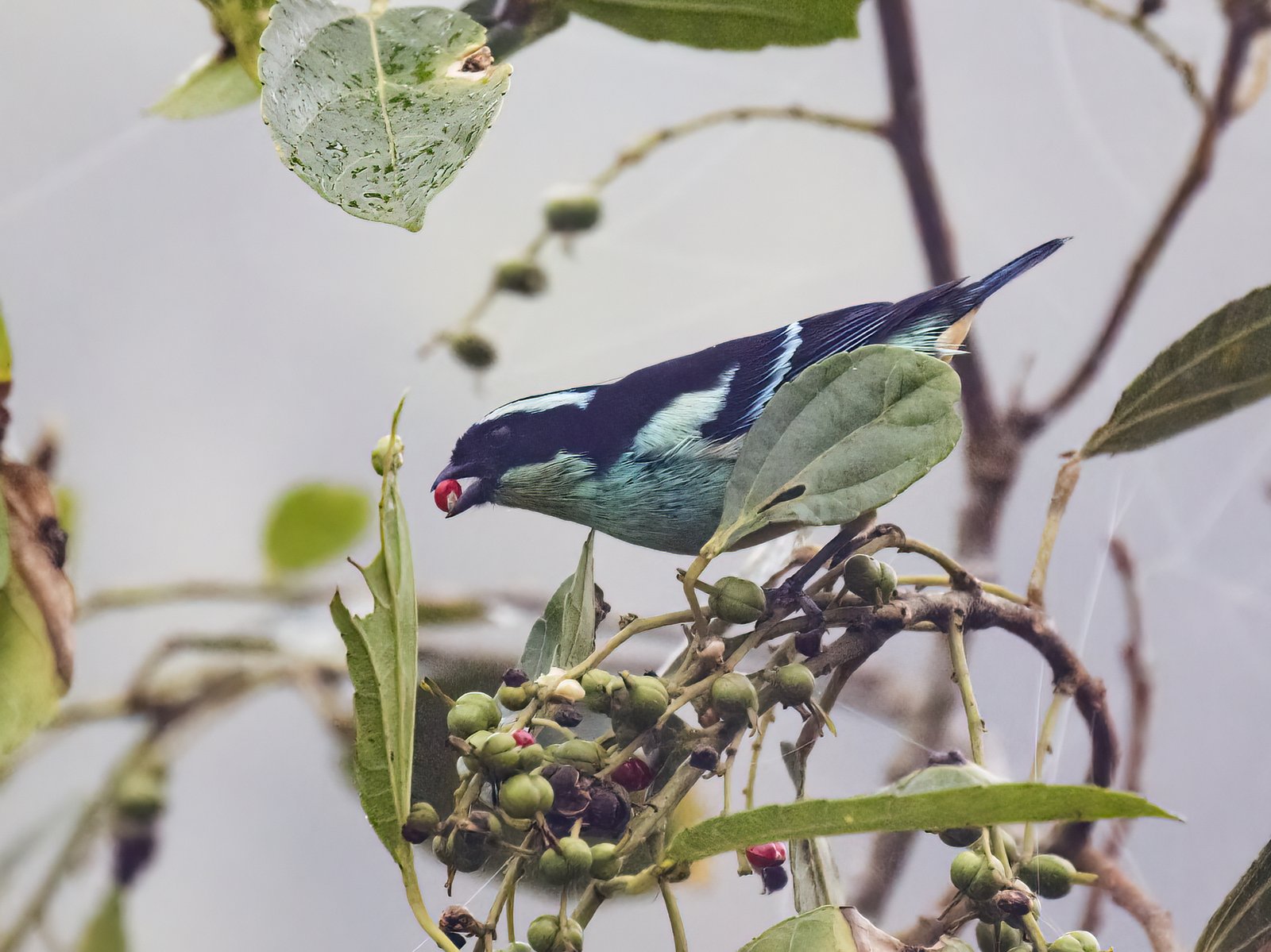
The Blue-browed Tanager is a small tanager of the eastern slope of the Andes, black above with a broad pale blue eyebrow. It is less numerous than most relatives and is mainly seen in mixed tanager flocks in the subtropical zone. The core of its range lies in Peru and Bolivia.
Voice
Thin, high tsit and tsip calls, as in related tanagers. The song is poorly described.
Recording: Daniel F. Lane — CC BY-NC-SA 4.0 · xeno-canto
Identification
12 cm. The head, back and mantle are black, with a broad, silvery pale blue eyebrow from above the eye to the hindcrown. The flight feathers and wing coverts are edged blue, the rump is turquoise-blue. The throat and breast are glossy turquoise-blue, sometimes with small black spots on the sides of the breast; the centre of the belly and the undertail coverts are buff. The bill is black and short. The sexes are alike; juveniles are duller.
Confusion species
Metallic-green Tanager Tangara labradorides is mostly silvery blue-green, without a black back. Beryl-spangled Tanager Tangara nigroviridis has a black mask and a spangled plumage without an eyebrow. Blue-and-black Tanager Tangara vassorii lives higher and is uniform blue with black wings. Blue-necked Tanager Stilpnia cyanicollis has an entirely blue head and a black belly.
Habitat
Canopy and edges of humid montane forest on the eastern slope, also secondary forest and forest edges, roughly between 1200 and 2200 m. It searches the outer twigs for insects and eats small fruits, usually in pairs within mixed flocks.
Where the bird is most at home, classified by the vegetation units of the Andes and the west coast.


Range and movements
In Colombia very local on the eastern slope of the Andes in the south; in Ecuador local on the eastern slope; in Peru along the entire eastern slope; in Bolivia on the eastern slope in the Yungas of La Paz, Cochabamba and Santa Cruz. Absent from the Galápagos. Does not occur outside the guide area.
- Resident
- dark = core range, pale = thinly spread
How and when to look
With mixed tanager flocks in the Yungas of Peru and Bolivia, for example along roads through montane forest on the eastern slope. Look for a small black tanager with a pale eyebrow among the other species.
Conservation status
Least Concern. Scarce and local in the north of its range, fairly common in Peru and Bolivia; deforestation of the eastern slope affects parts of its habitat.
Scientific name
Tangara cyanotis | (Sclater, 1858)
Sclater described the species in 1858 as Calliste cyanotis; because it was later moved to another genus, the author and year stand in brackets. The genus Tangara was introduced in 1760 by Brisson. The genus name comes from the extinct Tupi language, in which tangara means 'dancer'. The specific name comes from Greek kuanos, 'dark blue', and ous (ōtos), 'ear', referring to the blue around the eye and ear. The specimen the first description was based on came from Peru, near the border with Bolivia.