All species › Passerines › Tanagers and allies › Plain-colored Tanager
Plain-colored Tanager | Tangara inornata
Grijze tangare | Tangara cenicienta | Saíra-cinza-lisa
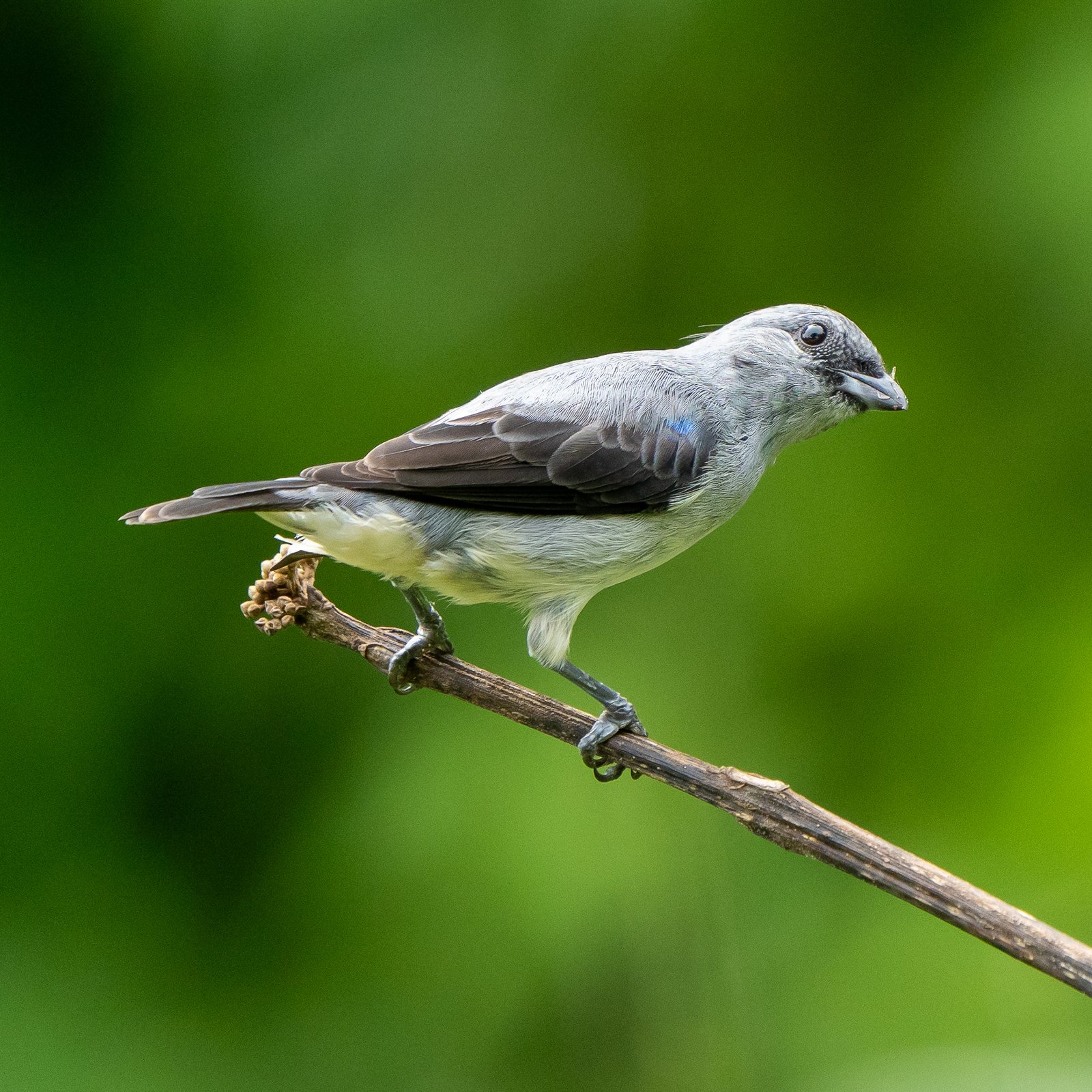
The Plain-colored Tanager is a soberly coloured member of a genus of mostly brightly coloured tanagers: grey with only a small blue shoulder patch. It lives in the warm lowlands of northern and western Colombia, where small groups move through the canopy of forest edges, gardens and plantations. Its English name describes the plumage without pattern.
Voice
High, thin tsit calls and a quick, high twitter as a group moves on.
Recording: Kent Livezey — CC BY-NC-SA 4.0 · xeno-canto
Identification
11.5–12 cm. The upperparts are dark slate-grey, the underparts paler grey, becoming whitish on the belly and undertail coverts. The lores are blackish. On the shoulder there is a small glossy blue patch that is often hidden by the feathers. The wings and tail are blackish grey. The bill and legs are dark. The sexes are alike; juveniles are browner grey.
Confusion species
Blue-grey Tanager Thraupis episcopus is larger and bluish grey with pale blue wing edges. Palm Tanager Thraupis palmarum is larger and olive-grey with a two-toned wing. Females of dacnises such as Blue Dacnis Dacnis cayana are green, not grey.
Habitat
Canopy and edges of humid lowland forest, secondary forest, forest edges, shaded plantations, gardens and open country with scattered trees, mainly below 1000 m. It eats small fruits and berries and searches branches and leaves for insects, in pairs or small groups, often with other tanagers.
Where the bird is most at home, classified by the vegetation units of the Andes and the west coast.


Range and movements
In Colombia in the Caribbean lowlands, the Magdalena valley and the north-west into northern Chocó. Occurrence in the far north-west of Ecuador is uncertain. Absent from Peru, Bolivia and the Galápagos. Outside the guide area in Panama and possibly the extreme south-east of Costa Rica.
- Resident
- dark = core range, pale = thinly spread
How and when to look
At forest edges, in gardens and at fruiting trees in the lowlands of northern Colombia, such as in the Magdalena valley. Look for small grey birds travelling with groups of tanagers.
Conservation status
Least Concern. It adapts to secondary growth and farmland and is locally fairly common.
Scientific name
Tangara inornata | (Gould, 1855)
Gould described the species in 1855 as Calliste inornata; because it was later moved to another genus, the author and year stand in brackets. The genus Tangara was introduced in 1760 by Brisson. The genus name comes from the extinct Tupi language, in which tangara means 'dancer'. The specific name comes from Latin inornatus, 'unadorned', referring to the plain plumage. The specimen the first description was based on came from Bogotá, Colombia.