All species › Passerines › Tanagers and allies › Turquoise Tanager
Turquoise Tanager | Tangara mexicana
Turkooistangare | Tangara turquesa | Saíra-de-bando
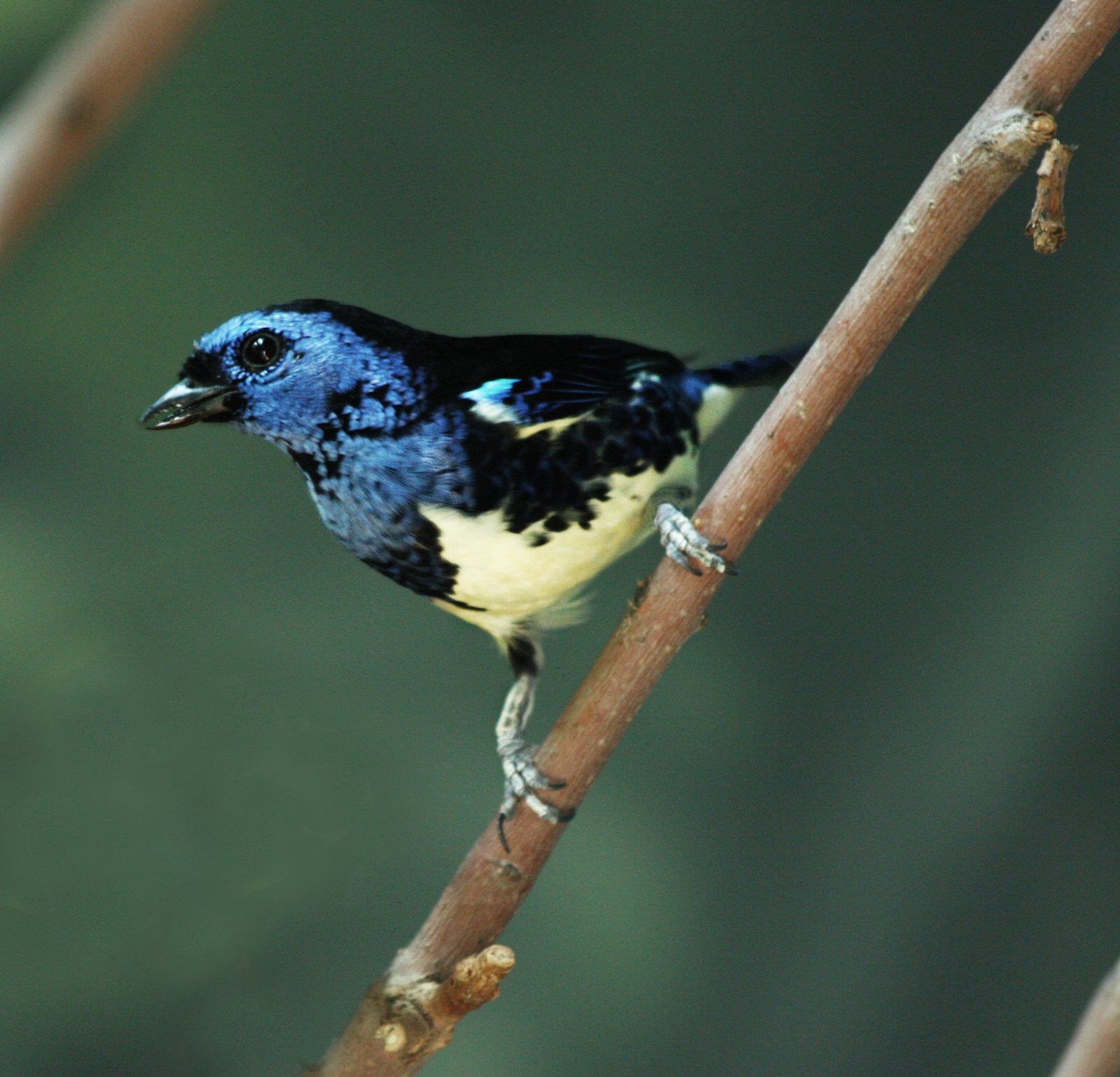
The Turquoise Tanager is a tanager of the Amazonian lowlands, dark blue and black with a pale yellow belly. It lives in noisy groups of four to ten birds, which often move through the canopy of forest edges and open woodland without other species. Despite the scientific name mexicana it does not occur in Mexico.
Voice
High, sharp tseet calls and a high, shrill twitter that the group gives constantly.
Recording: Odirlei Vieira da Fonseca — CC BY-NC-SA 4.0 · xeno-canto
Identification
13–14 cm. The head, throat and breast are dark cobalt-blue, with a black forehead and black lores. The back, wings and tail are black; the shoulders and edges of the wing coverts are pale blue to turquoise. The flanks and sides of the breast are blue with black spots. The belly and undertail coverts are pale yellow. The bill is black. The sexes are alike; juveniles are duller.
Confusion species
Opal-rumped Tanager Tangara velia has a pale opalescent rump and a chestnut lower belly. Paradise Tanager Tangara chilensis has a green head and a red rump. Yellow-bellied Tanager Ixothraupis xanthogastra is green with black spots and a yellow belly.
Habitat
Canopy and edges of humid lowland forest, várzea, secondary forest, forest edges, clearings with scattered trees and gardens near villages, mainly below 600 m and locally higher in the foothills. It eats small fruits, including those of Cecropia, and searches branches for insects.
Where the bird is most at home, classified by the vegetation units of the Andes and the west coast.


Range and movements
In Colombia east of the Andes in Amazonia and along the adjacent edges of the llanos; in Ecuador and Peru in the lowlands east of the Andes; in Bolivia in the north and east of the lowlands. Absent from the Galápagos. Outside the guide area in Venezuela, the Guianas, Amazonian Brazil and, as a distinct form, in eastern Brazil.
- Resident
- dark = core range, pale = thinly spread
How and when to look
In groups at forest edges, in clearings around lodges and in trees near villages in Amazonian Ecuador and Peru. Groups often perch on bare branches at the top of the canopy.
Conservation status
Least Concern. Widespread and fairly common, also in secondary growth.
Scientific name
Tangara mexicana | (Linnaeus, 1766)
Linnaeus described the species in 1766 as Tanagra mexicana; because it was later moved to another genus, the author and year stand in brackets. The genus Tangara was introduced in 1760 by Brisson. The genus name comes from the extinct Tupi language, in which tangara means 'dancer'. The specific name refers to Mexico, an error: the species occurs in South America. The specimen the first description was based on came from Cayenne, French Guiana.