All species › Passerines › Tanagers and allies › Paradise Tanager
Paradise Tanager | Tangara chilensis
Paradijstangare | Tangara paraíso | Sete-cores-da-amazônia
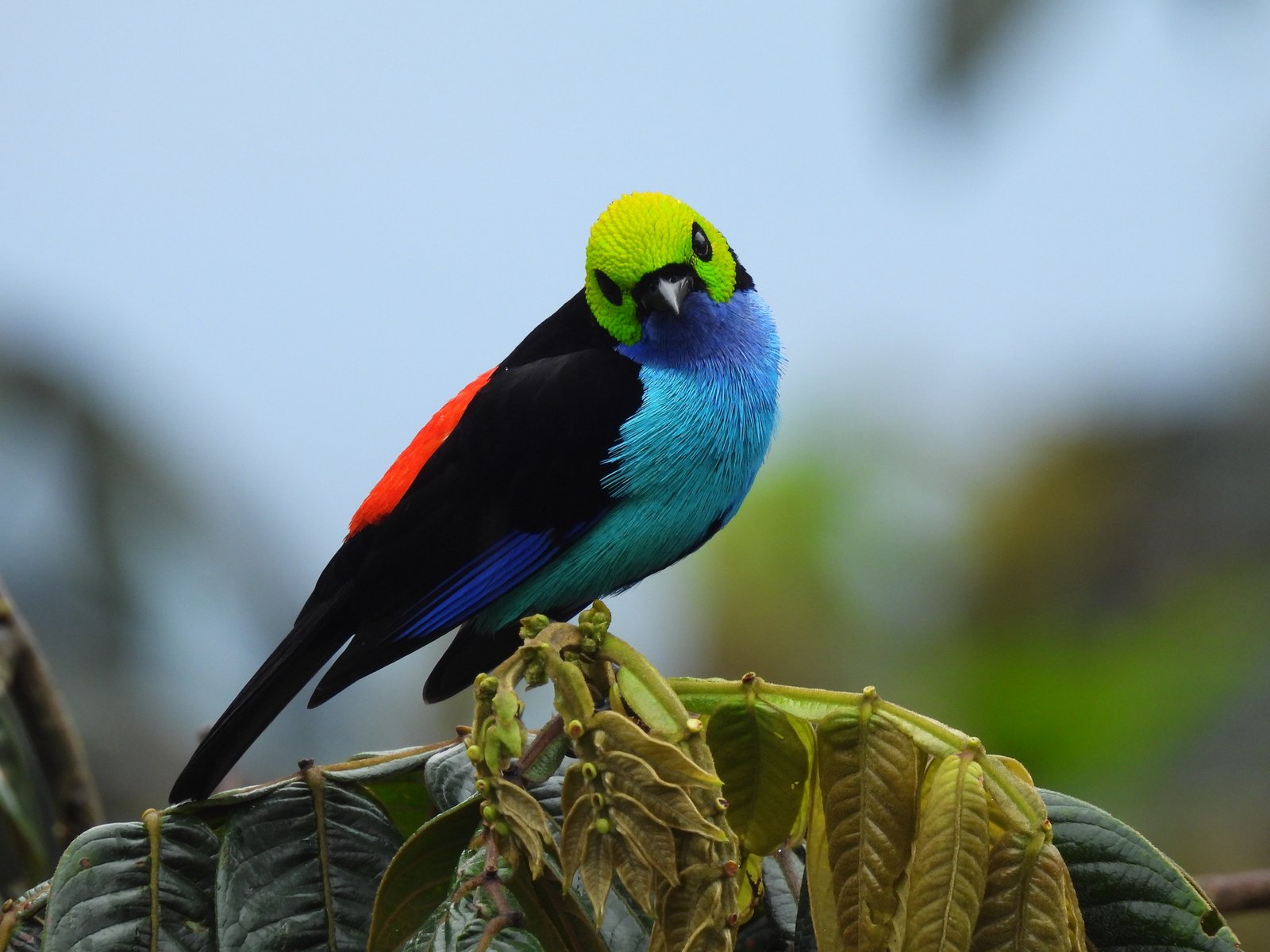
The Paradise Tanager is one of the most colourful birds of Amazonia, with an apple-green head, a black back, a red rump and turquoise-blue underparts. Small groups move noisily through the canopy, often together with other tanagers. Despite its bright colours it often stays hidden in the foliage high in the canopy.
Voice
Groups give constant high, thin tsit calls and sharp, dry chip notes. The song is inconspicuous.
Recording: JAYRSON ARAUJO DE OLIVEIRA — CC BY-NC-SA 4.0 · xeno-canto
Identification
13–15 cm. The head and face are bright apple green with a scaly sheen. The hindneck, back, wings and tail are black; the wing coverts have blue edges. The rump is bright red, in some birds with yellow towards the tail. The throat is violet-blue, the breast and flanks bright turquoise, the centre of the belly black. The bill is black and fairly short. The sexes are alike; juveniles are duller.
Confusion species
Unmistakable thanks to the combination of green head, red rump and turquoise breast. Opal-rumped Tanager Tangara velia has a dark blue head, a pale opalescent rump and a chestnut belly. Turquoise Tanager Tangara mexicana is dark blue and black with a yellow belly. Green-and-gold Tanager Tangara schrankii has a yellow centre to the underparts and a black mask, without red on the rump.
Habitat
Canopy and edges of humid lowland forest, both terra firme and várzea, and of foothill forest on the eastern slope of the Andes, also secondary forest and trees in clearings. It forages in the canopy for small fruits and searches branches and leaves for insects, usually in small groups and often in mixed flocks with other tanagers.
Where the bird is most at home, classified by the vegetation units of the Andes and the west coast.


Range and movements
In Colombia east of the Andes in Amazonia and the adjacent foothills; in Ecuador and Peru in the lowlands and foothills east of the Andes; in Bolivia in the north and along the base of the Andes. Absent from the Galápagos. Outside the guide area in southern Venezuela, the Guianas and Amazonian Brazil.
- Resident
- dark = core range, pale = thinly spread
How and when to look
From canopy towers and walkways at lodges in Amazonian Ecuador and Peru, where groups pass through the treetops at eye level. Also at roadside forest edges in the foothills.
Conservation status
Least Concern. Widespread and fairly common in large tracts of forest, but locally affected by deforestation.
Scientific name
Tangara chilensis | (Vigors, 1832)
Vigors described the species in 1832 as Aglaïa Chilensis; because it was later moved to another genus, the author and year stand in brackets. The genus Tangara was introduced in 1760 by Brisson. The genus name comes from the extinct Tupi language, in which tangara means 'dancer'. The specific name refers to Chile, wrongly presumed to be its origin; the species lives in Amazonia. The specimen the first description was based on came from Bolivia.