All species › Passerines › Tanagers and allies › Blue-whiskered Tanager
Blue-whiskered Tanager | Tangara johannae
Blauwbaardtangare | Tangara bigotuda | Saíra-de-bigode-azul
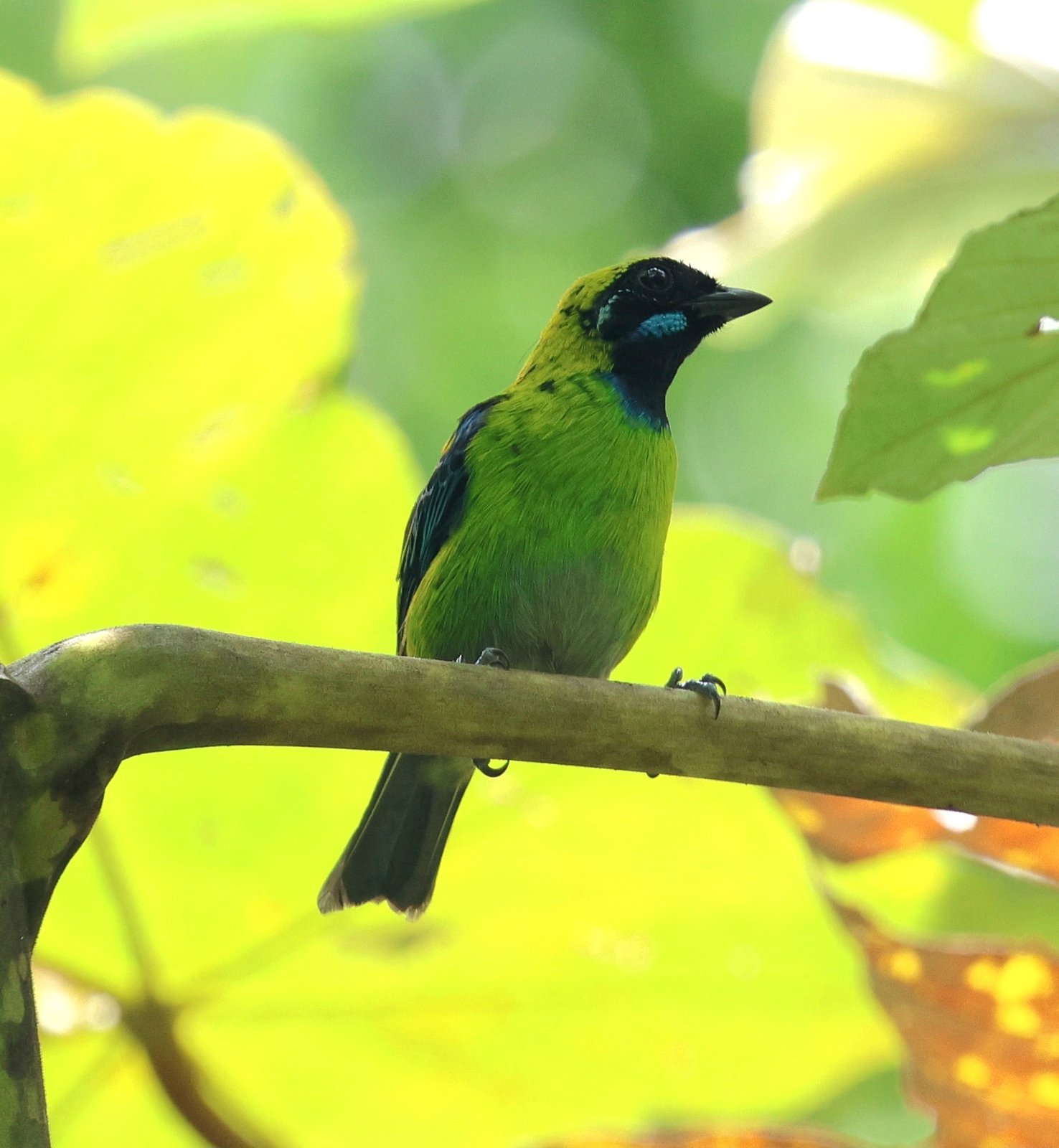
The Blue-whiskered Tanager is a green tanager of the Chocó rainforest of western Colombia and north-western Ecuador, with a black face and a narrow, pale blue moustachial stripe. It has a small range in the wet lowlands and low foothills along the Pacific coast and lives in the canopy, often in mixed flocks.
Voice
High, thin tsit and tseet calls, often repeated in mixed flocks; any song is inconspicuous.
Recording: Olaf Jahn — CC BY-NC-SA 4.0 · xeno-canto
Identification
13 cm, with a short, black bill. The forehead, lores, cheeks and chin are black; below the black face runs a narrow, glossy pale blue moustachial stripe. The crown and hindneck are glossy golden green, the back green with black spots or scales. Throat, breast and flanks are glossy green, the centre of the belly and the undertail coverts buff. Wings and tail are black with green edges. The sexes are alike; juveniles are duller.
Confusion species
Emerald Tanager Tangara florida is smaller and brighter green, with a yellow crown in the male and a black spot on the ear coverts, without a black face and blue whisker, and usually lives higher. Bay-headed Tanager Tangara gyrola has a rufous-brown head. The female Green Honeycreeper Chlorophanes spiza is plain green, with a longer, decurved yellow bill.
Habitat
Canopy and edges of wet lowland rainforest, tall secondary forest and trees in semi-open country in the Chocó, from sea level to roughly 1000 m, mostly below 600 m. It eats small fruits and searches branches and leaves for insects, usually in the canopy and often in mixed flocks. Little is known about the nest.
Where the bird is most at home, classified by the vegetation units of the Andes and the west coast.


Range and movements
In Colombia in the Pacific lowlands from Chocó to Nariño. In Ecuador in the north-west, mainly in Esmeraldas and northern Pichincha. Absent from Peru, Bolivia and the Galápagos. Not known outside the guide area.
- Resident
- dark = core range, pale = thinly spread
How and when to look
Search the canopy at forest edges and roadside trees in the lowlands of north-western Ecuador, for example around Playa de Oro and the Canandé reserve in Esmeraldas, or around Bahía Solano and Buenaventura in Colombia.
Conservation status
Least Concern. The range is small, and lowland forest in the Chocó is being cleared for timber, oil palm and cattle.
Scientific name
Tangara johannae | (de Dalmas, 1900)
De Dalmas described the species in 1900 as Calliste johannae; because it was later moved to another genus, the author and year stand in brackets. The genus Tangara was introduced in 1760 by Brisson. The genus name comes from the extinct Tupi language, in which tangara means 'dancer'. The species name honours Jeanne Henriette de Dalmas (1888–1978), daughter of the French ornithologist Raymond Comte de Dalmas, who described the species. The specimen the first description was based on came from El Pailón, Valle del Cauca, Colombia.