All species › Passerines › Tanagers and allies › Green-and-gold Tanager
Green-and-gold Tanager | Tangara schrankii
Groen-gouden tangare | Tangara verdidorada | Saíra-ouro
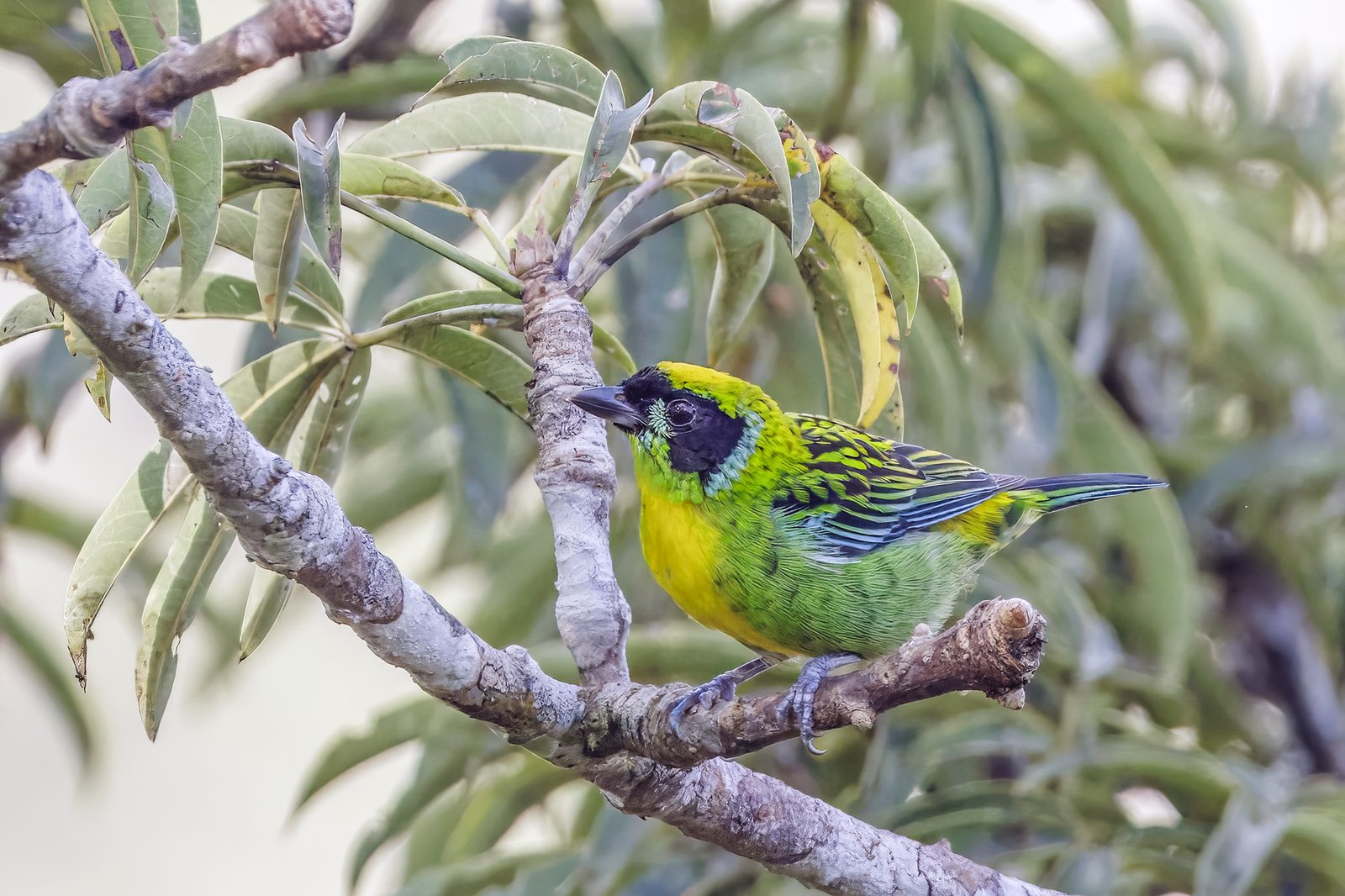
The Green-and-gold Tanager is a green tanager of the Amazonian lowlands with a golden-yellow crown, a black mask and a yellow centre to the underparts. Unlike most of its relatives it often forages in the middle and lower storeys of the forest, as a regular member of mixed flocks.
Voice
High, thin tsit calls and a short, rapid series of high notes, especially when the flock is moving.
Recording: Jerome Fischer — CC BY-NC-SA 4.0 · xeno-canto
Identification
13 cm, with a short, black bill. The male has a black forehead and a black mask around the eye, a golden-yellow crown and a green hindneck. The back is green with black spots, the rump golden yellow. Throat and flanks are green, the centre of the breast and belly bright golden yellow. Wings and tail are black with blue-green edges. The female has a greener crown with less yellow and a less sharp mask. Juveniles are duller.
Confusion species
Yellow-bellied Tanager Ixothraupis xanthogastra is smaller, green with dense black spots on the head and breast and a yellow belly, without a black mask. Spotted Tanager Ixothraupis punctata has spotted, whitish underparts. Paradise Tanager Tangara chilensis has a black back, a red rump and turquoise-blue underparts. Bay-headed Tanager Tangara gyrola has a rufous-brown head.
Habitat
Humid lowland forest in terra firme and várzea, bamboo forest and foothill forest, also forest edges and tall secondary forest, from the lowlands to roughly 1200 m. It searches branches and leaves for insects in the middle storey and the lower canopy and eats small fruits, usually in mixed flocks. The nest is a cup in a tree.
Where the bird is most at home, classified by the vegetation units of the Andes and the west coast.


Range and movements
In Colombia east of the Andes in Amazonia and the adjacent foothills. In Ecuador in the eastern lowlands and foothills. In Peru in the Amazonian lowlands and the foothills east of the Andes. In Bolivia in the north and along the base of the Andes. Does not occur on the Galápagos. Outside the guide area in southern Venezuela and western Amazonian Brazil.
- Resident
- dark = core range, pale = thinly spread
How and when to look
Follow mixed flocks along trails in lowland forest at Amazonian lodges, for example in Yasuní in Ecuador or in Manu and Tambopata in Peru; look at mid-level, not only in the canopy.
Conservation status
Least Concern. Common and widespread in western Amazonia, but dependent on forest and declining locally through deforestation.
Scientific name
Tangara schrankii | (Spix, 1825)
Spix described the species in 1825 as Tanagra schrankii; because it was later moved to another genus, the author and year stand in brackets. The genus Tangara was introduced in 1760 by Brisson. The genus name comes from the extinct Tupi language, in which tangara means 'dancer'. The specific name honours Franz von Paula Schrank (1747–1835), a German botanist and entomologist in Munich. The specimen the first description was based on came from Tabatinga, Rio Solimões, Brazil.