All species › Passerines › Tanagers and allies › Flame-faced Tanager
Flame-faced Tanager | Tangara parzudakii
Vuurmaskertangare | Tangara cariflama | Saíra-de-cara-flamejante
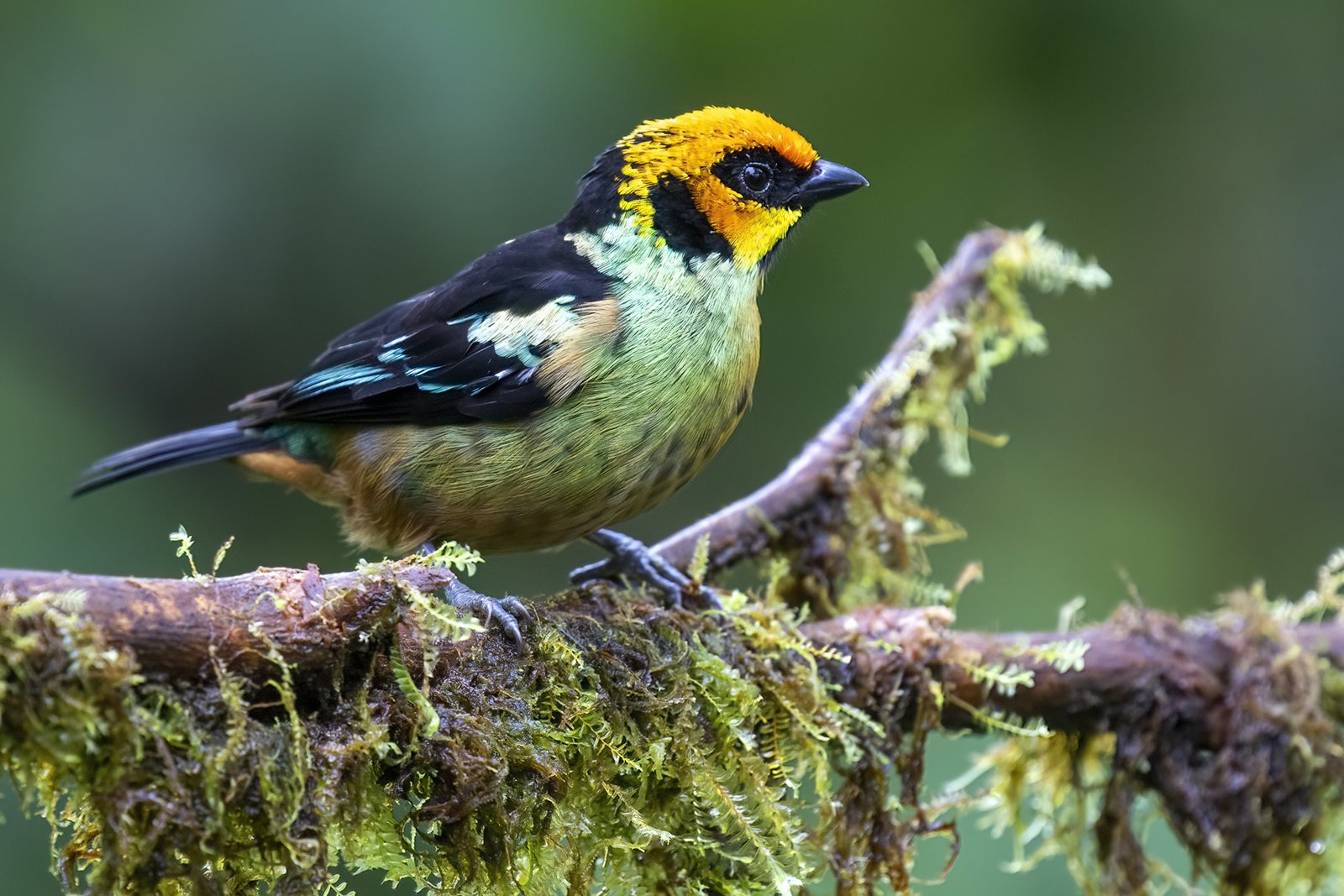
The Flame-faced Tanager is one of the largest tanagers in the genus Tangara, with a flame-red and golden-yellow face, a black throat and back, and opalescent underparts. It lives in montane forest of the northern Andes and northern Peru, usually in pairs or small groups within mixed flocks.
Voice
Sharp, high tsit calls and short, metallic notes, often in mixed flocks; a distinct song is not known.
Recording: Alejandro Pinto-Gómez — CC BY-NC-SA 4.0 · xeno-canto
Identification
14–15 cm, with a short, black bill. The forehead and front of the face are flame red to orange-red, merging behind into golden yellow on the crown, ear coverts and hindneck. The lores, the area around the eye, the throat and upper breast are black. The back and scapulars are black, the rump opal green. The underparts are silvery opal green, the centre of the belly and the undertail coverts buff to cinnamon. The lesser wing coverts are opal green, the rest of the wings and tail black. Birds of the western slope have less red and more golden yellow in the face. The sexes are alike; juveniles are duller.
Confusion species
Golden-eared Tanager Tangara chrysotis has a golden-green crown, a golden-orange ear patch, a streaked back and a cinnamon belly, without red in the face. Saffron-crowned Tanager Tangara xanthocephala is smaller, with a plain saffron-yellow head, only a small black mask and a blue-green body. Golden Tanager Tangara arthus is entirely golden yellow with a black ear patch.
Habitat
Humid montane forest and cloud forest, forest edges and secondary forest with scattered trees, roughly between 1000 and 2700 m, mostly between 1400 and 2300 m. It eats many small fruits and searches mossy branches for insects, usually in the middle storey and the canopy. The nest is a cup in a tree.
Where the bird is most at home, classified by the vegetation units of the Andes and the west coast.


Range and movements
In Colombia in all three Andean ranges. In Ecuador on both slopes of the Andes. In Peru on the eastern slope from the north to the south-east. Not known from Bolivia or the Galápagos. Outside the guide area in the far west of Venezuela.
- Resident
- dark = core range, pale = thinly spread
How and when to look
Search mixed flocks along forest edges and roads in cloud forest, for example around Mindo and along the old Nono road in Ecuador or at Cock-of-the-rock Lodge in Peru; the flame-red head shows even from below.
Conservation status
Not evaluated in the taxonomy followed here. Fairly common in continuous montane forest and at forest edges; declining locally through deforestation.
Scientific name
Tangara parzudakii | (de Lafresnaye, 1843)
De Lafresnaye described the species in 1843 as Tanagra Parzudakii; because it was later moved to another genus, the author and year stand in brackets. The genus Tangara was introduced in 1760 by Brisson. The genus name comes from the extinct Tupi language, in which tangara means 'dancer'. The specific name honours Charles Parzudaki, a 19th-century French natural-history dealer in Paris. The specimen the first description was based on came from Bogotá, Colombia.