All species › Pelicans, herons and ibises › Herons, egrets and bitterns › Boat-billed Heron
Boat-billed Heron | Cochlearius cochlearius
Schuitbekreiger | Garza cucharón | Arapapá
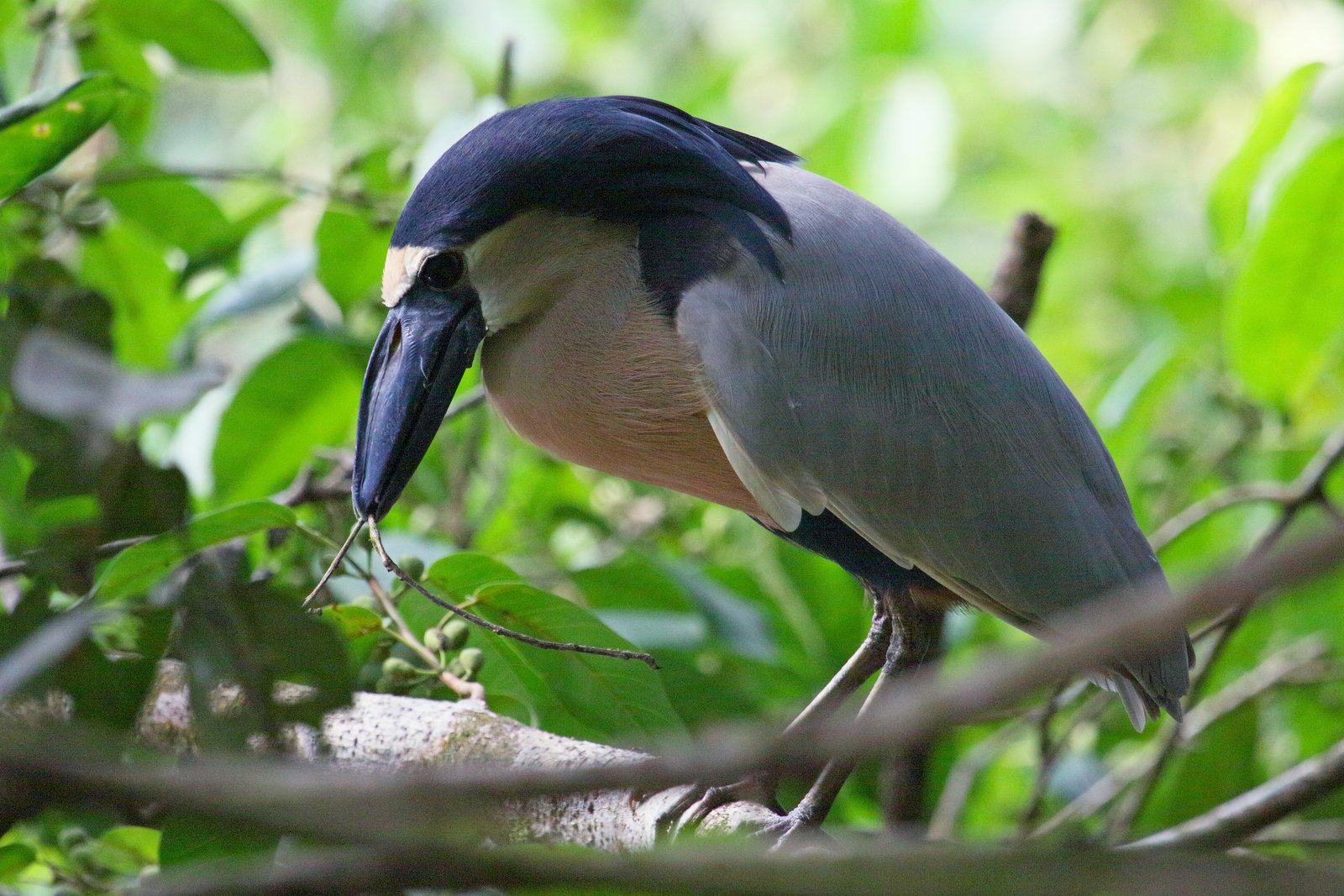
The Boat-billed Heron is a stocky night heron with a broad, flat bill shaped like an upturned boat and large, dark eyes. By day it rests hidden in dense trees over water; at dusk it starts to hunt. It uses the bill both to scoop up and to seize prey.
Voice
Various low croaking and grunting sounds, such as a frog-like kwa and a series of hollow po-po-po notes, mainly at dusk and at night; also bill-clapping at the nest.
Recording: Leonardo Guzman Hernandez — CC BY-NC-SA 4.0 · xeno-canto
Identification
45–51 cm, with a large head, a short neck and a very broad, flattened bill. Adults have a black crown with a long black crest, a white forehead and a whitish to pale grey face and breast. The back is pale grey, the belly rufous and the flanks black. The eyes are large and dark, and the legs yellowish green. Juveniles are brown above and paler cinnamon below, without a crest. The sexes are alike.
Confusion species
Black-crowned Night Heron Nycticorax nycticorax has a narrow, pointed bill, smaller red eyes and a white belly without rufous. Yellow-crowned Night Heron Nyctanassa violacea is grey with a black-and-white head pattern and has longer legs and a thick but pointed bill. Juvenile night herons are brown with pale spots but lack the broad bill.
Habitat
Mangroves, wooded river banks, oxbow lakes (cochas), swamp forest and flooded forest in the lowlands, mostly below 500 m. It hunts at night from branches or in shallow water, taking fish, shrimps, crabs, frogs and insects. It nests singly or in small colonies; the nest is a platform of sticks in a tree or shrub over water.
Where the bird is most at home, classified by the vegetation units of the Andes and the west coast.


Range and movements
In Colombia widespread in the lowlands of the Caribbean region, the Pacific coast, the Magdalena Valley, the llanos and Amazonia. In Ecuador in the western lowlands and the Amazonian lowlands. In Peru mainly in the Amazonian lowlands. In Bolivia in the lowlands of the north and east. Absent from the Galápagos. Outside the guide area from Mexico to northern Argentina.
- Resident
- dark = core range, pale = thinly spread
How and when to look
On a boat trip along cochas and wooded river banks in the Amazonian lowlands, birds often sit in small groups in dense, overhanging branches by day. After sunset you can find them with a torch along the bank.
Conservation status
Least Concern. Locally the species suffers from the clearance of mangroves and riverine forest and disturbance at breeding sites.
Scientific name
Cochlearius cochlearius | (Linnaeus, 1766)
Linnaeus described the species in 1766 as Cancroma Cochlearia; because it was later moved to another genus, the author and year stand in brackets. The genus Cochlearius was introduced in 1760 by Brisson. The genus name comes from Latin cochlearium or cochleare, 'spoon', after the broad, spoon-shaped bill. The species name repeats the genus name (a tautonym), from Latin cochlearium, 'spoon', after the bill. The specimen the first description was based on came from the Guianas (probably French Guiana).