All species › Pelicans, herons and ibises › Herons, egrets and bitterns › Fasciated Tiger Heron
Fasciated Tiger Heron | Tigrisoma fasciatum
Gestreepte tijgerroerdomp | Garza tigre barreteada | Socó-jararaca
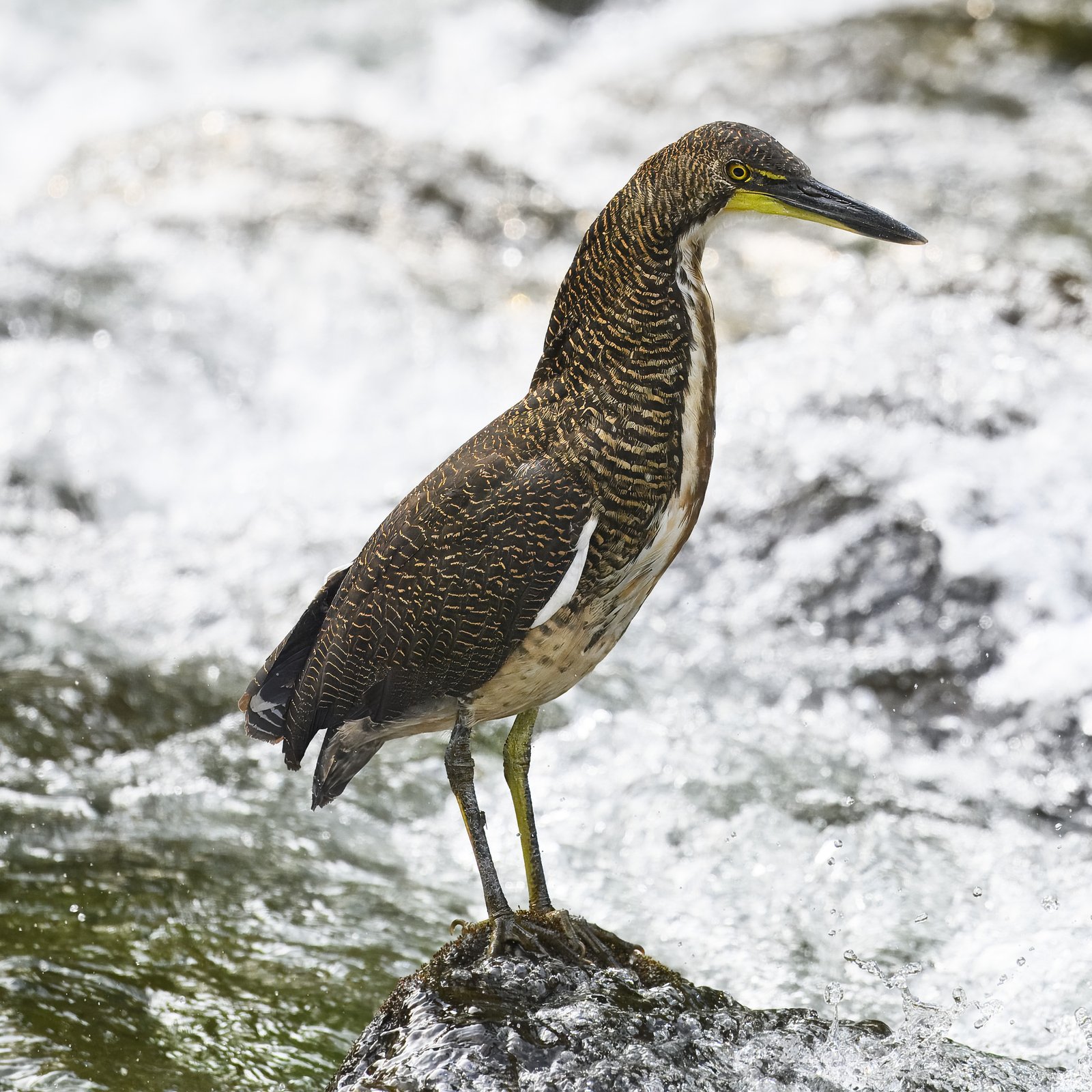
The Fasciated Tiger Heron is the tiger heron of mountain rivers. It lives along fast-flowing, rocky rivers and streams in the Andean foothills, where it waits for fish on stones in mid-stream. It is smaller, darker and greyer than the lowland Rufescent Tiger Heron.
Voice
Usually silent. When alarmed a hoarse, short kwok; also low, grunting calls.
Recording: Bernabe Lopez-Lanus — CC BY-NC-SA 4.0 · xeno-canto
Identification
61–71 cm, with a noticeably short, thick bill. Adults have a black crown, a grey head and a slate-grey neck and back with fine pale bars. A white central stripe with dark edges runs down the foreneck. The belly is greyish to cinnamon-brown. The legs are greenish. Juveniles are ochre-buff with black bars, finer and denser than in juvenile Rufescent. The sexes are alike.
Confusion species
Rufescent Tiger Heron Tigrisoma lineatum is larger, with a rufous head and neck and a longer bill, and lives in the lowlands by still or slow-flowing water; juveniles are best told by the longer bill and coarser barring of Rufescent. Bare-throated Tiger Heron Tigrisoma mexicanum has a bare throat and lives on the coast of north-western Colombia.
Habitat
Fast-flowing, clear rivers and streams with boulders and gravel bars in forested hill and mountain country, roughly between 300 and 1500 m, locally lower or up to about 2000 m. It stands on stones in or beside the current and hunts fish, crustaceans and aquatic insects. The nest is a platform of sticks in a tree by the river.
Where the bird is most at home, classified by the vegetation units of the Andes and the west coast.


Range and movements
In Colombia along the slopes of the Andes and in the Sierra Nevada de Santa Marta. In Ecuador on both the eastern and western slopes of the Andes. In Peru on the eastern slope of the Andes. In Bolivia in the Yungas and the foothills of the eastern slope. Absent from the Galápagos. Outside the guide area in Costa Rica and Panama, in Venezuela and in south-eastern Brazil and north-eastern Argentina.
- Resident
- dark = core range, pale = thinly spread
How and when to look
Scan large boulders in fast-flowing rivers in the Andean foothills, for example from bridges over mountain rivers on the eastern slope; birds often stand motionless on a stone in mid-stream.
Conservation status
Least Concern. Locally the species suffers from deforestation along rivers, pollution and the construction of dams.
Scientific name
Tigrisoma fasciatum | (Such, 1825)
Such described the species in 1825 as Ardea Fasciata; because it was later moved to another genus, the author and year stand in brackets. The genus Tigrisoma was introduced in 1827 by Swainson. The genus name comes from Greek tigris, 'tiger', and sōma, 'body', after the barred plumage. The species name is Latin fasciatus, 'banded', after the fine bars. The specimen the first description was based on came from Brazil.