All species › Passerines › New World sparrows › Bolivian Brushfinch
Bolivian Brushfinch | Atlapetes rufinucha
Roodnekstruikgors | Atlapetes nuquirrufo | Tico-tico-boliviano
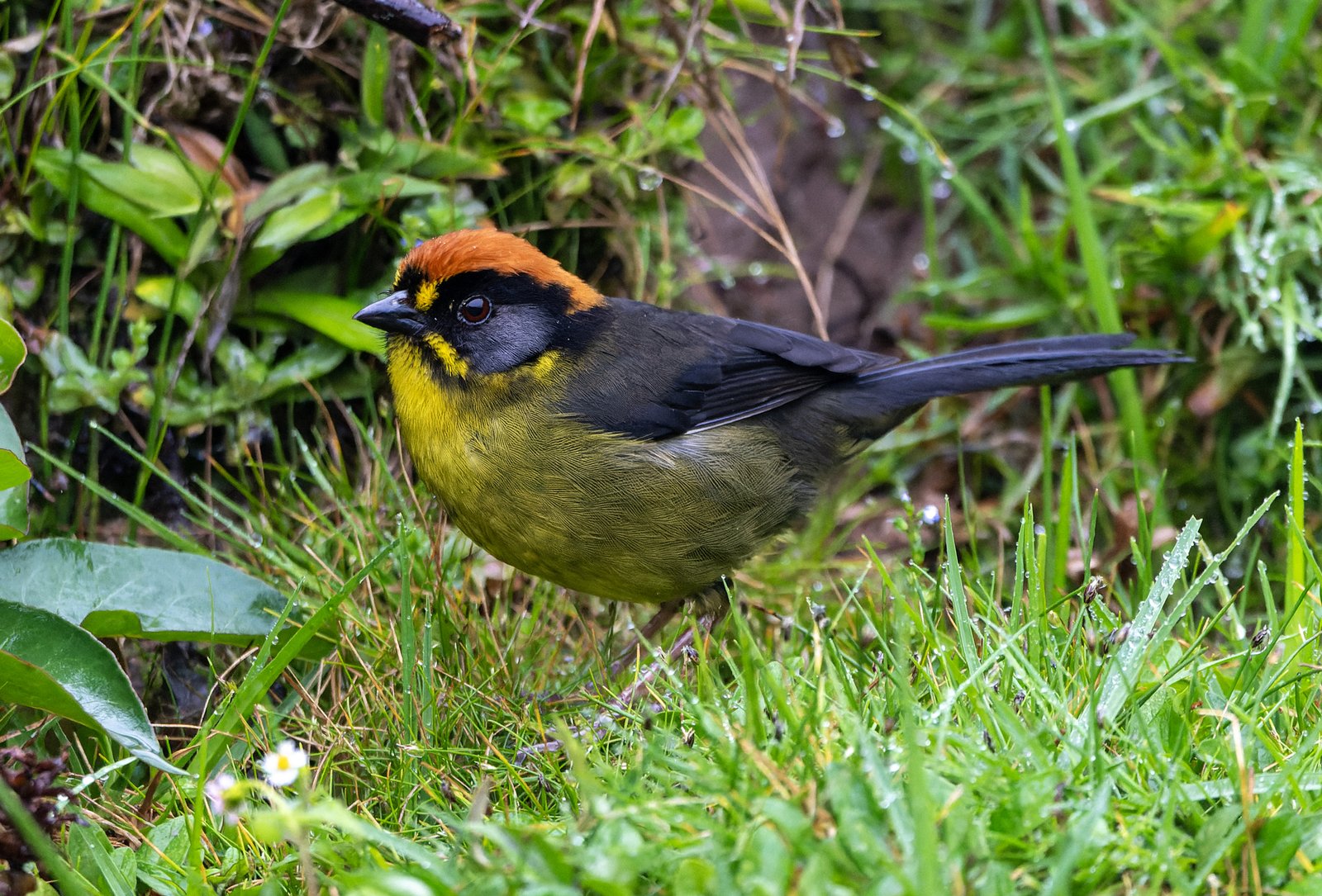
The Bolivian Brushfinch is a brushfinch found only in Bolivia, on the eastern slope of the Andes. It has a rufous crown, a blackish face with yellow markings and a bright yellow throat. It lives mainly at forest edges and in semi-open scrub and partly benefits from the opening up of montane forest.
Voice
The song is simple, a short series of repeated high notes. The call is a high, buzzy note, roughly tseet.
Recording: Jacob Wijpkema — CC BY-NC-SA 4.0 · xeno-canto
Identification
17 cm, with a short, sturdy, black bill and a fairly long tail. The forehead is blackish, the crown and nape are rufous. The face is mostly blackish, with in the nominate form a yellow spot above the lores, a yellow moustachial stripe and a blackish stripe below it. The upperparts are blackish with a greenish rump; the wings and tail are blackish with olive edges. The throat and underparts are bright yellow, the flanks greenish. The subspecies carrikeri in Santa Cruz is smaller, lacks the yellow loral spot and is olive-green above. The sexes are alike. Juveniles are browner above and faintly streaked below.
Confusion species
Grey-eared Brushfinch Atlapetes melanolaemus in La Paz has a blackish throat, no yellow loral spot and dusky scaling on the breast. Fulvous-headed Brushfinch Atlapetes fulviceps has a wholly cinnamon head and a green back. White-browed Brushfinch Arremon torquatus has a black-and-grey striped head and white underparts.
Habitat
Semi-open country: edges of montane and Yungas forest, secondary forest, scrub and overgrown pastures, roughly between 1200 and 3600 m. It lives in pairs or family groups and forages on the ground or low in the vegetation; its diet has been little studied. The breeding season includes at least December to February; little else is known about breeding.
Where the bird is most at home, classified by the vegetation units of the Andes and the west coast.


Range and movements
Only in Bolivia, on the eastern slope of the Andes in a fragmented range: the nominate form at two small sites in La Paz and in a larger area in Cochabamba, the subspecies carrikeri in Santa Cruz. Absent from Colombia, Ecuador, Peru and the Galápagos. Does not occur outside the guide area.
- Resident
- dark = core range, pale = thinly spread
How and when to look
Search along mountain roads in Cochabamba, for example on the old road to the Chapare, and in the mountains of Santa Cruz. Check forest edges, roadside scrub and overgrown pastures; pairs move low through the vegetation and call frequently.
Conservation status
Least Concern. The range is fairly large; the population is thought to be declining, but no immediate threats are known. Fairly common to common; the species tolerates disturbed forest and forest edges.
Scientific name
Atlapetes rufinucha | (d'Orbigny, ACVMD & de Lafresnaye, 1837)
D'Orbigny, ACVMD & de Lafresnaye described the species in 1837 as Embernagra rufi-nucha; because it was later moved to another genus, the author and year stand in brackets. The genus Atlapetes was introduced in 1831 by Wagler. The genus name comes from Greek: the mythical titan Atlas and petēs, 'flyer'. The species name comes from Latin rufus, 'rufous', and Medieval Latin nucha, 'nape', for the rufous crown and nape. The specimen the first description was based on came from Yungas, La Paz, Bolivia.