All species › Passerines › New World sparrows › Grey-eared Brushfinch
Grey-eared Brushfinch | Atlapetes melanolaemus
Zwartkeelstruikgors | Atlapetes carinegro | Tico-tico-de-orelha-cinza
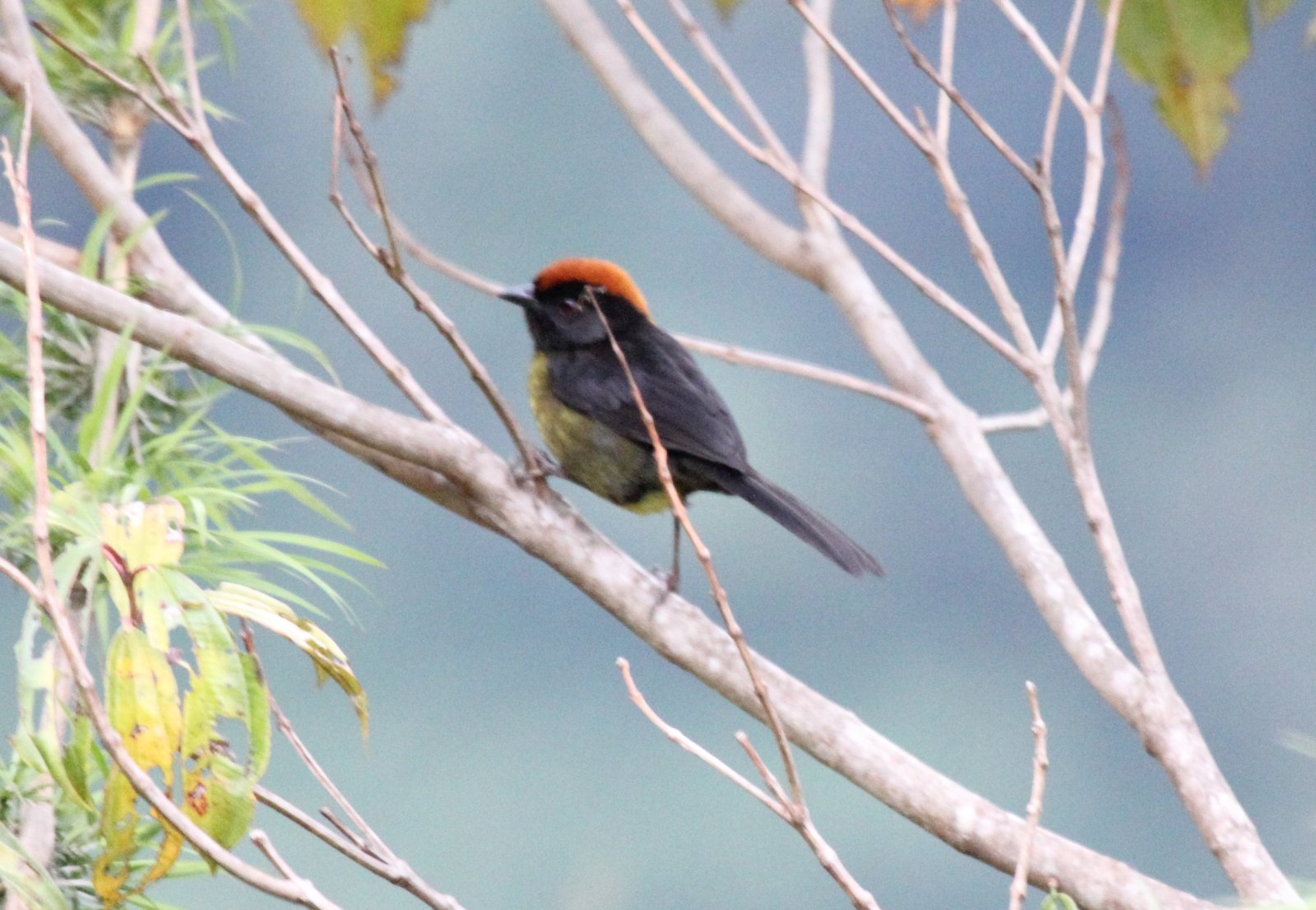
The Grey-eared Brushfinch is a brushfinch of the humid montane forests on the eastern slope of the Andes in south-eastern Peru and adjacent western Bolivia. It has a rufous crown, a blackish face and a blackish throat above yellow underparts. For a long time it was treated as a subspecies of a broader Rufous-naped Brushfinch, which was later split into a series of species.
Voice
The call is a high, thin tsit. The song is a short series of high, thin and somewhat scratchy notes, often given as a duet by a pair.
Recording: Joseph Tobias and Nathalie Seddon — CC BY-NC-SA 3.0 · xeno-canto
Identification
17 cm, with a short, sturdy, black bill and a fairly long tail. The forehead, crown and nape are bright rufous. The face, chin and throat are blackish. The upperparts are blackish, with a slight olive wash on the rump; the wings and tail are blackish, the tail feathers with olive edges. The underparts are dull yellow, with dusky scaling on the breast and olive flanks. The iris is dark reddish brown, the legs are blackish. The sexes are alike. Juveniles are duller and browner.
Confusion species
Bolivian Brushfinch Atlapetes rufinucha in Bolivia has a bright yellow throat, a yellow spot above the lores and a yellow moustachial stripe. Cuzco Brushfinch Atlapetes canigenis in Cusco also has a rufous crown, but is grey above and below, without yellow. White-browed Brushfinch Arremon torquatus has a black-and-grey striped head and white underparts.
Habitat
Edges and clearings of humid montane forest and cloud forest, shrubby slopes, secondary growth and bamboo, roughly between 1400 and 3300 m, mainly in the middle and upper zone. It lives in pairs or family groups and searches on or just above the ground for insects, seeds and fruit. Little is known about the nest.
Where the bird is most at home, classified by the vegetation units of the Andes and the west coast.


Range and movements
In Peru on the eastern slope of the Andes from eastern Cusco south through Puno. In Bolivia in western La Paz. Absent from Colombia, Ecuador and the Galápagos. Does not occur outside the guide area.
- Resident
- dark = core range, pale = thinly spread
How and when to look
Search along the road through the montane forest of Manu in Cusco and along mountain roads in Puno, especially at forest edges and in scrub. Pairs forage low in the vegetation; listen for their high calls and look along the roadside.
Conservation status
Least Concern. The range is limited and the population is thought to be declining, but no immediate threats are known. Locally fairly common; it tolerates forest edges and secondary growth.
Scientific name
Atlapetes melanolaemus | (Sclater & Salvin, 1879)
Sclater & Salvin described the species in 1879 as Buarremon melanolaemus; because it was later moved to another genus, the author and year stand in brackets. The genus Atlapetes was introduced in 1831 by Wagler. The genus name comes from Greek: the mythical titan Atlas and petēs, 'flyer'. The species name comes from Greek melas, 'black', and laimos, 'throat', for the black throat. The specimen the first description was based on came from Cchachupata, Cuzco, Peru.