All species › Passerines › Antpittas › Brown-banded Antpitta
Brown-banded Antpitta | Grallaria milleri
Caldasmierpitta | Tororoí bandeado | Tovacuçu-de-faixa-parda
Brown-banded Antpitta is a small brown antpitta with a broad breast band, found only in the Central Andes of Colombia. It was described in 1912 and for a long time was hardly recorded again. Today it is known from a series of sites in high montane forest, where it lives mainly in young, regenerating forest.
Voice
The song consists of a single rising note and a three-note phrase, tu, tu-tu. The call is a loud, shrill note repeated in series. It sings year-round, mainly in the morning, usually from a low perch in dense undergrowth.
Recording: Iván Lau — CC BY-NC-SA 4.0 · xeno-canto
Identification
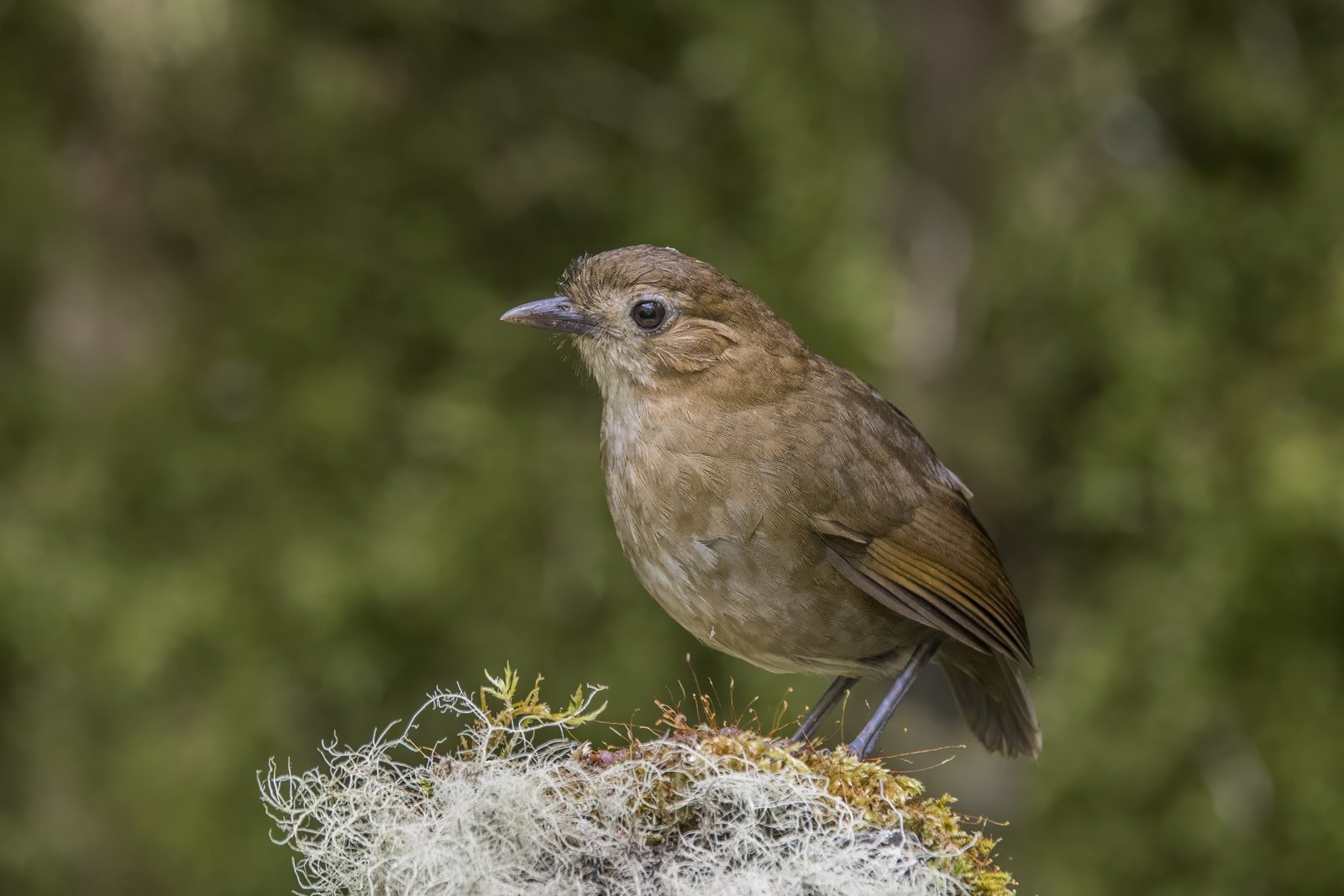
17–18 cm, round and short-tailed, on slate-grey to blackish legs, with a black bill with a paler tip. Whitish lores with black speckles. The upperparts are deep raw umber. The throat is greyish white; a broad tawny-olive band across the breast contrasts with the creamy white belly centre. The sexes are alike.
Confusion species
Bicolored Antpitta Grallaria rufocinerea in the same area is rufous, with grey underparts and no breast band. Chami Antpitta Grallaria alvarezi is uniformly rufous. Chestnut-crowned Antpitta Grallaria ruficapilla is larger, with a rufous head and streaked underparts. Tawny Antpitta Grallaria quitensis lives higher in open páramo and has tawny underparts without a contrasting white belly.
Habitat
Temperate-zone forest regenerating after natural disturbance such as landslides, with Chusquea bamboo or alder (Alnus acuminata), also forest edges and riparian woodland. Mainly between 2700 and 3200 m, with records down to 1800 m. It searches the ground for earthworms and other invertebrates. Little is known about its breeding.
Where the bird is most at home, classified by the vegetation units of the Andes and the west coast.


Range and movements
Only in Colombia, in the Central Andes: on the west slope from Caldas through Risaralda to Quindío, and on the east slope in Tolima. The subspecies gilesi is known only from a single old specimen from Antioquia. Absent from Ecuador, Peru, Bolivia and the Galápagos. Does not occur outside the guide area.
- Resident
- dark = core range, pale = thinly spread
How and when to look
In the Río Blanco reserve near Manizales, antpittas including this species come to places where earthworms are fed in the morning. Elsewhere, listen early in the morning in young montane forest with bamboo or alder, for example in the Toche valley in Tolima.
Conservation status
Vulnerable. The population is estimated at 10,000 to 20,000 mature individuals and is probably decreasing. Most forest below 3300 m in the Central Andes has long been converted to farmland for coffee, potatoes, beans and cattle. The species occurs in several protected areas and tolerates some disturbance, but disappears where forest is cleared completely.
Scientific name
Grallaria milleri | Chapman, 1912
Chapman described the species in 1912 and placed it straight away in the genus where it still stands. The genus Grallaria was introduced in 1816 by Vieillot. The genus name comes from New Latin grallarius, 'stilt-walker', referring to the long legs. The species name honours Leo Edward Miller (1887–1952), American collector in tropical America from 1910 to 1917. The specimen the first description was based on came from Laguneta near the Quindío Pass, Colombia.