All species › Passerines › Antpittas › Rufous-faced Antpitta
Rufous-faced Antpitta | Grallaria erythrotis
Roodoormierpitta | Tororoí carirrufo | Tovacuçu-de-face-ruiva
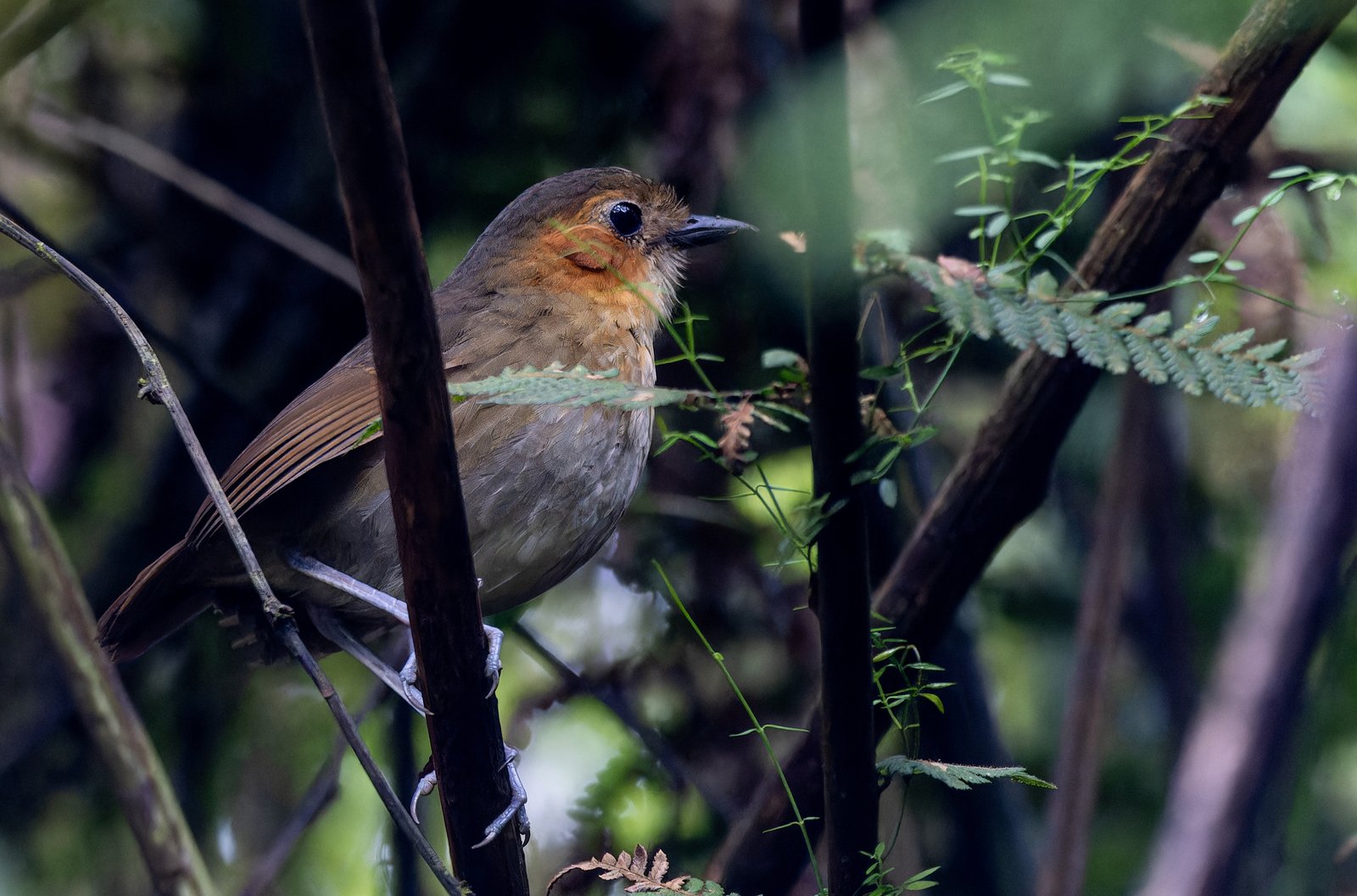
Rufous-faced Antpitta is a medium-sized antpitta of the Yungas of Bolivia, with a bright orange-ochre face and a white throat. It lives mainly in second growth and dense vegetation along roads and streams, and less in the interior of mature forest. Over most of its range it is mainly detected by its whistled song.
Voice
The song is a series of three flat whistles, each slightly higher and shorter than the previous one, the last rising. There is also a single long, falling whistle. It sings mainly in the morning, less in the afternoon and at dusk, usually low near the ground from a log or branch.
Recording: Niels Krabbe — CC BY-NC-SA 4.0 · xeno-canto
Identification
17–19 cm, round and short-tailed, on long legs. The crown, back, wings and tail are dull ochre-grey to ochre-brown. The face, lores and sides of the neck are bright orange-ochre, the throat bright white. The breast is pale orange-ochre with faint white streaks; the lower breast and belly are whitish. The sexes are alike.
Confusion species
Bolivian Antpitta Grallaria cochabambae and Puno Antpitta Grallaria sinaensis are smaller and uniformly rufous, without a white throat. Stripe-headed Antpitta Grallaria andicolus has a streaked head and underparts and lives higher, in Polylepis and scrub. Red-and-white Antpitta Grallaria erythroleuca in Cusco has a similar pattern, but does not occur in the same area.
Habitat
Dense vegetation, such as second growth and forest edges along roads and watercourses; it seldom enters the interior of mature forest and seems to prefer disturbed places. Roughly between 1700 and 3300 m, most numerous between 2000 and 3000 m. It searches the ground for insects and other invertebrates. Little is known about its breeding.
Where the bird is most at home, classified by the vegetation units of the Andes and the west coast.


Range and movements
In Bolivia on the east slope of the Andes in La Paz and Cochabamba to the far west of Santa Cruz. In Peru possibly only in the far south-east of Puno, on the border with Bolivia. Absent from Colombia, Ecuador and the Galápagos. Does not occur outside the guide area.
- Resident
- dark = core range, pale = thinly spread
How and when to look
Listen early in the morning along roads through the Yungas of La Paz, for example around Cotapata, and in the montane forests of Cochabamba for the three-note whistled song. The bird often sings from a low branch at the edge of dense roadside vegetation.
Conservation status
Least Concern. The range is restricted, but the population is considered stable and no immediate threats are known. Because it tolerates disturbed vegetation, it depends less on mature forest than many other antpittas.
Scientific name
Grallaria erythrotis | Sclater & Salvin, 1876
Sclater & Salvin described the species in 1876 and placed it straight away in the genus where it still stands. The genus Grallaria was introduced in 1816 by Vieillot. The genus name comes from New Latin grallarius, 'stilt-walker', referring to the long legs. The species name comes from Greek eruthros, 'red', and ous, ōtos, 'ear'. The specimen the first description was based on came from Tilotilo, Yungas, Bolivia.