All species › Passerines › Ovenbirds and woodcreepers › Brown-billed Scythebill
Brown-billed Scythebill | Campylorhamphus pusillus
Bruinsnavelmuisspecht | Picoguadaña piquipardo | Arapaçu-de-bico-marrom
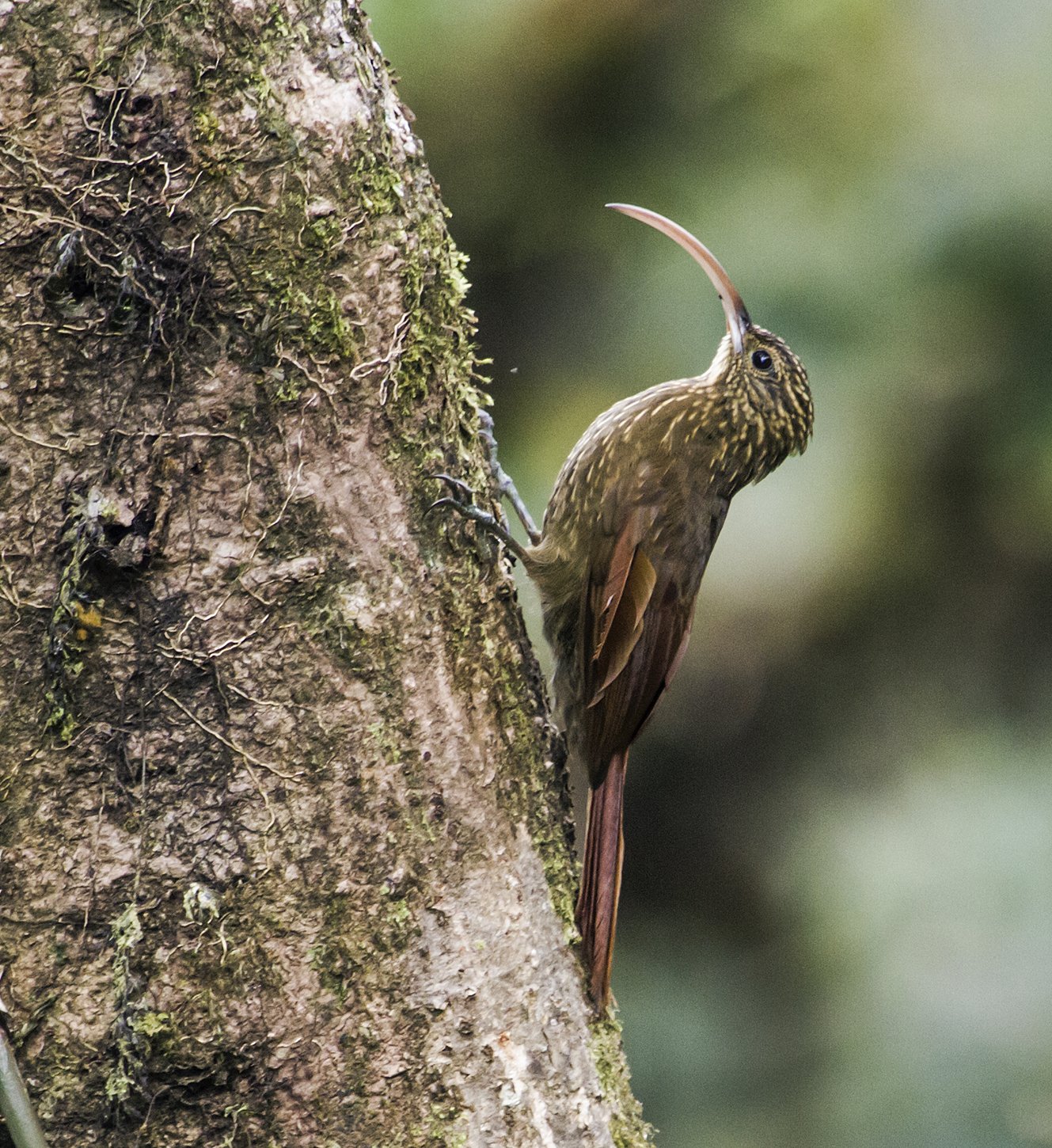
The Brown-billed Scythebill is the scythebill of humid montane forest in the northern Andes. Its long, strongly decurved bill is brown, not red. It is scarce and keeps to the lower and middle levels of mossy forest.
Voice
The song is a series of clear, trilled whistles that first rises and then falls; it is heard mainly in the early morning.
Recording: Iván Lau — CC BY-NC-SA 4.0 · xeno-canto
Identification
23–24 cm, with a very long, thin, strongly decurved, brown bill. The head, mantle and underparts are dark rufous-brown with narrow, distinct buff streaks; the throat is buff. The wings, rump and tail are rufous. The sexes are alike.
Confusion species
Red-billed Scythebill Campylorhamphus trochilirostris has a red bill and lives lower, in drier or open forests and in Amazonia. Greater Scythebill Drymotoxeres pucheranii is larger, with white cheek and malar stripes, and mostly lives higher. Olive-backed Woodcreeper Xiphorhynchus triangularis and Montane Woodcreeper Lepidocolaptes lacrymiger of the same montane forest have a much shorter bill.
Habitat
Humid foothill and montane forest and cloud forest, also edges, mostly from 900 to 2100 m, locally lower. It searches mossy trunks, lianas and bamboo in the lower and middle levels for insects and spiders, often in mixed flocks. The nest is in a tree cavity.
Where the bird is most at home, classified by the vegetation units of the Andes and the west coast.


Range and movements
Colombia: in all three Andean ranges and the Sierra de Perijá. Ecuador: locally on both slopes of the Andes. Peru: locally in the north. Absent from Bolivia and the Galápagos. Outside the guide area in Costa Rica, Panama and western Venezuela.
- Resident
- dark = core range, pale = thinly spread
How and when to look
In montane forest, follow mixed flocks in the lower and middle levels; the long brown bill shows when the bird climbs a mossy trunk. In Colombia and northwestern Ecuador it is seen regularly in montane forest on the western slope.
Conservation status
Least Concern. The species is scarce and tied to montane forest; deforestation of the Andean slopes reduces its habitat.
Scientific name
Campylorhamphus pusillus | (Sclater, 1860)
Sclater described the species in 1860 as Xiphorhynchus pusillus; because it was later moved to another genus, the author and year stand in brackets. The genus Campylorhamphus was introduced in 1901 by Bertoni. The genus name comes from Ancient Greek kampulos, 'curved', and rhamphos, 'bill'. The species name comes from Latin pusillus, 'very small'. The specimen the first description was based on came from Bogotá, Colombia.