All species › Passerines › Ovenbirds and woodcreepers › Curve-billed Scythebill
Curve-billed Scythebill | Campylorhamphus procurvoides
Kromsnavelmuisspecht | Picoguadaña piquicurvo | Arapaçu-de-bico-curvo
The Curve-billed Scythebill is a scythebill of the interior of terra firme forest in northern Amazonia. In the guide area it reaches the western edge of its range, in southeastern Colombia, northeastern Ecuador and northeastern Peru. It is scarce throughout and avoids fragmented forest.
Voice
It sings mainly in the early morning, in short series of whistled notes. The call is an explosive, rather harsh chit-di-dit.
Recording: Luiz Fernando Matos — CC BY-NC-SA 4.0 · xeno-canto
Identification
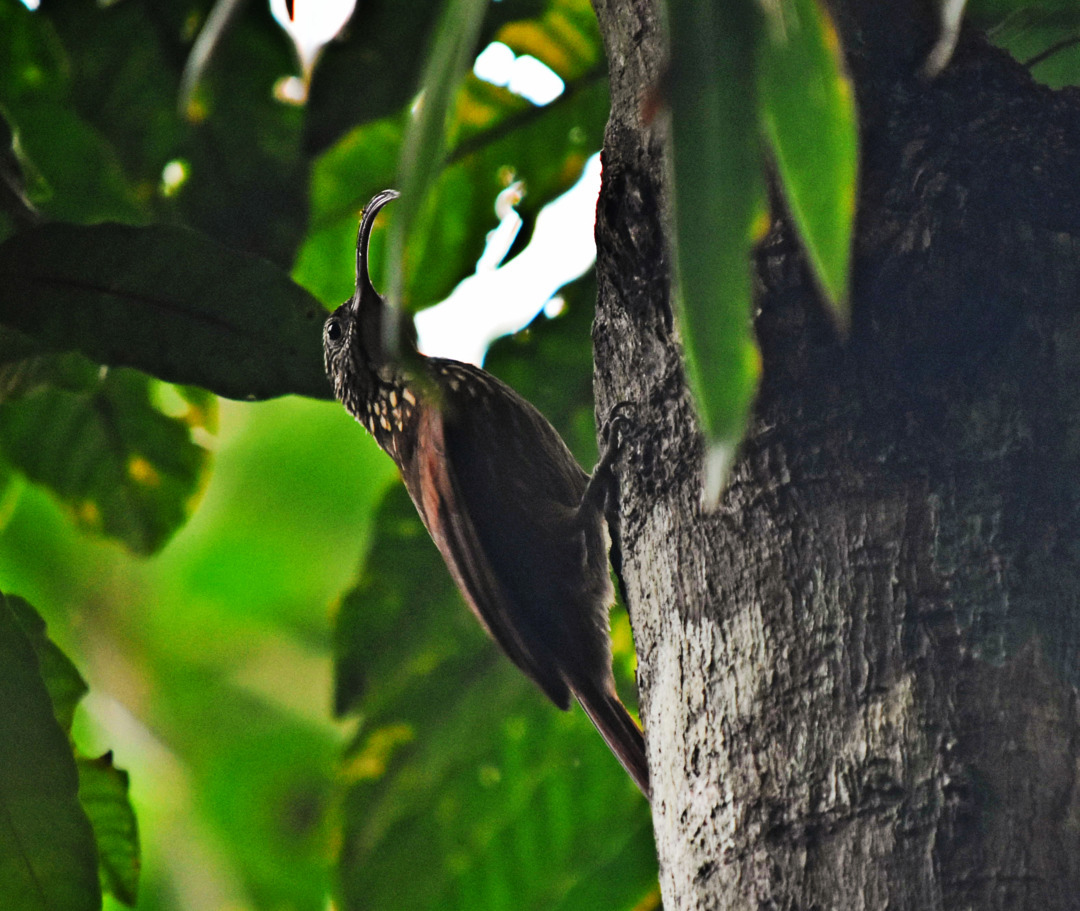
22–24 cm, with a long, strongly decurved, dark reddish-brown bill that is shorter than that of Red-billed Scythebill. The head, mantle and underparts are brown with fine buff streaks; the throat is whitish and streaked. The wings, rump and tail are rufous. The sexes are alike.
Confusion species
Red-billed Scythebill Campylorhamphus trochilirostris has a longer, red bill and lives mainly in riverine forest, várzea and bamboo. Other woodcreepers in the guide area have a much shorter, less decurved bill.
Habitat
The interior of humid terra firme forest, also forest on sandy soils, only occasionally in flooded forest or at the forest edge; mostly below 500 m. It searches trunks and lianas in the middle levels for insects and spiders, often with mixed flocks. The nest is in a tree cavity.
Where the bird is most at home, classified by the vegetation units of the Andes and the west coast.


Range and movements
Colombia: in Amazonia in the southeast. Ecuador: rare in the northeast. Peru: in the extreme northeast. Absent from Bolivia and the Galápagos. Outside the guide area in southern Venezuela, the Guianas and northern Brazil.
- Resident
- dark = core range, pale = thinly spread
How and when to look
In large, undisturbed terra firme forest, follow mixed flocks in the middle level and listen in the early morning for the short whistled series and the explosive chit-di-dit.
Conservation status
Least Concern. The species is sensitive to fragmentation and quickly disappears from fragmented forest; in the guide area it is scarce.
Scientific name
Campylorhamphus procurvoides | (de Lafresnaye, 1850)
De Lafresnaye described the species in 1850 as Xiphorhynchus procurvoides; because it was later moved to another genus, the author and year stand in brackets. The genus Campylorhamphus was introduced in 1901 by Bertoni. The genus name comes from Ancient Greek kampulos, 'curved', and rhamphos, 'bill'. The species name means 'resembling procurvus' (with Greek -oidēs, 'resembling'), after Dendrocolaptes procurvus Temminck, 1821 (now a synonym of Campylorhamphus trochilirostris); according to de la Fresnaye it resembles that bird in bill and plumage colour but is smaller. The specimen the first description was based on came from Cayenne, French Guiana.