All species › Passerines › Ovenbirds and woodcreepers › Red-billed Scythebill
Red-billed Scythebill | Campylorhamphus trochilirostris
Kolibriemuisspecht | Picoguadaña piquirrojo | Arapaçu-beija-flor
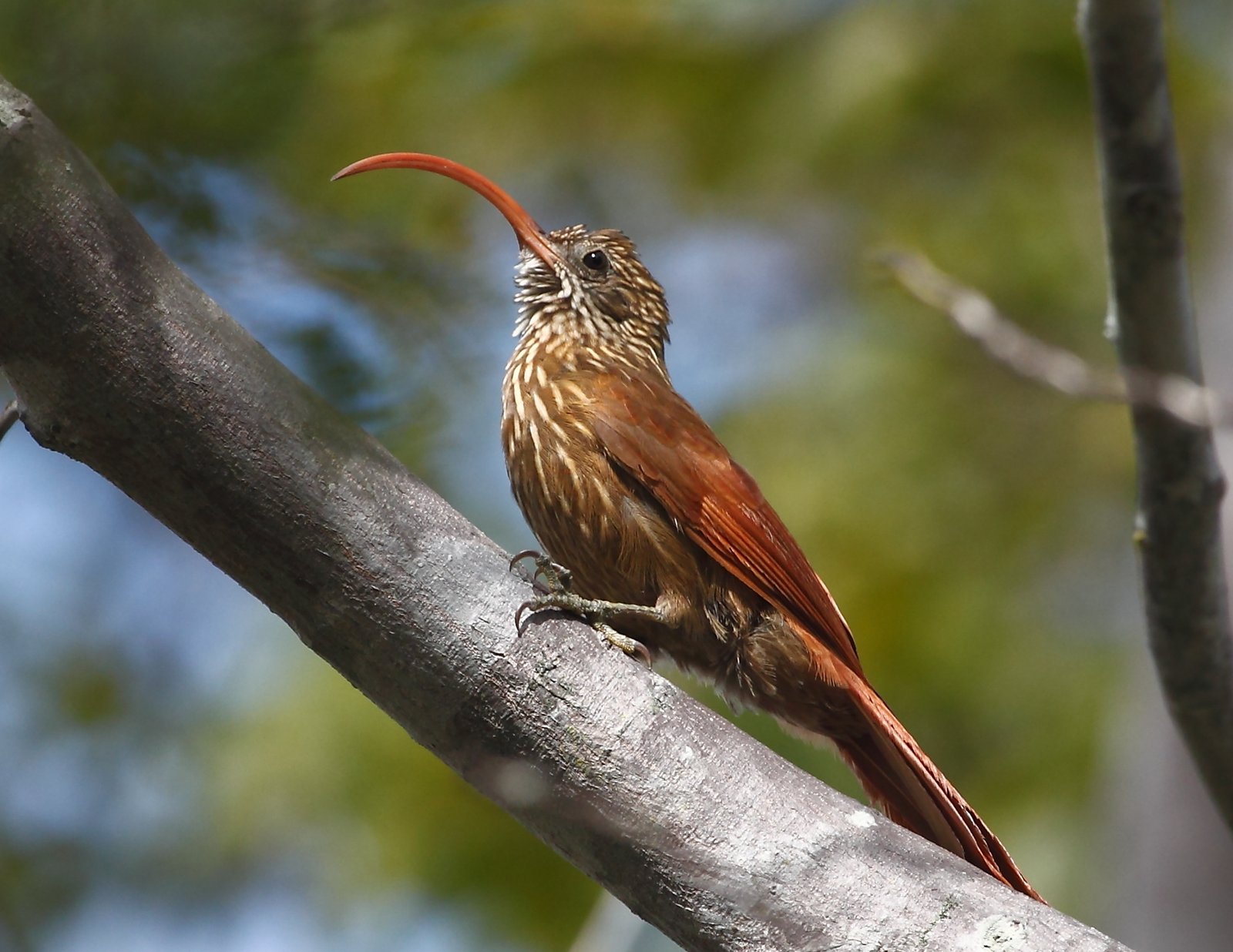
The Red-billed Scythebill, like the other scythebills (Campylorhamphus), has a very long, strongly decurved bill, red in this species. It uses it to extract insects from bark crevices, bromeliads and hollow stems. In the guide area it lives both in Amazonia and in the dry forests on the Pacific side.
Voice
The song is a loud, fast series of clear whistles that rises slightly and falls again, wee-wee-wee-wee-weeu; pattern and pace vary by region.
Recording: Juan Freile — CC BY-NC-SA 4.0 · xeno-canto
Identification
22–25 cm, much of it bill; the bill is thin, strongly sickle-shaped and red to orange-red. The head, mantle and underparts are brown with narrow buff streaks; the wings, rump and tail are rufous. The sexes are alike; juveniles have a shorter, duller bill.
Confusion species
Brown-billed Scythebill Campylorhamphus pusillus has a brown bill and lives in montane forest. Curve-billed Scythebill Campylorhamphus procurvoides has a shorter, darker bill and lives in the interior of terra firme forest. Greater Scythebill Drymotoxeres pucheranii is larger, with white cheek and malar stripes, and lives high in the Andes. Other woodcreepers have a much shorter bill.
Habitat
A wide range of forest types: várzea and riverine forest, rainforest edges, bamboo, gallery forest, Tumbesian dry forest and Chaco dry forest, from the lowlands to about 1500 m. It searches trunks, lianas and branches in the middle levels for insects and spiders, which it extracts with the long bill from crevices and bromeliads. The nest is in a tree cavity.
Where the bird is most at home, classified by the vegetation units of the Andes and the west coast.


Range and movements
Colombia: in the Caribbean lowlands, the Magdalena valley, the Llanos and Amazonia. Ecuador: in the dry forest of the southwest and in the eastern lowlands. Peru: in the dry forest of the northwest and in Amazonia. Bolivia: in the lowlands, south into the Chaco of the southeast. Absent from the Galápagos. Outside the guide area from Panama and Venezuela to Brazil, Paraguay and northern Argentina.
- Resident
- dark = core range, pale = thinly spread
How and when to look
In the Tumbesian dry forest of southwestern Ecuador and northwestern Peru it forages along trunks in open woodland, where the red bill is clearly visible. In Amazonia mainly in riverine forest and bamboo; listen for the whistled song.
Conservation status
Least Concern. The species has a very large range; habitat is lost locally, especially in dry forest on the Pacific side.
Scientific name
Campylorhamphus trochilirostris | (Lichtenstein, 1820)
Lichtenstein described the species in 1820 as Dendrocolaptes trochilirostris; because it was later moved to another genus, the author and year stand in brackets. The genus Campylorhamphus was introduced in 1901 by Bertoni. The genus name comes from Ancient Greek kampulos, 'curved', and rhamphos, 'bill'. The species name combines Trochilus (hummingbird) with Latin rostrum, 'bill': 'hummingbird-billed'. The specimen the first description was based on came from Bahia, Brazil.