All species › Passerines › Ovenbirds and woodcreepers › Long-billed Woodcreeper
Long-billed Woodcreeper | Nasica longirostris
Langsnavelmuisspecht | Trepatroncos piquilargo | Arapaçu-de-bico-comprido
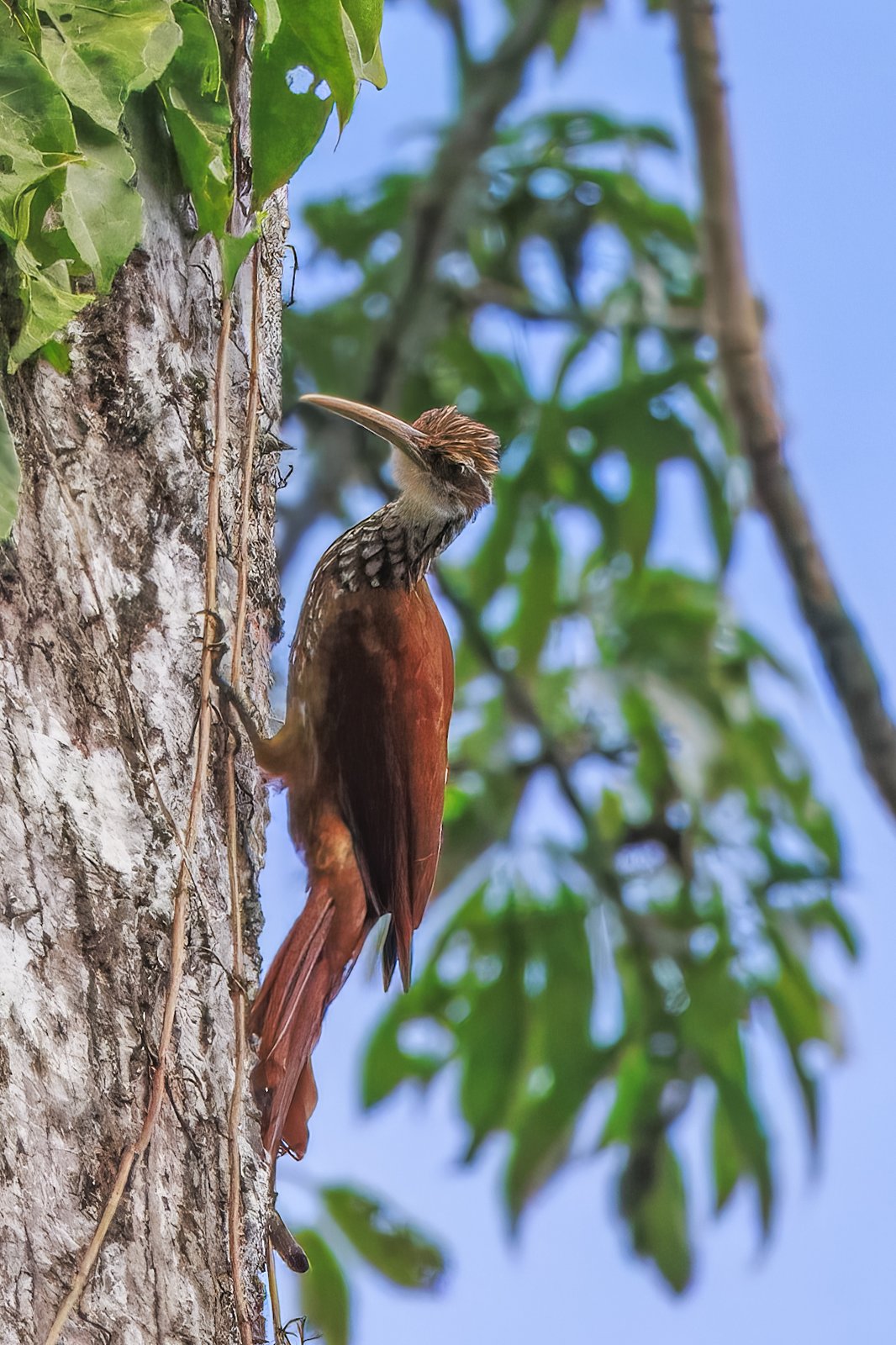
The Long-billed Woodcreeper is a large woodcreeper of flooded forest along Amazonian rivers and lakes, with a very long, straight, ivory bill and a slender head on a long neck. With it, it probes deep into bromeliads, bark crevices and cavities. Its drawn-out, rising whistles are among the characteristic sounds of the várzea.
Voice
The song consists of two to four long, rising, plaintive whistles, each slightly higher than the previous one, wuuuee… wuuuee… wuuuee. Heard mainly at dawn and dusk, often from pairs answering each other.
Recording: JAYRSON ARAUJO DE OLIVEIRA — CC BY-NC-SA 4.0 · xeno-canto
Identification
33–36 cm, with a very long, straight, pale ivory bill. The head and neck are blackish with white streaks, with a white supercilium and a white throat. The back, wings and tail are warm chestnut. The breast is brown with long, white, black-edged streaks. The sexes are alike.
Confusion species
Straight-billed Woodcreeper Dendroplex picus also has a straight, pale bill, but is much smaller, with a short bill and a spotted throat. Zimmer's Woodcreeper Dendroplex kienerii is also much smaller and lives in the same river-island forest. Red-billed Scythebill Campylorhamphus trochilirostris has a strongly decurved, reddish bill. Strong-billed Woodcreeper Xiphocolaptes promeropirhynchus has a heavy, dark, slightly decurved bill and a brown head.
Habitat
Várzea and igapó, swamp forest, palm swamps and the wooded shores of oxbow lakes and lakes in the Amazonian lowlands, up to about 400 m. It probes with its long bill into bromeliads, bark crevices and cavities for insects, spiders and small vertebrates. It usually lives in pairs and rarely joins mixed flocks. The nest is in a tree cavity.
Where the bird is most at home, classified by the vegetation units of the Andes and the west coast.


Range and movements
Colombia: in the lowlands east of the Andes, in the Amazon and Orinoco basins. Ecuador: in the Amazonian lowlands. Peru: in the Amazonian lowlands. Bolivia: in the lowlands of the north and north-east. Absent from the Galápagos. Outside the guide area in southern Venezuela, the Guianas and Amazonian Brazil.
- Resident
- dark = core range, pale = thinly spread
How and when to look
Travel by boat or walk along wooded shores of lakes and oxbows; the bird often sits on thick trunks or in palms just above the water. Its rising whistles are heard mainly in the early morning.
Conservation status
Least Concern. The species has a large range in flooded forest, but depends on old trees and declines where riverine forest is cleared.
Scientific name
Nasica longirostris | (Vieillot, 1818)
Vieillot described the species in 1818 as Dendrocopus longirostris; because it was later moved to another genus, the author and year stand in brackets. The genus Nasica was introduced in 1830 by Lesson. The genus name comes from Latin nasica, 'big-nosed', after the long bill. The species name longirostris comes from Latin longus, 'long', and rostrum, 'bill': 'long-billed'. The specimen the first description was based on came from Óbidos, Pará, Brazil.