All species › Passerines › Ovenbirds and woodcreepers › Straight-billed Earthcreeper
Straight-billed Earthcreeper | Ochetorhynchus ruficaudus
Rechtsnavelgrondkruiper | Bandurrita de pico recto | Bandurrita-de-bico-reto
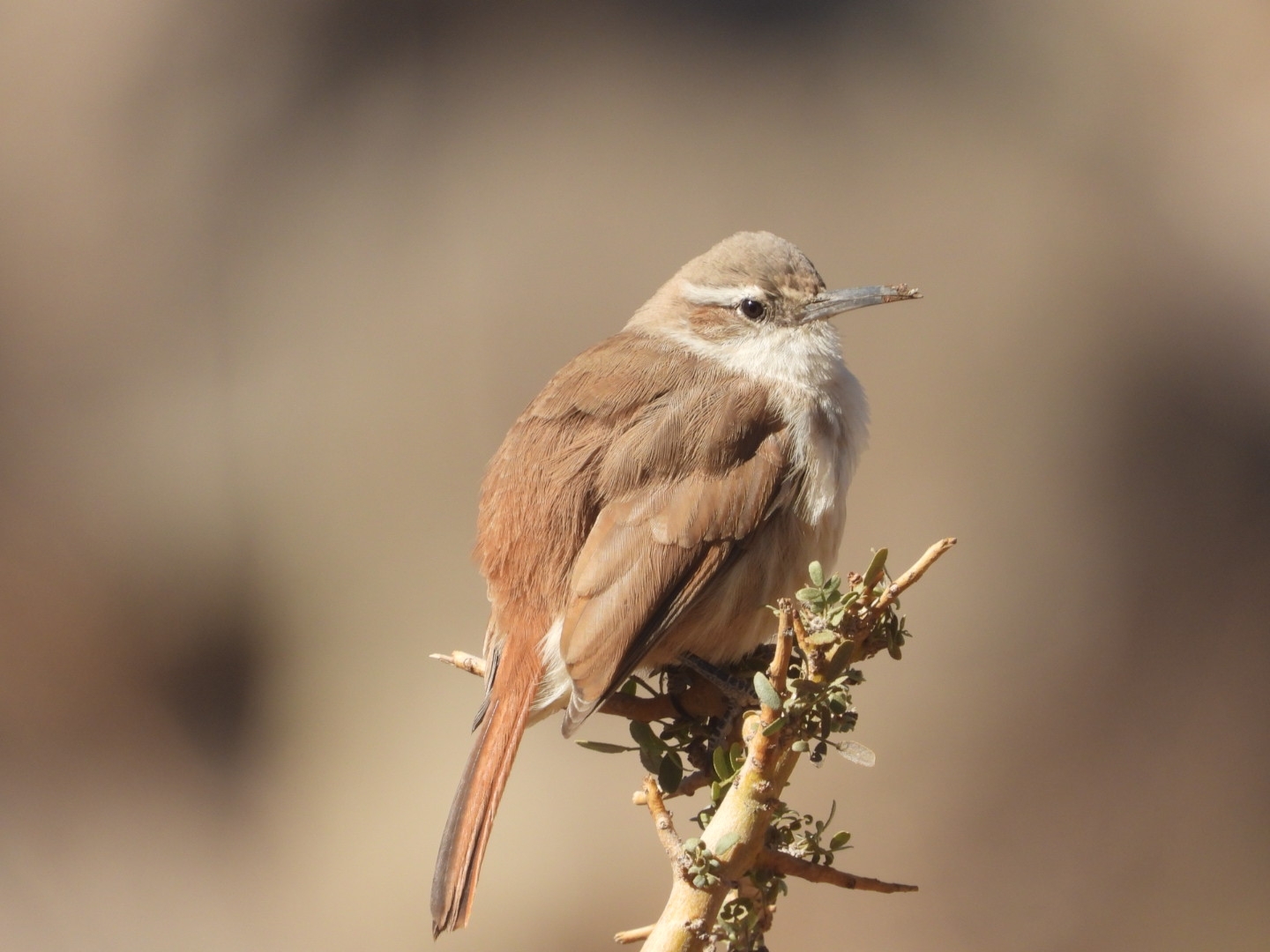
The Straight-billed Earthcreeper is a grey-brown ovenbird of rocky slopes in the dry southern Andes. Unlike most earthcreepers it has a long, almost straight bill. It walks and hops among boulders and bushes, often flicking its rufous tail.
Voice
The song is a loud, fast series of shrill notes that speeds up slightly and descends at the end, given from a boulder. The call is a sharp, short tick.
Recording: Niels Krabbe — CC BY-NC-SA 4.0 · xeno-canto
Identification
17–18 cm, with a long, straight, dark bill. The upperparts are plain greyish brown; the wings have a rufous patch that shows mainly in flight. The tail is rufous with darker central feathers. A whitish supercilium. The throat is white and the underparts greyish white, with faint dark streaks on the breast. The sexes are alike.
Confusion species
Rock Earthcreeper Ochetorhynchus andaecola lives on similar rocky slopes, but has a slightly decurved bill, warmer brown upperparts and buff, streaked underparts. Buff-breasted Earthcreeper Upucerthia validirostris has a long, clearly decurved bill and buff underparts. Cinclodes (Cinclodes) have a shorter bill and a pale wing bar and live more near water.
Habitat
Dry, rocky slopes, ravines and boulder fields with scattered bushes and bunchgrass in the puna and the higher dry valleys, mostly between 2500 and 4500 m. It forages on the ground and among stones for insects and other arthropods. The nest is in a rock crevice or in a cavity in an earth bank.
Where the bird is most at home, classified by the vegetation units of the Andes and the west coast.


Range and movements
Absent from Colombia, Ecuador and the Galápagos. Peru: only in the far south, scarce. Bolivia: in the Andes of La Paz and Oruro south to Potosí, Chuquisaca and Tarija. Outside the guide area in northern Chile and western Argentina.
- Resident
- dark = core range, pale = thinly spread
How and when to look
Walk along rocky slopes and ravines in the dry Bolivian Andes and watch for a grey-brown bird hopping among the stones. A singing bird often perches on a prominent boulder.
Conservation status
Least Concern. The species has a large range in a little-disturbed landscape; no threats are known.
Scientific name
Ochetorhynchus ruficaudus | Meyen, 1834 (GBIF: Upucerthia ruficaudus)
Meyen described the species in 1834 and placed it straight away in the genus where it still stands. He introduced the genus Ochetorhynchus in that same work. The genus name combines Greek okhetos, 'channel, conduit, groove', and rhunkhos, 'bill'. The species name ruficaudus comes from Latin rufus, 'rufous', and cauda, 'tail': 'rufous-tailed'. The specimen the first description was based on came from Volcán Maipo, Santiago, Chile.