All species › Passerines › Ovenbirds and woodcreepers › Rock Earthcreeper
Rock Earthcreeper | Ochetorhynchus andaecola
Rotsgrondkruiper | Bandurrita de las rocas | Bandurrita-das-pedras
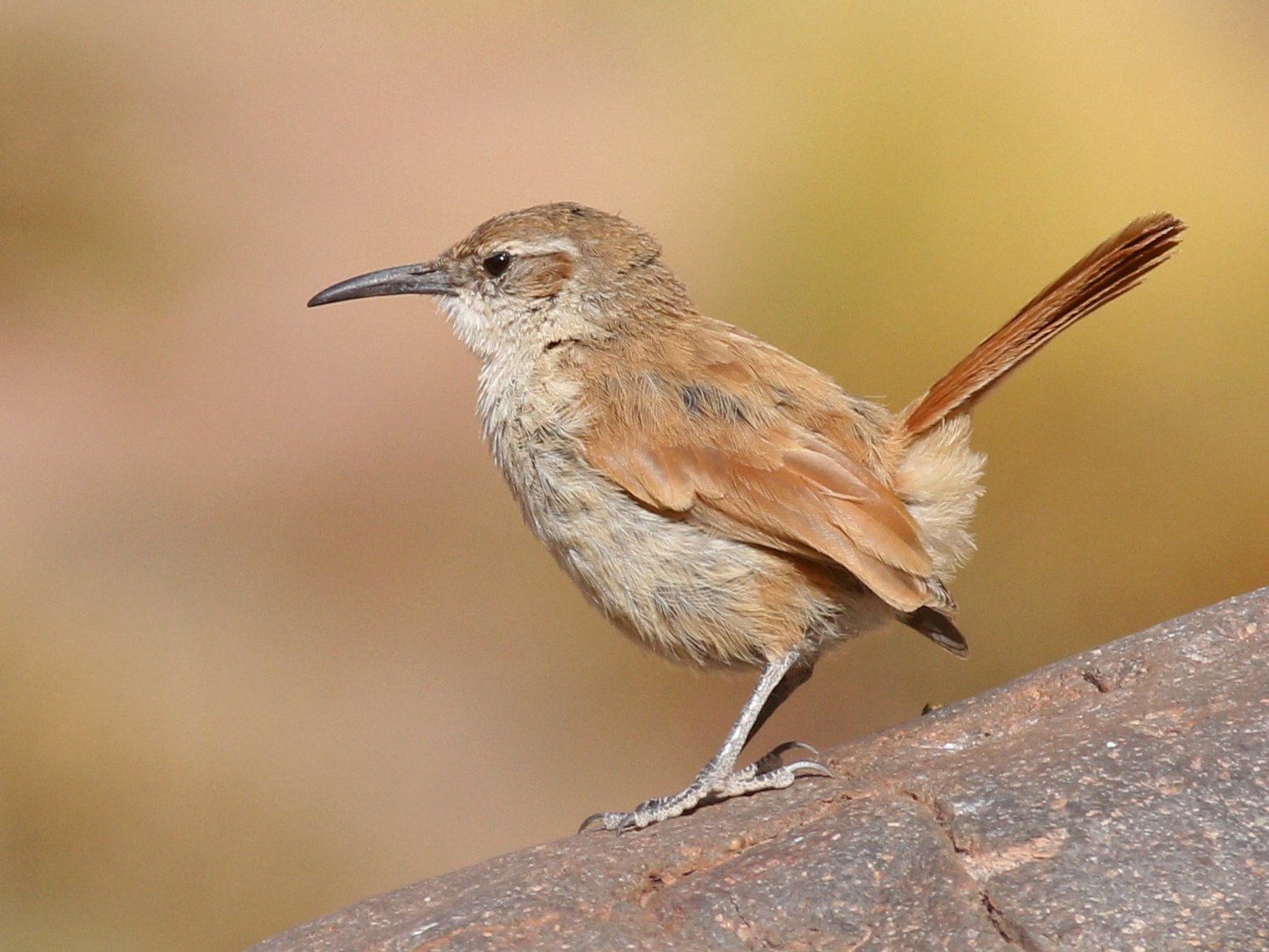
The Rock Earthcreeper is a brown ovenbird with a long, slightly decurved bill of rocky slopes in the dry southern Andes. It hops among boulders, bunchgrass and bushes, often holding its tail cocked. In the guide area it occurs only in Bolivia.
Voice
The song is a series of loud, shrill notes, sometimes ending in a splutter, sung from a bush or boulder. The alarm call is a high, squeaky whistle.
Recording: Andrew Spencer — CC BY-NC-SA 3.0 · xeno-canto
Identification
16–18 cm, with a long, slightly decurved, blackish bill with a grey base to the lower mandible. The crown, back and rump are rich brown, the wings slightly more rufous and the tail dark rufous. A buff supercilium, a dark stripe behind the eye and buff cheeks. The throat is whitish buff; the breast and belly are darker, warm buff, with dark streaks on the sides and flanks. The sexes are alike. Juveniles have pale fringes on the back and scaly underparts.
Confusion species
Straight-billed Earthcreeper Ochetorhynchus ruficaudus lives on similar rocky slopes, but has a straight bill, a white throat and more rufous in the tail. Buff-breasted Earthcreeper Upucerthia validirostris has a more strongly decurved bill and almost unstreaked buff underparts.
Habitat
Arid scrub and puna with bunchgrass and scattered bushes, especially rocky slopes, outcrops and ravines, mostly between 2600 and 4200 m, locally to 4500 m. It forages on the ground among stones, grass and bushes for insects and other arthropods. The nest is at the end of a self-dug tunnel in an earth bank or in a rock crevice.
Where the bird is most at home, classified by the vegetation units of the Andes and the west coast.


Range and movements
Absent from Colombia, Ecuador, Peru and the Galápagos. Bolivia: in the Andes from La Paz south to the south of the country. Outside the guide area in north-western Argentina, south to Catamarca, and very scarce in northern Chile.
- Resident
- dark = core range, pale = thinly spread
How and when to look
Walk along rocky slopes and ravines with scattered bushes in the dry south of the Bolivian Andes and watch for a brown bird hopping among the stones. Birds are wary and fly a long way when disturbed; the song from a boulder gives them away.
Conservation status
Least Concern. The range is fairly restricted and the population is thought to be declining; overgrazing is the only known disturbance.
Scientific name
Ochetorhynchus andaecola | (d'Orbigny, ACVMD & de Lafresnaye, 1838) (GBIF: Upucerthia andaecola)
D'Orbigny, ACVMD & de Lafresnaye described the species in 1838 as Uppucerthia andaecola; because it was later moved to another genus, the author and year stand in brackets. The genus Ochetorhynchus was introduced in 1834 by Meyen. The genus name combines Greek okhetos, 'channel, conduit, groove', and rhunkhos, 'bill'. The species name andaecola means 'inhabitant of the Andes', from Latin -cola, 'dweller'. The specimen the first description was based on came from Sica Sica, La Paz, Bolivia.