All species › Passerines › Ovenbirds and woodcreepers › Brown Cacholote
Brown Cacholote | Pseudoseisura lophotes
Bruine cacholote | Cacholote castaño | Coperete
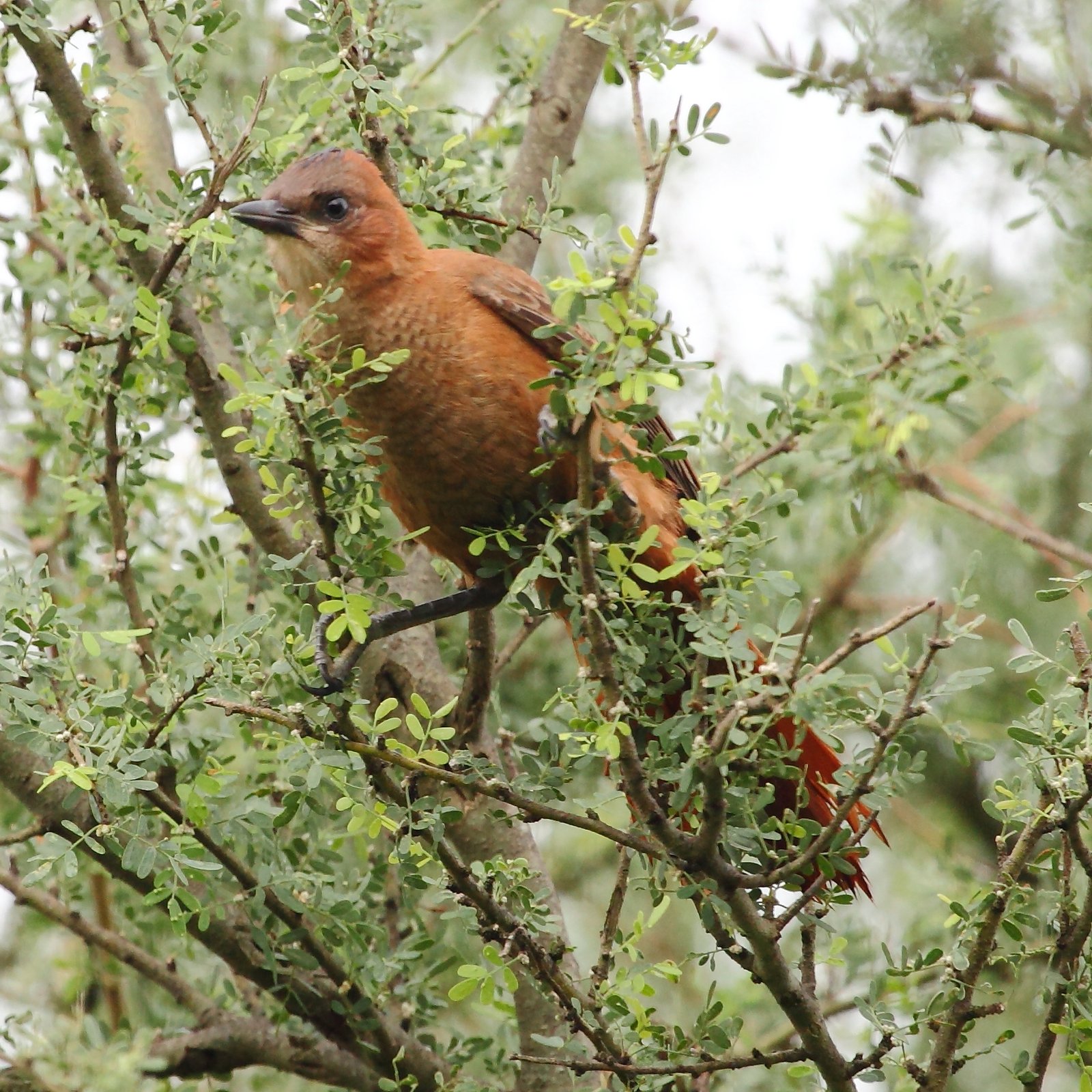
The Brown Cacholote is the largest cacholote, a dark brown ovenbird with a long, dark crest, of the Chaco and open woodlands of southern South America. In the guide area it reaches only south-eastern Bolivia. Pairs call loudly in duet and build large stick nests.
Voice
Pairs sing loud duets: long, shrill, rattling series that speed up and slow down. Also harsh, short calls.
Recording: Bernard BOUSQUET — CC BY-NC-SA 4.0 · xeno-canto
Identification
25–27 cm, sturdy, with a strong, straight, pale bill, a long tail and a long, shaggy crest. The head and body are plain greyish brown to earth brown, the crest dark brown to blackish; the wings and tail are rufous. The eye is yellow. The sexes are alike. Juveniles have a shorter crest and a darker eye.
Confusion species
Grey-crested Cacholote Pseudoseisura unirufa is smaller and brighter cinnamon, with a greyish crest, and lives further north in Beni and Santa Cruz. Crested Hornero Furnarius cristatus is much smaller and paler, with a short crest, and walks on the ground. Greater Thornbird Phacellodomus ruber is smaller, without a crest, with a rufous crown.
Habitat
Chaco woodland, open dry woodland, gallery forest and farmland and pasture with trees; in the guide area in the lowlands and lower dry valleys up to about 1000 m. It forages in pairs on the ground and on branches for insects and other invertebrates, sometimes seeds. The nest is a large, closed structure of thorny sticks with an entrance tunnel, in a tree.
Where the bird is most at home, classified by the vegetation units of the Andes and the west coast.


Range and movements
Bolivia: in the south-east, in the Chaco and adjacent valleys of Tarija, Chuquisaca and southern Santa Cruz. Absent from Colombia, Ecuador, Peru and the Galápagos. Outside the guide area in Paraguay, Argentina, Uruguay and southern Brazil.
- Resident
- dark = core range, pale = thinly spread
How and when to look
Search the Chaco of southern Santa Cruz and eastern Tarija along woodland edges and farmyards; pairs often sit high in a tree near their nest and give themselves away in the early morning by their duet.
Conservation status
Least Concern. The species has a large range and tolerates cattle ranching and farmland with trees.
Scientific name
Pseudoseisura lophotes | (Reichenbach, 1853)
Reichenbach described the species in 1853 as Homorus lophotes; because it was later moved to another genus, the author and year stand in brackets. The genus Pseudoseisura was introduced in 1853 by Reichenbach. The genus name combines Greek pseudos, 'false', with seisoura, a bird mentioned by Hesychius of Alexandria and thought to be a wagtail. The species name lophotes comes from Greek lophōtēs, 'crested'. The specimen the first description was based on came from Bolivia (probably erroneous).