All species › Passerines › Ovenbirds and woodcreepers › Cinnamon-rumped Foliage-Gleaner
Cinnamon-rumped Foliage-Gleaner | Philydor pyrrhodes
Kaneelstuitbladspeurder | Limpiafronda lomicanela | Limpa-folha-vermelho
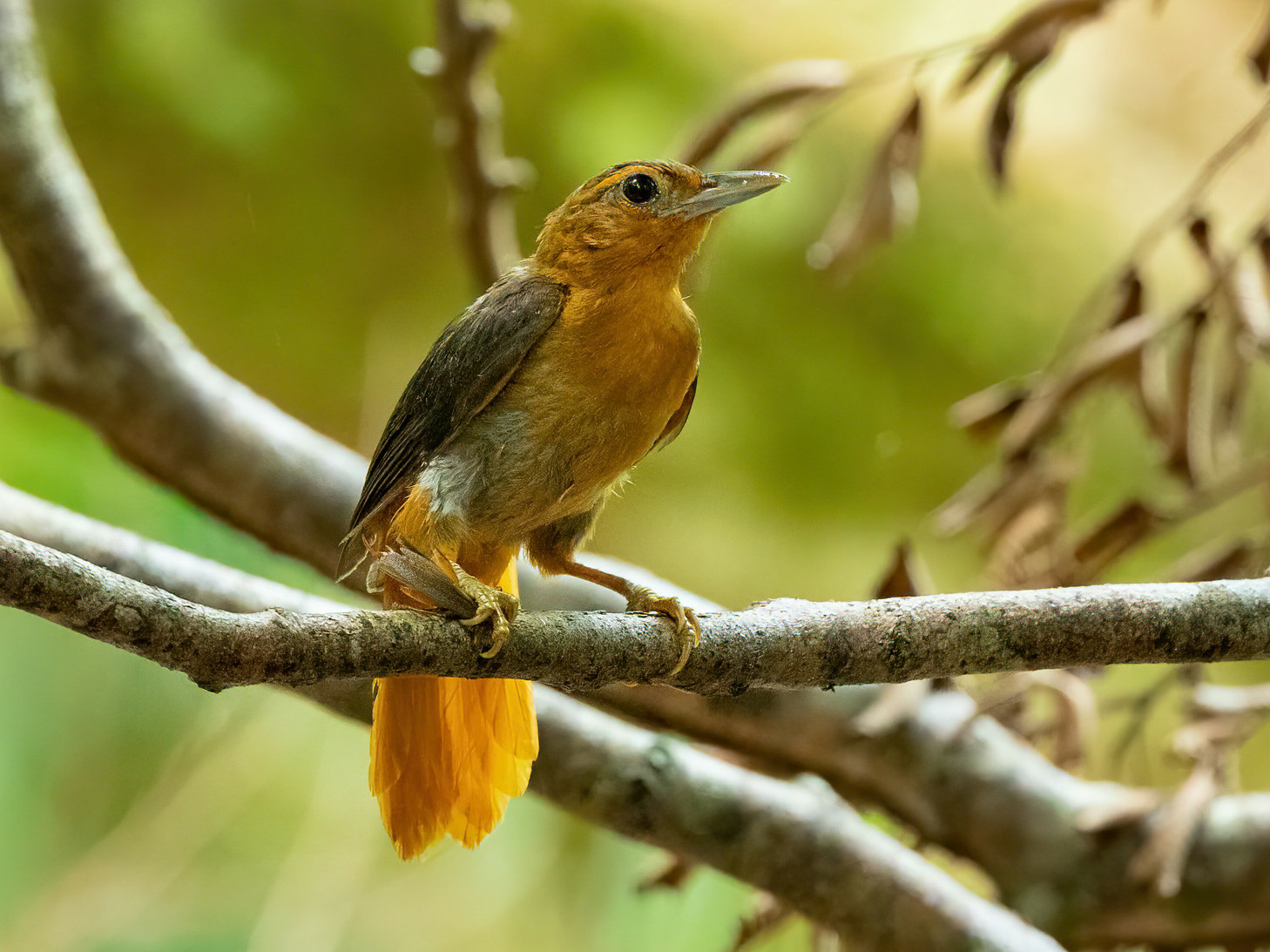
The Cinnamon-rumped Foliage-Gleaner is a two-toned foliage-gleaner of the Amazonian lowlands: the wings are slaty grey to blackish, the rest of the body largely bright cinnamon. It searches dense vegetation, often in palms, among dead leaves for insects and usually keeps hidden in the lower levels of the forest.
Voice
The song is a fast, dry, slightly descending trill, often from dense cover. The call is a sharp, short chik.
Recording: JAYRSON ARAUJO DE OLIVEIRA — CC BY-NC-SA 4.0 · xeno-canto
Identification
16–17 cm, with a straight, fairly stout bill. The crown and mantle are olive-brown; the rump, tail and entire underparts are bright cinnamon to orange-rufous. A cinnamon supercilium and cinnamon cheeks. The wings are dark slaty grey and contrast sharply with the rest of the plumage. The sexes are alike.
Confusion species
Rufous-rumped Foliage-Gleaner Neophilydor erythrocercum has olive-brown wings without contrast, paler buff underparts and keeps higher in the forest. Chestnut-winged Foliage-Gleaner Dendroma erythroptera has rufous wings instead and greyish-olive underparts. Chestnut-crowned Foliage-Gleaner Automolus rufipileatus is darker brown, without a supercilium, with a rufous crown and an orange eye.
Habitat
Humid lowland forest on terra firme and in várzea, especially in the lower and middle levels with many palms, vines and dead leaves, also palm swamp and stream edges, up to about 1000 m. It forages alone or in pairs, sometimes in mixed flocks, in clusters of dead leaves and in palm fronds for insects. It nests in a cavity in a bank or a dead palm.
Where the bird is most at home, classified by the vegetation units of the Andes and the west coast.


Range and movements
Colombia: in the Amazonian south-east. Ecuador: in the eastern lowlands. Peru: in the Amazonian lowlands in the north and centre, scarcer further south. Bolivia: in the north (Pando, Beni, La Paz). Absent west of the Andes and from the Galápagos. Outside the guide area in Amazonian Brazil, Venezuela and the Guianas.
- Resident
- dark = core range, pale = thinly spread
How and when to look
Search lowland forest with many palms, especially around palm swamps, and listen for the dry trill. The bird usually stays in dense cover; it sometimes shows briefly while probing a cluster of dead leaves.
Conservation status
Least Concern. The species has a very large range, but depends on undisturbed forest and disappears with deforestation.
Scientific name
Philydor pyrrhodes | (Cabanis, 1849)
Cabanis described the species in 1849 as Anabates pyrrhodes; because it was later moved to another genus, the author and year stand in brackets. The genus Philydor was introduced in 1824 by Spix. The genus name comes from Greek philudros, 'water-loving'. The species name pyrrhodes comes from Greek purrhōdēs, 'reddish' or 'flame-coloured', after the cinnamon plumage. The specimen the first description was based on came from Coast of Guyana.