All species › Passerines › Ovenbirds and woodcreepers › Brown-capped Tit-Spinetail
Brown-capped Tit-Spinetail | Leptasthenura fuliginiceps
Bruinkapmeesstekelstaart | Tijeral canelo | Grimpeirinho-de-boné-pardo
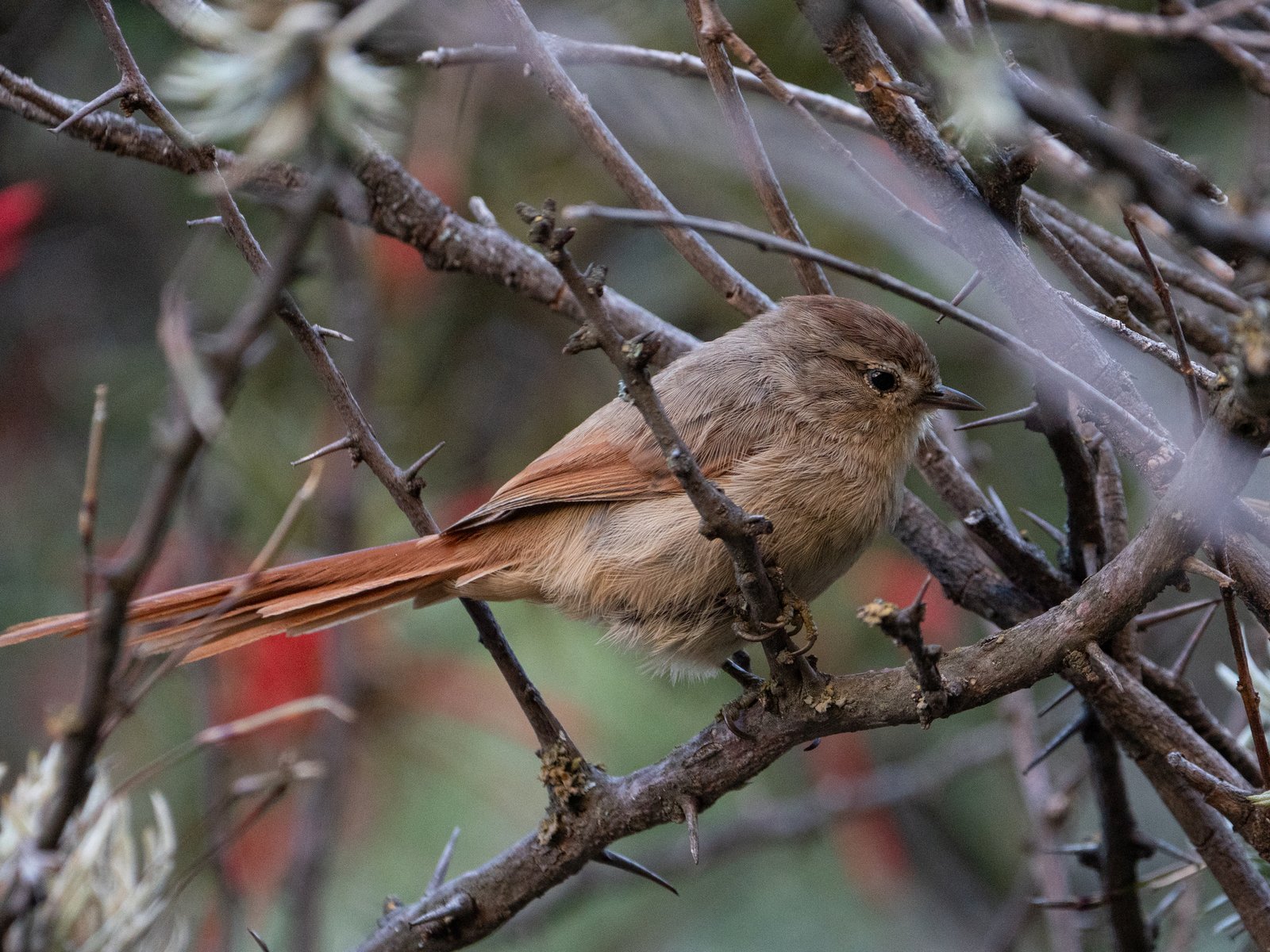
The Brown-capped Tit-Spinetail is a small, plain-coloured tit-spinetail with a brown crown and rufous wings and tail. It lives in scrub and open woodland in the eastern Andes of Bolivia and Argentina. In the guide area it occurs only in Bolivia.
Voice
The song is barely described. The call is a faint, insect-like pree.
Recording: Niels Krabbe — CC BY-NC-SA 3.0 · xeno-canto
Identification
15–16 cm, a small, slender bird with a short bill and a long, graduated tail. The crown is plain dark brown, the back greyish brown, with a pale buff eyebrow. The wings and tail are largely rufous. The throat is whitish, the rest of the underparts pale tawny. The sexes are alike.
Confusion species
Plain-mantled Tit-Spinetail Leptasthenura aegithaloides has a streaked crown and a dark tail with pale edges. Tawny Tit-Spinetail Sylviorthorhynchus yanacensis is warm cinnamon on the crown and underparts as well and lives higher, mainly in Polylepis. Andean Tit-Spinetail Leptasthenura andicola is heavily streaked with white. Canasteros (Asthenes) have a shorter tail and stay more on or near the ground.
Habitat
Arid to semi-humid montane scrub, preferably in steep ravines, Polylepis woodland and semi-humid woodland, in Bolivia between about 1500 and 3900 m. It forages in pairs or small groups in shrubs and low trees for insects and other arthropods. The nest is a ball in a crevice in a rock or a building; the clutch is two or three eggs.
Where the bird is most at home, classified by the vegetation units of the Andes and the west coast.


Range and movements
Absent from Colombia, Ecuador, Peru and the Galápagos. Bolivia: in the Andes from La Paz south through Cochabamba and Chuquisaca to Potosí and Tarija. Outside the guide area in northwestern and central Argentina, south to Mendoza and the Sierras de Córdoba.
- Resident
- dark = core range, pale = thinly spread
How and when to look
Search shrubby ravines in the dry valleys of central and southern Bolivia; the birds move through the bushes in pairs, often together with other small passerines.
Conservation status
Least Concern. The range is large, the population is considered stable and no immediate threats are known.
Scientific name
Leptasthenura fuliginiceps | (d'Orbigny, ACVMD & de Lafresnaye, 1837)
D'Orbigny, ACVMD & de Lafresnaye described the species in 1837 as Synallaxis fuliginiceps; because it was later moved to another genus, the author and year stand in brackets. The genus Leptasthenura was introduced in 1853 by Reichenbach. The genus name combines Greek leptos, 'thin', asthenēs, 'weak', and oura, 'tail'. The species name fuliginiceps comes from Latin fuligo, 'soot', and -ceps, 'capped': 'sooty-capped'. The specimen the first description was based on came from Sica Sica, La Paz, Bolivia.