All species › Passerines › Ovenbirds and woodcreepers › Plain-mantled Tit-Spinetail
Plain-mantled Tit-Spinetail | Leptasthenura aegithaloides
Staartmeesstekelstaart | Tijeral colinegro | Grimpeirinho-de-manto-liso
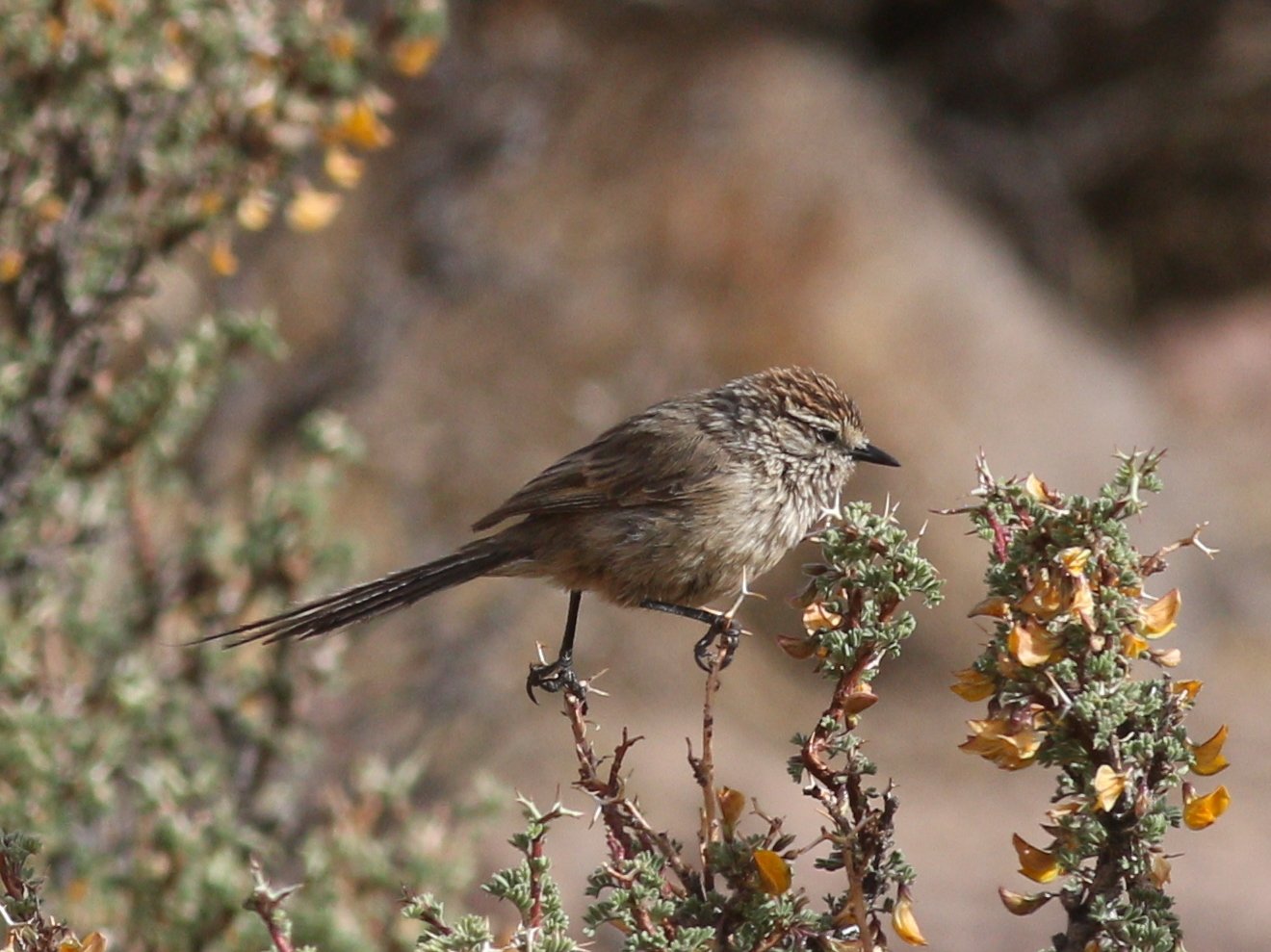
The Plain-mantled Tit-Spinetail is a small tit-spinetail with a streaked crown and a plain, unstreaked mantle, ranging from southern Peru to Tierra del Fuego. Two forms live in the guide area: a grey form of the coastal desert and a buffy form of the altiplano, which is sometimes treated as a separate species. The forms also differ in voice.
Voice
Each form has its own vocalizations. In the coastal form the song is a rapid, high, descending trill; in the altiplano form a buzzy, descending trill. The call is a short, high tsip.
Recording: Cristian Pinto Fernandez — CC BY-NC-SA 4.0 · xeno-canto
Identification
15–17 cm, small and slender, with a short bill and a long, graduated tail with projecting central feathers that make the tail look forked. The crown is dark with pale streaks, with a white to pale eyebrow; the mantle is plain greyish brown and the throat whitish. The altiplano form (berlepschi) is larger, with a cinnamon crown and entirely buffy underparts; the coastal form (grisescens) is paler, with a grey back and grey underparts. The sexes are alike.
Confusion species
Streak-backed Tit-Spinetail Leptasthenura striata has a clearly streaked back. Andean Tit-Spinetail Leptasthenura andicola is heavily streaked on the underparts as well. Brown-capped Tit-Spinetail Leptasthenura fuliginiceps of Bolivia has a plain brown crown and rufous wings and tail.
Habitat
On the coast arid scrub, lomas, oases, fields and parks, up to about 2000 m; on the altiplano puna grassland and scrub between 3500 and 4300 m. It forages in pairs or family groups, outside the breeding season also in flocks and mixed flocks, for arthropods on leaves and twigs. The nest is a cup in a cavity, such as a woodpecker hole, a cactus, a rock crevice or a building.
Where the bird is most at home, classified by the vegetation units of the Andes and the west coast.


Range and movements
Absent from Colombia, Ecuador and the Galápagos. Peru: the coastal form on the coast and in the oases from Arequipa southwards, the altiplano form in the Andes of Arequipa, Moquegua, Tacna and Puno. Bolivia: on the altiplano in the west, from La Paz and Oruro to Potosí. Outside the guide area in Chile and Argentina, south to Tierra del Fuego.
- Resident
- dark = core range, pale = thinly spread
How and when to look
On the coast of southern Peru search shrubs at oases and in the lomas, and on the altiplano shrubby puna grassland. The birds move through the tops of the bushes.
Conservation status
Not Evaluated in this broad treatment of the species. The forms are widespread, tolerate some habitat degradation and the population is considered stable.
Scientific name
Leptasthenura aegithaloides | (Kittlitz, 1830)
Kittlitz described the species in 1830 as Synnalaxis Aegithaloides; because it was later moved to another genus, the author and year stand in brackets. The genus Leptasthenura was introduced in 1853 by Reichenbach. The genus name combines Greek leptos, 'thin', asthenēs, 'weak', and oura, 'tail'. The species name aegithaloides means 'resembling Aegithalos', the genus of the long-tailed tit. The specimen the first description was based on came from Valparaíso, Chile.