All species › Passerines › Ovenbirds and woodcreepers › Rusty-crowned Tit-Spinetail
Rusty-crowned Tit-Spinetail | Leptasthenura pileata
Roestkruinmeesstekelstaart | Tijeral coronado | Grimpeirinho-de-coroa-ferrugínea
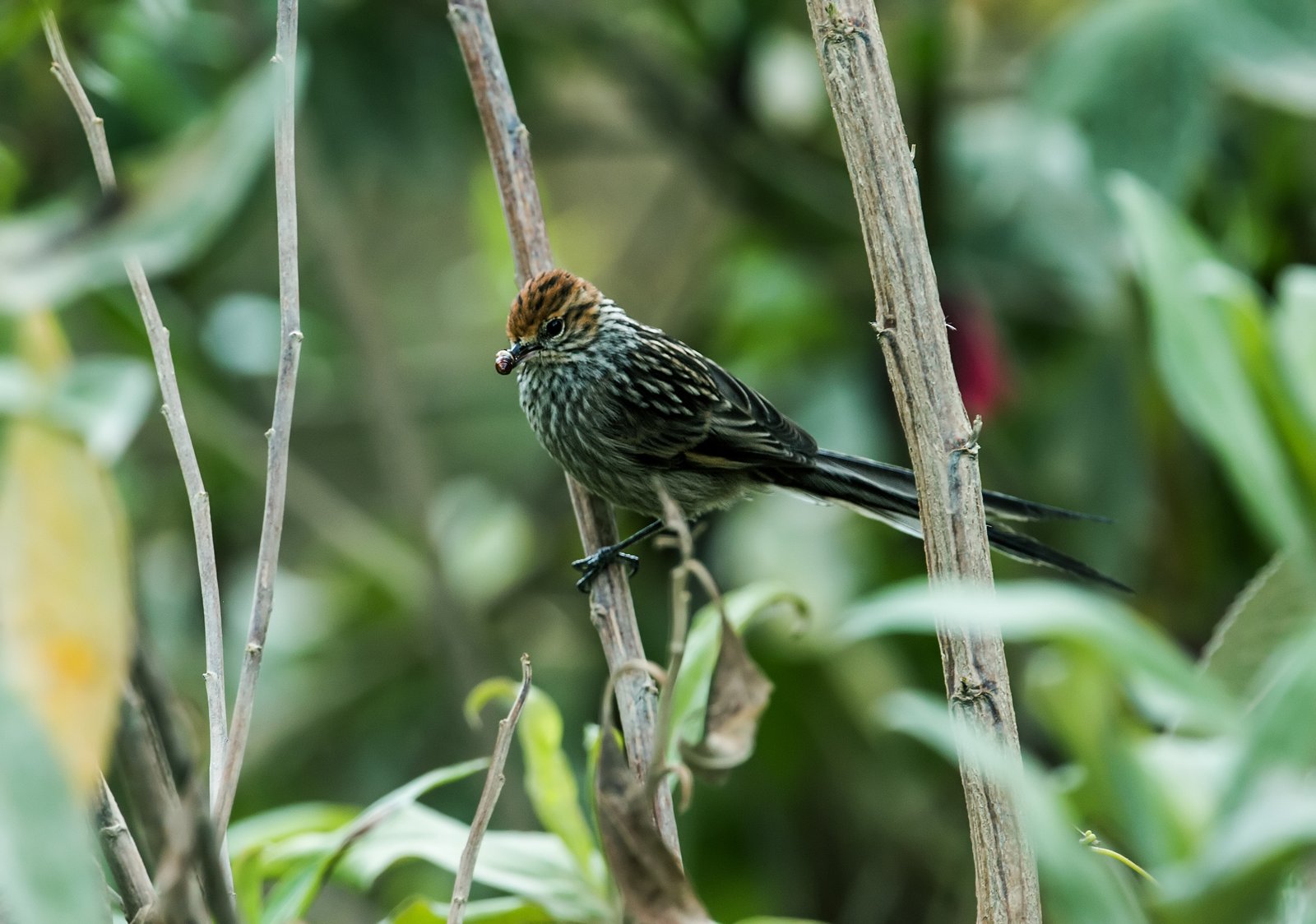
The Rusty-crowned Tit-Spinetail is a small tit-spinetail with a rufous crown and a white-streaked back, found only in the Andes of western Peru. It lives in arid montane scrub and in remnants of Polylepis woodland. Three subspecies are recognized.
Voice
The song is a trill of about two seconds that becomes slightly louder and faster, repeated every three to six seconds. Calls are a short tsak and a sharp, high tchit.
Recording: Dries Van de Loock — CC BY-NC-SA 4.0 · xeno-canto
Identification
15–16 cm, small and slender, with a short bill and a long, graduated tail. The crown is rufous with narrow white streaks, the face grey with a faint white eyebrow. The back is blackish with white streaks, the underparts greyish brown. In the north (cajabambae) the crown has black streaks; in the south (latistriata) the back streaks are broader and more contrasting, the underparts darker grey and the breast more heavily streaked. The sexes are alike.
Confusion species
Streak-backed Tit-Spinetail Leptasthenura striata partly shares the same areas, but has a black crown with rufous streaks (a cinnamon crown in Ancash and Lima), a whitish throat and paler grey underparts. Andean Tit-Spinetail Leptasthenura andicola has a clear white eyebrow and heavily streaked underparts. White-browed Tit-Spinetail Leptasthenura xenothorax has a broad white eyebrow and lives only in Apurímac and Cusco.
Habitat
Arid montane scrub and woodland remnants, especially with Polylepis, mostly between 2900 and 4200 m, locally down to 2000 m. It forages in pairs or small groups, often in mixed flocks, in shrubs and low trees for insects and other arthropods. Nothing is known about its breeding biology.
Where the bird is most at home, classified by the vegetation units of the Andes and the west coast.


Range and movements
Endemic to Peru: on the western slope of the Andes and in the inter-Andean valleys, from Cajamarca south through Ancash, Lima and Junín to Huancavelica, Ayacucho and Arequipa. Not known from Colombia, Ecuador, Bolivia or the Galápagos.
- Resident
- dark = core range, pale = thinly spread
How and when to look
In the Santa Eulalia valley above Lima, around San Pedro de Casta, the species lives in scrub and Polylepis along the road; listen for the swelling trill.
Conservation status
Least Concern. The species is fairly common, the population is considered stable and no immediate threats are known.
Scientific name
Leptasthenura pileata | Sclater, 1881
Sclater described the species in 1881 and placed it straight away in the genus where it still stands. The genus Leptasthenura was introduced in 1853 by Reichenbach. The genus name combines Greek leptos, 'thin', asthenēs, 'weak', and oura, 'tail'. The species name pileata comes from Latin pileatus, 'capped', after the rusty crown. The specimen the first description was based on came from Andes above Lima, Peru.