All species › Passerines › Ovenbirds and woodcreepers › White-browed Tit-Spinetail
White-browed Tit-Spinetail | Leptasthenura xenothorax
Witbrauwmeesstekelstaart | Tijeral cejiblanco | Grimpeirinho-de-sobrancelha-branca
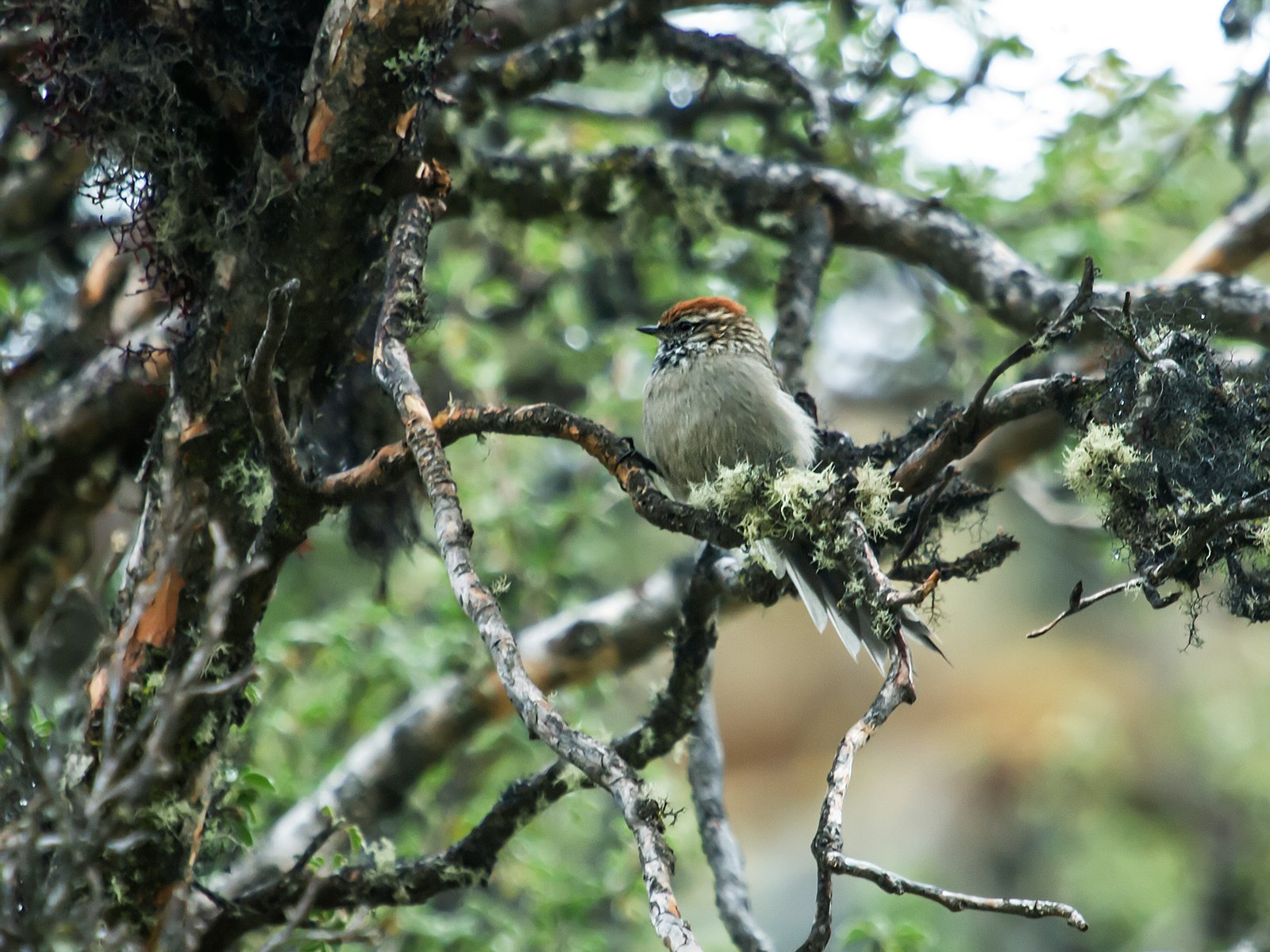
The White-browed Tit-Spinetail is a tit-spinetail with a bright rufous crown and a broad white eyebrow that lives only in high-elevation Polylepis woodland in southern Peru. It is known from a limited number of sites in Cusco and Apurímac. Because of the degradation of this woodland it is listed as Near Threatened.
Voice
It sings a lot, also while foraging. The song is a rapid, descending trill; the contact call is a short, sharp note.
Recording: Niels Krabbe — CC BY-NC-SA 3.0 · xeno-canto
Identification
16–18 cm, small and slender, with a short bill and a long tail; the feathers have bare shaft tips, giving the tail a spiny edge. The crown is bright rufous, with a broad white eyebrow narrowly bordered black. The upperparts are greyish brown with white streaks. The throat and upper breast are whitish with black spots, the rest of the underparts grey. The sexes are alike.
Confusion species
Andean Tit-Spinetail Leptasthenura andicola has a streaked crown and heavily streaked underparts. Tawny Tit-Spinetail Sylviorthorhynchus yanacensis lives in the same Polylepis woodland, but is plain cinnamon without streaks or spots. Rusty-crowned Tit-Spinetail Leptasthenura pileata has only a faint eyebrow and lives farther west and north.
Habitat
Mainly Polylepis woodland, occasionally montane scrub, between 3700 and 4550 m, most numerous in the lower part of that range. It prefers larger tracts of old woodland, but also forages in small groves. It forages in pairs or family groups, often in mixed flocks, acrobatically gleaning arthropods from dense foliage on the outer branches. The only nest described was a cup of moss, lichen and bark fibres in a tree cavity, with two eggs.
Where the bird is most at home, classified by the vegetation units of the Andes and the west coast.


Range and movements
Endemic to Peru: known only from a few sites in the Andes of Cusco and Apurímac, including the Cordillera Vilcanota and the Cordillera Urubamba. Not known from Colombia, Ecuador, Bolivia or the Galápagos.
- Resident
- dark = core range, pale = thinly spread
How and when to look
The Polylepis groves at Abra Málaga, above the Urubamba valley, are the best-known site; the birds often forage there in mixed flocks with other Polylepis species.
Conservation status
Near Threatened; it was previously listed as Endangered. Its habitat is small and fragmented, and grazing and fire degrade the Polylepis woodland, one of the most threatened woodland types in the world. At several sites in the Cordillera Vilcanota the woodland is being restored with local communities.
Scientific name
Leptasthenura xenothorax | Chapman, 1921
Chapman described the species in 1921 and placed it straight away in the genus where it still stands. The genus Leptasthenura was introduced in 1853 by Reichenbach. The genus name combines Greek leptos, 'thin', asthenēs, 'weak', and oura, 'tail'. The species name xenothorax combines Greek xenos, 'strange', and thōrax, 'breast': 'strange-breasted'. The specimen the first description was based on came from Torontoy, Cusco, Peru.