All species › Passerines › Ovenbirds and woodcreepers › Streak-backed Tit-Spinetail
Streak-backed Tit-Spinetail | Leptasthenura striata
Gestreepte meesstekelstaart | Tijeral listado | Grimpeirinho-de-dorso-estriado
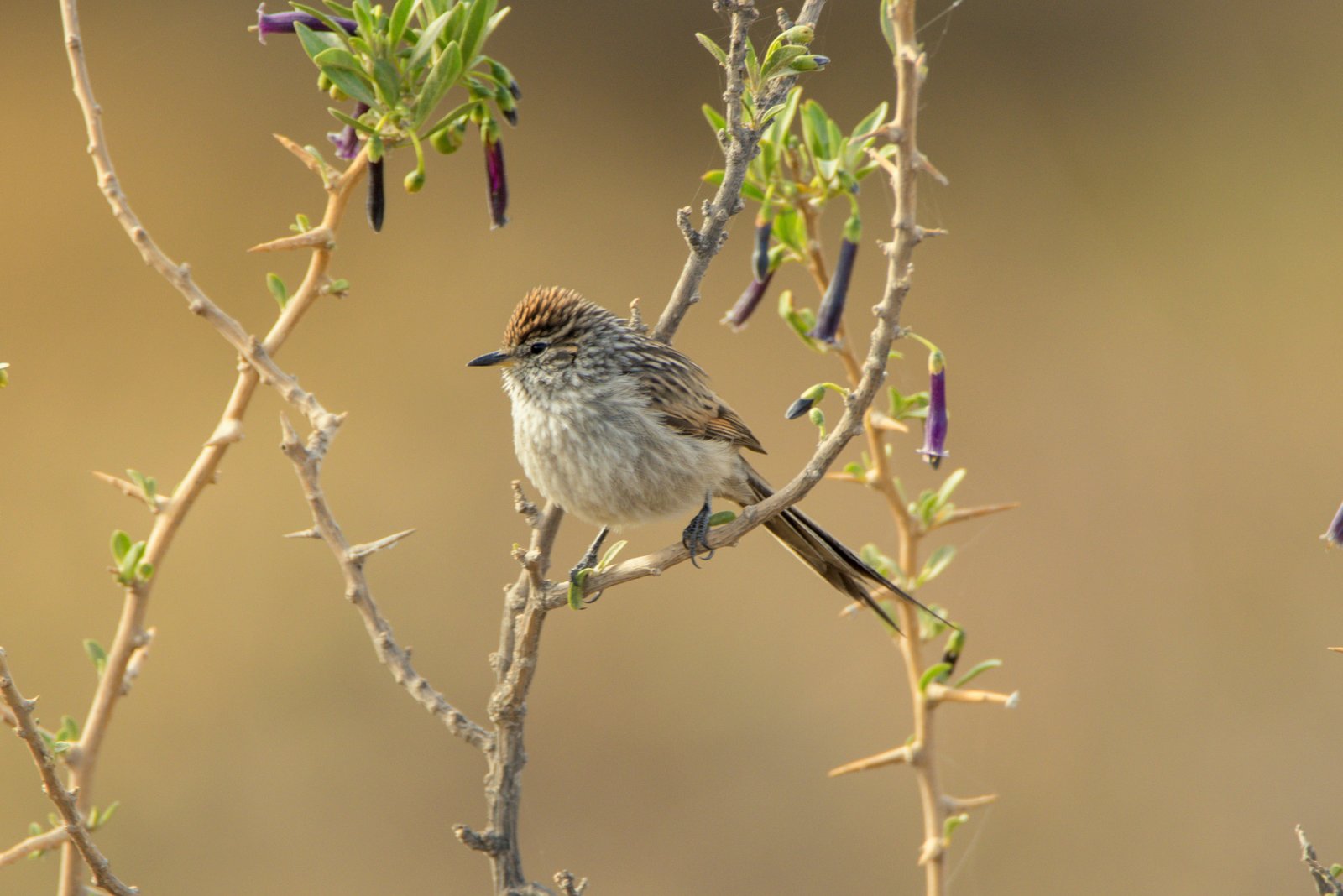
The Streak-backed Tit-Spinetail is a small tit-spinetail with a streaked crown and back, of the arid western slope of the Andes in Peru and northern Chile. It lives in scrub with cacti and bromeliads and in Polylepis woodland. The three subspecies differ mainly in the colour of the crown and throat.
Voice
The song is a descending series of high, ringing whistles. Calls are a wheezy twet, a harsh tzip and a short, gruff tchut.
Recording: L Martin Vallejos Bardales — CC BY-NC-SA 4.0 · xeno-canto
Identification
15–16 cm, small and slender, with a short bill and a long, graduated tail. The crown is black with rufous streaks, the face streaked, with a pale eyebrow. The back is streaked. The throat is whitish with fine dusky spots, the rest of the underparts grey. In Ancash and Lima (superciliaris) the crown is cinnamon and the underparts paler; in Huancavelica (albigularis) the throat is unspotted white. Juveniles are duller, with more rufous on the wings. The sexes are alike.
Confusion species
Rusty-crowned Tit-Spinetail Leptasthenura pileata has a rufous crown with white streaks, a blackish back with white streaks and darker greyish-brown underparts. Plain-mantled Tit-Spinetail Leptasthenura aegithaloides has a plain, unstreaked mantle. Andean Tit-Spinetail Leptasthenura andicola has heavily streaked underparts and lives higher, in puna and Polylepis.
Habitat
Arid montane scrub, sometimes with cacti and bromeliads, and Polylepis woodland, in Peru mostly between 2000 and 4200 m, locally down to 900 m. It forages in pairs or small groups in shrubs for insects and other arthropods. It breeds at least in April and May; little else is known about its breeding biology.
Where the bird is most at home, classified by the vegetation units of the Andes and the west coast.


Range and movements
Absent from Colombia, Ecuador, Bolivia and the Galápagos. Peru: on the western slope of the Andes, from Ancash and Lima through Huancavelica to Arequipa, Moquegua and Tacna. Outside the guide area in northern Chile, south to Tarapacá.
- Resident
- dark = core range, pale = thinly spread
How and when to look
In the Colca Canyon in Arequipa and in the dry valleys above Lima the species lives in scrub on rocky slopes, often among cacti; listen for the descending whistles.
Conservation status
Least Concern. The population is unknown and probably declining; no immediate threats are known, but local loss of scrub may play a role.
Scientific name
Leptasthenura striata | (Philippi & Landbeck, 1863)
Philippi & Landbeck described the species in 1863 as Synallaxis striata; because it was later moved to another genus, the author and year stand in brackets. The genus Leptasthenura was introduced in 1853 by Reichenbach. The genus name combines Greek leptos, 'thin', asthenēs, 'weak', and oura, 'tail'. The species name striata comes from Latin striatus, 'streaked'. The specimen the first description was based on came from Andes near Arica, Chile.