All species › Passerines › Ovenbirds and woodcreepers › Andean Tit-Spinetail
Andean Tit-Spinetail | Leptasthenura andicola
Andesmeesstekelstaart | Tijeral andino | Grimpeirinho-andino
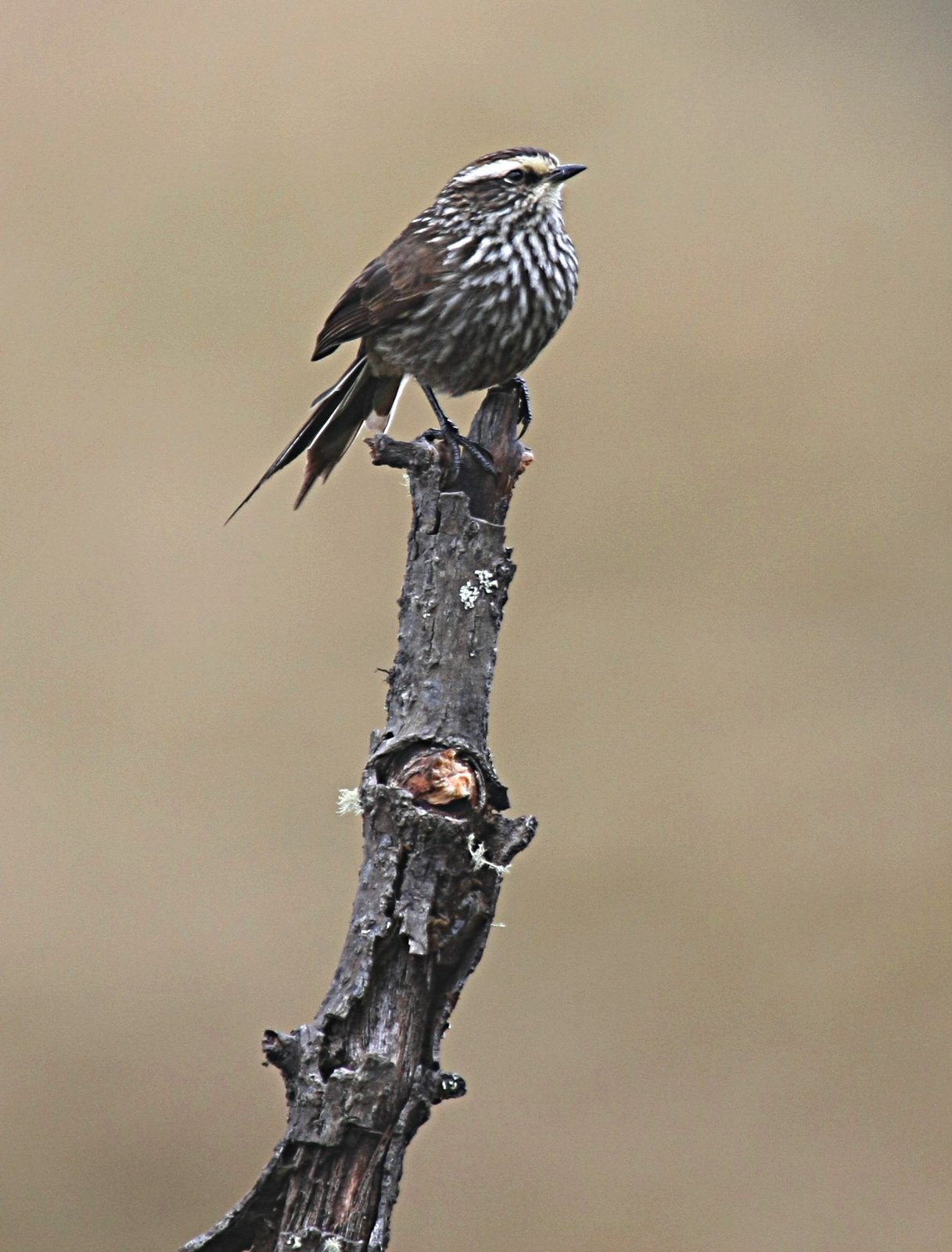
The Andean Tit-Spinetail is a heavily white-streaked tit-spinetail of páramo, puna and Polylepis woodland, from Venezuela to Bolivia. In Colombia and Ecuador it is the only tit-spinetail. The long, pointed central tail feathers give the tail a forked appearance.
Voice
The song is a descending series of notes ending in a trill, sometimes a hesitant series of high, short trills. Calls are weak, tinkling notes and a high, squealing sound.
Recording: Mitch Lysinger — CC BY-NC-SA 4.0 · xeno-canto
Identification
15–17 cm, small and slender, with a short bill and a long, graduated tail with pointed central feathers. The crown is rufous with black streaks, with a white eyebrow. The upperparts are dark brown with white streaks, the breast and belly heavily streaked. The subspecies differ in brightness, in the amount of buff and in the width of the eyebrow and streaks. Juveniles have little crown streaking and a scaly rather than streaked belly. The sexes are alike.
Confusion species
Thistletails, such as White-chinned Thistletail Asthenes fuliginosa, are plainer brown, with a frayed tail and no white streaks. Many-striped Canastero Asthenes flammulata is also streaked, but larger and heavier, with a shorter tail, and stays more on the ground. In Peru, Rusty-crowned Tit-Spinetail Leptasthenura pileata has a faint eyebrow and less streaked underparts, and White-browed Tit-Spinetail Leptasthenura xenothorax has a plain rufous crown and a grey belly.
Habitat
Páramo and humid grassland with shrubs in the north, arid montane scrub and Polylepis woodland throughout; in Colombia and Ecuador mostly between 3000 and 4200 m, in Peru and Bolivia between 3500 and 4450 m. It forages in pairs, often in mixed flocks, in shrubs, Espeletia and Polylepis for insects. The nest is a cup of grass and moss lined with fur, seed down and feathers, on the ground, in a vegetated cavity, under an eave or at the end of an abandoned burrow; usually two eggs.
Where the bird is most at home, classified by the vegetation units of the Andes and the west coast.


Range and movements
Colombia: in the Sierra Nevada de Santa Marta, in the Eastern Andes in Boyacá and Cundinamarca, and in the Central Andes from Tolima southwards. Ecuador: in the Andes throughout, south to Zamora-Chinchipe. Peru: in the Andes from Ancash south to Arequipa and Puno; absent from the north. Bolivia: in La Paz. Absent from the Galápagos. Outside the guide area in the Andes of Venezuela.
- Resident
- dark = core range, pale = thinly spread
How and when to look
In the páramo of Cajas National Park in Ecuador and of the Central and Eastern Andes in Colombia, look for the species in shrubs and Espeletia; listen for the high, descending song.
Conservation status
Least Concern. The range is very large, the species is fairly common and the population is considered stable; no immediate threats are known.
Scientific name
Leptasthenura andicola | Sclater, 1870
Sclater described the species in 1870 and placed it straight away in the genus where it still stands. The genus Leptasthenura was introduced in 1853 by Reichenbach. The genus name combines Greek leptos, 'thin', asthenēs, 'weak', and oura, 'tail'. The species name andicola means 'inhabitant of the Andes', from Latin -cola, 'dweller'. The specimen the first description was based on came from Panza, Chimborazo, Ecuador.