All species › Passerines › Ovenbirds and woodcreepers › Buff-winged Cinclodes
Buff-winged Cinclodes | Cinclodes fuscus
Bandvleugelwipstaart | Churrete acanelado | Pedreiro-dos-andes
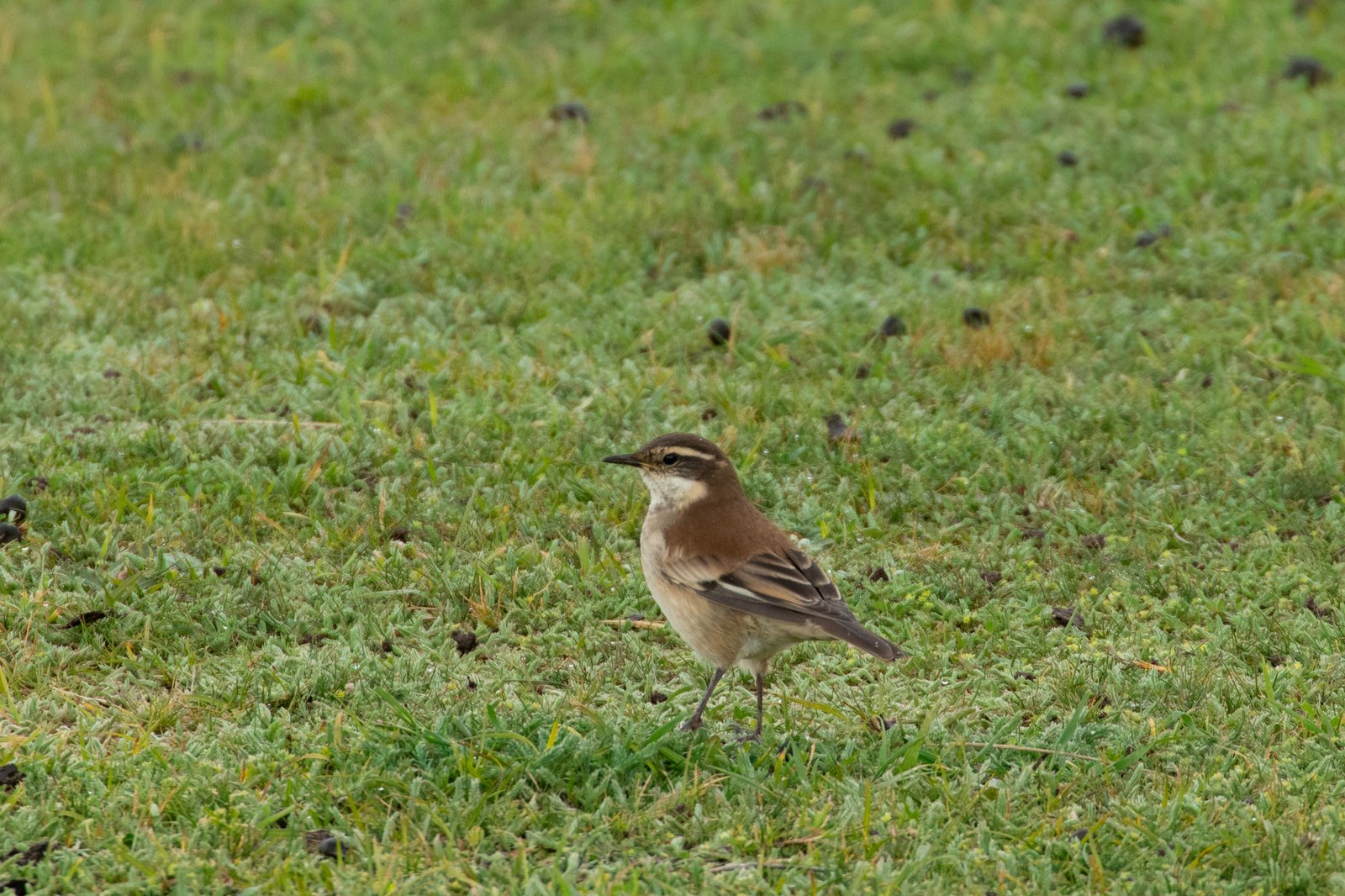
The Buff-winged Cinclodes is the commonest and most widespread cinclodes of the puna. It walks over short turf and along water, constantly flicking its tail. Birds in the guide area have a creamy white wing band; the form with a buff band from southern South America is sometimes treated as a separate species.
Voice
The song is a fast, rising trill, often given while the bird sits on a stone and raises its wings. The call is a short, sharp tseet.
Recording: Cristian Pinto Fernandez — CC BY-NC-SA 4.0 · xeno-canto
Identification
16–18 cm, with a short, straight, dark bill. The upperparts are brown, with a distinct whitish eyebrow. The throat is whitish, breast and belly grey-brown to pale brown. In flight a broad pale wing band shows, in the guide area usually creamy white, in southern birds buff. The outer tail feathers have pale tips. The sexes are alike.
Confusion species
Chestnut-winged Cinclodes Cinclodes albidiventris of Colombia, Ecuador and northern Peru has a rufous wing band. White-winged Cinclodes Cinclodes atacamensis is larger, with warmer rufous-brown upperparts and large white wing patches. Miners such as Common Miner Geositta cunicularia are paler and sandier, with a shorter tail.
Habitat
Short-grazed grassland, bofedales, the shores of lakes and streams, rocky slopes and fields in the puna, roughly between 3000 and 4800 m. It searches the ground for insects, larvae and other invertebrates. The nest is placed in a burrow in a bank or in a rock crevice, sometimes in a wall.
Where the bird is most at home, classified by the vegetation units of the Andes and the west coast.


Range and movements
Peru: in the Andes from the north (Cajamarca) south to Puno and Tacna. Bolivia: in the Andes and on the altiplano. Absent from Colombia, Ecuador and the Galápagos. Outside the guide area in Chile and Argentina, south to Tierra del Fuego; the southernmost birds move north in the austral winter.
- Resident
- dark = core range, pale = thinly spread
How and when to look
Around lakes, bofedales and pastures on the altiplano and along roads through the puna. The bird often sits in the open on stones, low walls and short turf.
Conservation status
Least Concern. The species is widespread and often common, also in grazed land and around settlements.
Scientific name
Cinclodes fuscus | (Vieillot, 1818)
Vieillot described the species in 1818 as Anthus fuscus; because it was later moved to another genus, the author and year stand in brackets. The genus Cinclodes was introduced in 1840 by Gray. The genus name combines Ancient Greek kinklos, an unidentified waterside bird, with -oidēs, 'resembling'. The species name comes from Latin fuscus, 'dark' or 'dusky'. The specimen the first description was based on came from Montevideo, Buenos Aires and Paraguay.