All species › Passerines › Ovenbirds and woodcreepers › Chestnut-winged Cinclodes
Chestnut-winged Cinclodes | Cinclodes albidiventris
Kastanjevleugelwipstaart | Churrete alicastaño | Pedreiro-de-asa-castanha
The Chestnut-winged Cinclodes is the cinclodes of the páramo of the northern Andes. It walks over short turf, along streams and across open patches, flicking its tail. It was formerly included in Buff-winged Cinclodes, but differs among other things in the colour of the wing band.
Voice
The song is a fast, rising trill, often given with raised wings. The call is a short, sharp cheek.
Recording: Scott Olmstead — CC BY-NC-SA 4.0 · xeno-canto
Identification
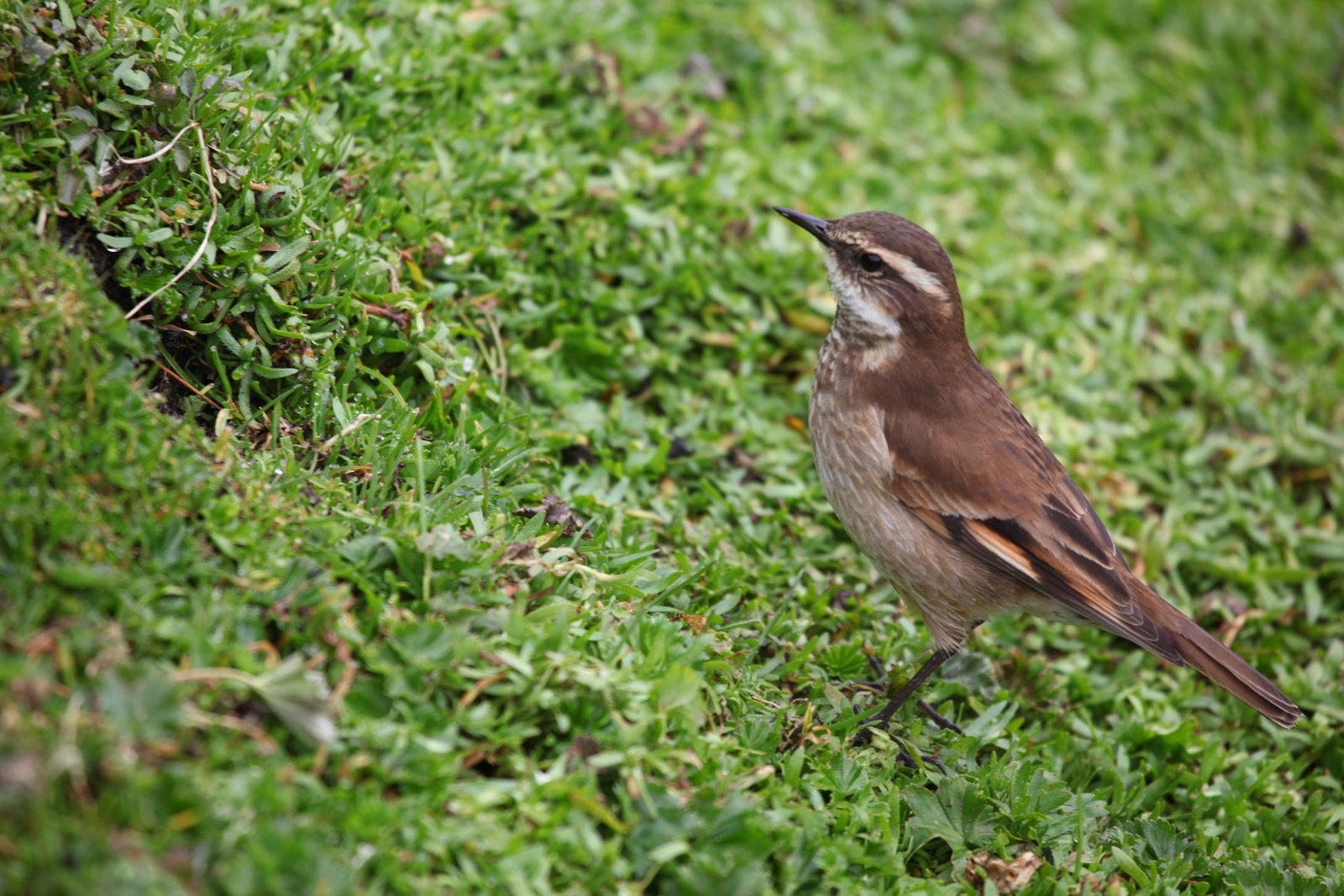
17–18 cm, with a short, straight, dark bill. The upperparts are dark brown, with a pale eyebrow. The throat is whitish with dusky spots, breast and belly grey-brown. In flight a rufous to chestnut wing band shows, also visible as a patch on the closed wing. The outer tail feathers have pale tips. The sexes are alike.
Confusion species
Stout-billed Cinclodes Cinclodes excelsior is larger, with a longer, thicker and slightly decurved bill. Buff-winged Cinclodes Cinclodes fuscus, which replaces it in northern Peru, has a pale, creamy wing band. Ground tyrants (Muscisaxicola) have a short, thin bill and a black tail.
Habitat
Páramo, jalca, wet grassland and bog, the banks of streams and lakes, also pastures and open areas near farms, roughly between 3000 and 4300 m. It searches the ground for insects and other invertebrates. The nest is placed in a burrow in a bank or in a crevice.
Where the bird is most at home, classified by the vegetation units of the Andes and the west coast.


Range and movements
Colombia: in the páramo of the Central and Eastern Andes and in Nariño. Ecuador: in the páramo along the whole length of the country. Peru: in the far north, in Piura and Cajamarca. Absent from Bolivia and the Galápagos. Outside the guide area in the Andes of Venezuela.
- Resident
- dark = core range, pale = thinly spread
How and when to look
On the páramo along roads over the passes, for example in the national parks of Ecuador. The bird often sits on stones and road edges and walks along streams.
Conservation status
Least Concern. The species is common in the páramo and also occurs in grazed land; locally habitat is lost to conversion.
Scientific name
Cinclodes albidiventris | Sclater, 1860
Sclater described the species in 1860 and placed it straight away in the genus where it still stands. The genus Cinclodes was introduced in 1840 by Gray. The genus name combines Ancient Greek kinklos, an unidentified waterside bird, with -oidēs, 'resembling'. The species name comes from Latin albidus, 'whitish', and venter, 'belly'. The specimen the first description was based on came from Chimborazo, Ecuador.