All species › Passerines › Ovenbirds and woodcreepers › Stout-billed Cinclodes
Stout-billed Cinclodes | Cinclodes excelsior
Grootsnavelwipstaart | Churrete piquigrueso | Pedreiro-de-bico-grosso
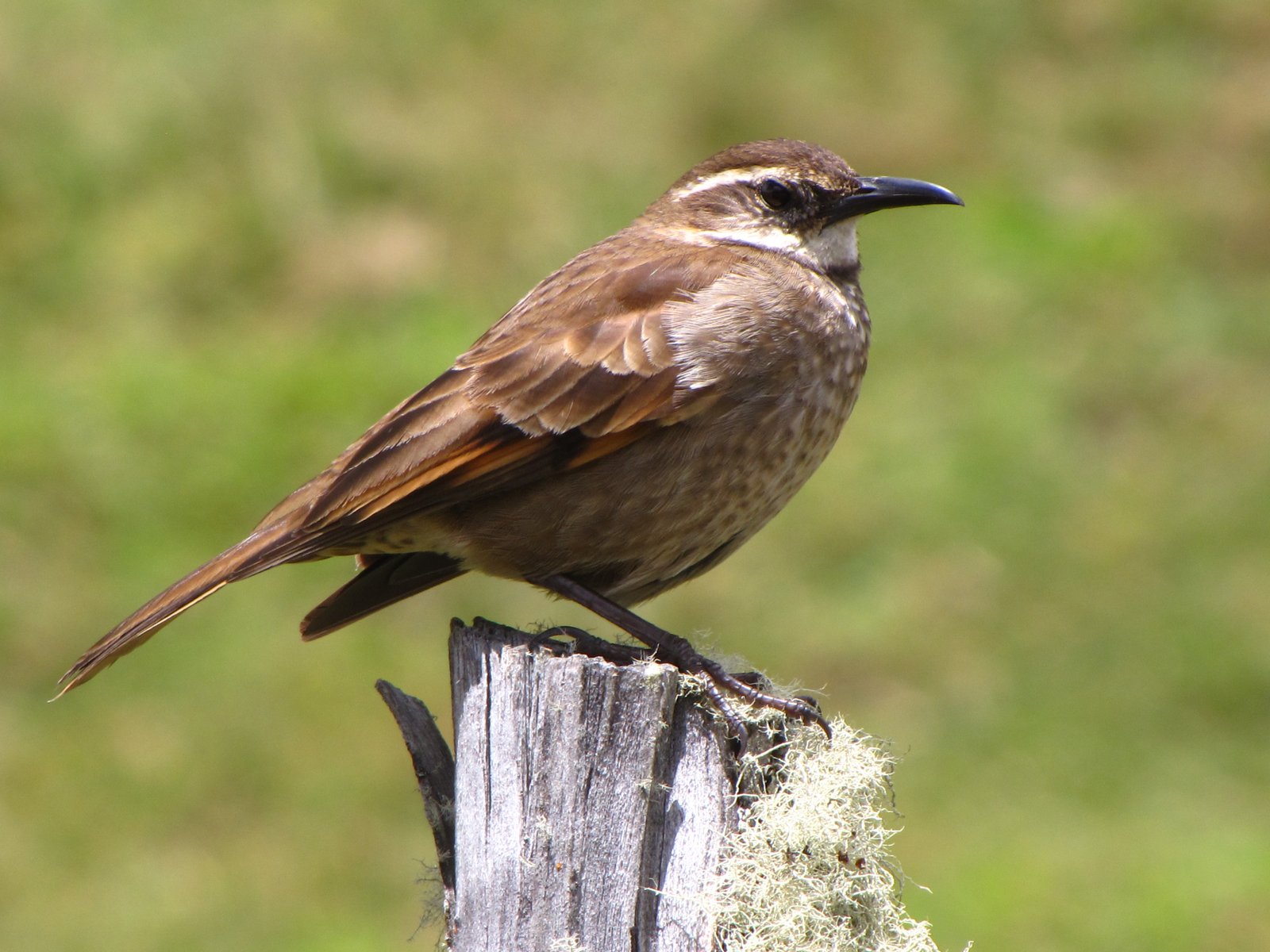
The Stout-billed Cinclodes is a large cinclodes of the high páramo of Colombia and Ecuador. Its thick, slightly decurved bill separates it from the smaller Chestnut-winged Cinclodes, which lives in the same area. It forages on the ground, often in wet parts of the páramo.
Voice
The song is a fast, dry trill. It gives hard, short calls.
Recording: Alejandro Pinto-Gómez — CC BY-NC-SA 4.0 · xeno-canto
Identification
20–21 cm, with a fairly long, thick and slightly decurved bill. The upperparts are dark brown, with a pale eyebrow. The throat is whitish with dark scaling, breast and flanks are brown, the breast with fine pale streaks, the belly slightly paler. A rufous wing band is visible mainly in flight. The sexes are alike.
Confusion species
Chestnut-winged Cinclodes Cinclodes albidiventris is smaller, with a shorter, thinner and straight bill. Royal Cinclodes Cinclodes aricomae of southern Peru and Bolivia is very similar and was formerly treated as a subspecies of this species; the ranges do not overlap.
Habitat
High páramo with grass tussocks, cushion plants and bog, the banks of streams and lakes, also the edges of Polylepis woodland, roughly between 3500 and 4500 m. It searches the ground and moss for insects and other invertebrates. The nest is placed in a burrow or crevice.
Where the bird is most at home, classified by the vegetation units of the Andes and the west coast.


Range and movements
Colombia: in the Central Andes and in the south (Nariño). Ecuador: in the high páramo of both Andean ranges, south to about Azuay. Not known from Peru, Bolivia or the Galápagos; does not occur outside the guide area.
- Resident
- dark = core range, pale = thinly spread
How and when to look
On the high páramo of the volcanoes of Ecuador, for example around Antisana and Cotopaxi, and in Colombia around Nevado del Ruiz. The bird often walks over open, wet patches.
Conservation status
Least Concern. Its habitat is restricted to the high páramo, where fires, grazing and conversion affect it.
Scientific name
Cinclodes excelsior | Sclater, 1860
Sclater described the species in 1860 and placed it straight away in the genus where it still stands. The genus Cinclodes was introduced in 1840 by Gray. The genus name combines Ancient Greek kinklos, an unidentified waterside bird, with -oidēs, 'resembling'. The species name comes from Latin excelsior, 'higher' or 'loftier'. The specimen the first description was based on came from Chimborazo, Ecuador.