All species › Pelicans, herons and ibises › Pelicans › Brown Pelican
Brown Pelican | Pelecanus occidentalis
Bruine pelikaan | Pelícano pardo | Pelicano-pardo
The Brown Pelican is the only pelican that fishes by plunge-diving into the sea from flight. It occurs along the warm coasts of Colombia and Ecuador and on the Galápagos, and in northern Peru it meets the larger Peruvian Pelican, formerly treated as a subspecies of this species. A small, dark subspecies, P. o. urinator, lives on the Galápagos.
Voice
Adults are almost always silent. At colonies young and adults make low grunting and hissing sounds.
Recording: Isain Contreras Rodríguez — CC BY-NC-SA 4.0 · xeno-canto
Identification
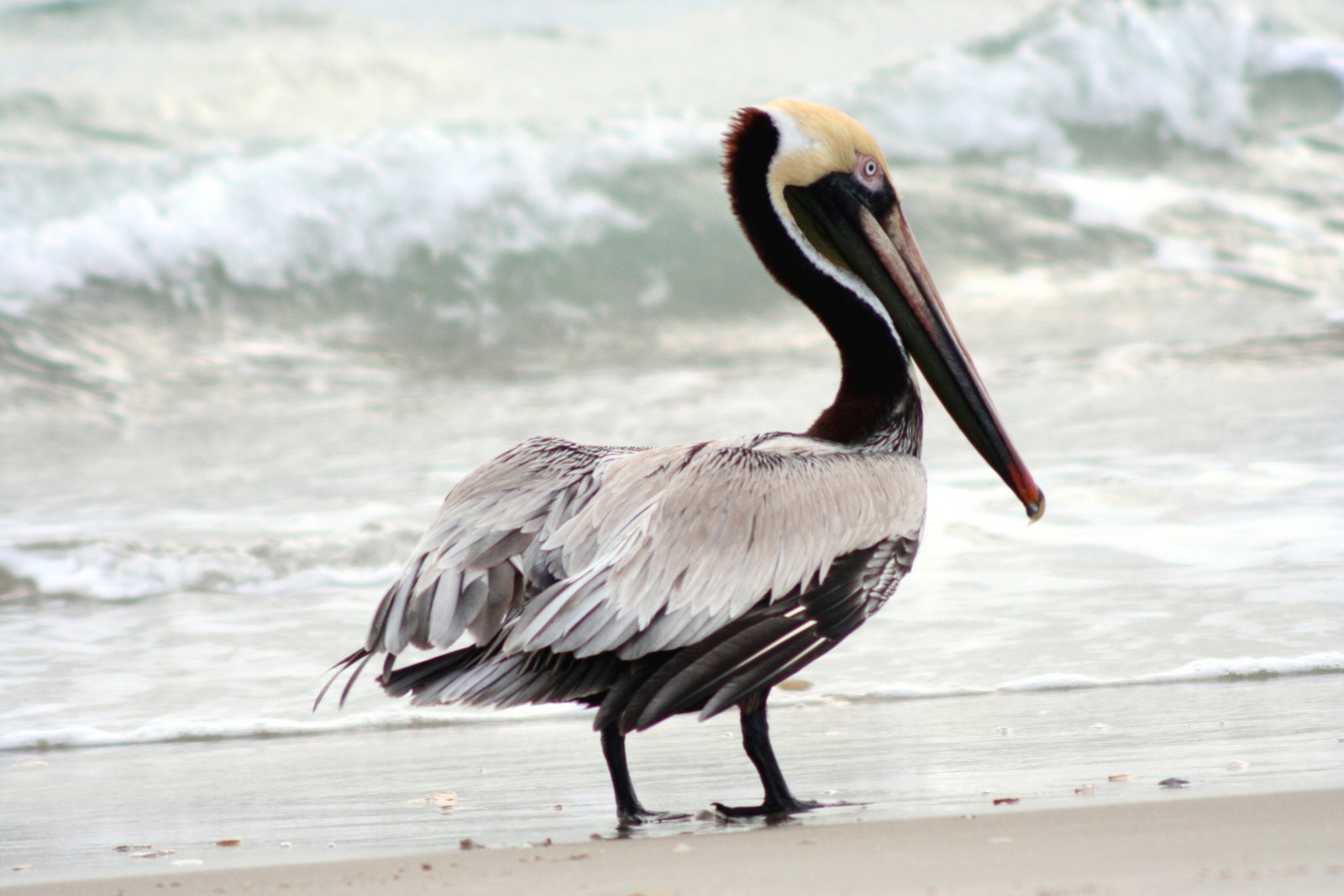
100–137 cm, with a wingspan of about two metres. The body is grey-brown, the upperparts streaked silvery grey. The bill is long and flat, with a dark pouch. Outside the breeding season the head and neck are white, the crown yellowish. In breeding plumage the hindneck and nape are dark chestnut, separated from the white head by a white stripe along the side of the neck. Juveniles are plain grey-brown on the head, neck and back, with a pale belly. The sexes are alike. It flies with the head drawn in, alternating a few wingbeats with long glides, often in lines low over the water.
Confusion species
Peruvian Pelican Pelecanus thagus is clearly larger and heavier, with more silvery grey on the wing coverts and a straw-yellow crest in breeding plumage; both species occur together in northern Peru and southern Ecuador, where juveniles are best told by size. American White Pelican Pelecanus erythrorhynchos, a rare vagrant, is white with black primaries and fishes while swimming. At a distance juvenile Brown Pelicans may recall Brown Booby Sula leucogaster, but that species is much smaller, with a slender, pointed bill and a sharply defined white belly.
Habitat
Shallow inshore waters, bays, estuaries, mangroves, sandy beaches and rocky shores; rarely far out at sea or inland. It rests on beaches, rocks, posts and in fishing harbours, where it comes to fish scraps. It fishes by diving with half-folded wings from a few to more than ten metres up and scooping fish with the pouch. It breeds in colonies on islets, in mangroves or on shrubs, with a stick nest on the ground or in low trees.
Where the bird is most at home, classified by the vegetation units of the Andes and the west coast.


Range and movements
In Colombia common along the entire Caribbean and Pacific coasts, with the nominate form in the Caribbean and P. o. murphyi on the Pacific side. In Ecuador common along the entire coast, with colonies on offshore islands. On the Galápagos year-round throughout the archipelago (P. o. urinator). In Peru mainly along the north coast, in Tumbes and Piura, scarcer further south and largely replaced by the Peruvian Pelican. Absent from Bolivia. Outside the guide area along the coasts of North and Central America, the Caribbean and northern South America.
- Resident
- dark = core range, pale = thinly spread
How and when to look
In harbours such as those of Puerto López, Salinas and Puerto Ayora on Santa Cruz, Brown Pelicans often sit at close range on jetties and boats waiting for fish scraps. Along the beaches of the Colombian Caribbean coast they can be seen flying in lines low over the surf and diving.
Conservation status
Least Concern. After a steep decline in North America caused by the pesticide DDT, the species has recovered there. Locally, disturbance of colonies, entanglement in fishing lines and nets, oil pollution and food shortage during El Niño events are threats.
Scientific name
Pelecanus occidentalis | Linnaeus, 1766
Linnaeus described the species in 1766 and placed it straight away in the genus where it still stands. The genus Pelecanus was introduced in 1758 by Linnaeus. The genus name comes from Greek pelekan, 'pelican', related to pelekus, 'axe'. The species name is Latin occidentalis, 'western', after its New World range. The specimen the first description was based on came from Jamaica.