All species › Pelicans, herons and ibises › Pelicans › Peruvian Pelican
Peruvian Pelican | Pelecanus thagus
Peruaanse pelikaan | Pelícano peruano | Pelicano-peruano
The Peruvian Pelican is a very large, dark pelican of the cold Humboldt Current and one of the three classic guano birds of Peru. It is much larger than the Brown Pelican, of which it was long treated as a subspecies. Large flocks hunt anchovy shoals and breed packed together on the guano islands.
Voice
Mostly silent. At colonies birds give low grunting and hissing sounds.
Recording: Dries Van de Loock — CC BY-NC-SA 4.0 · xeno-canto
Identification
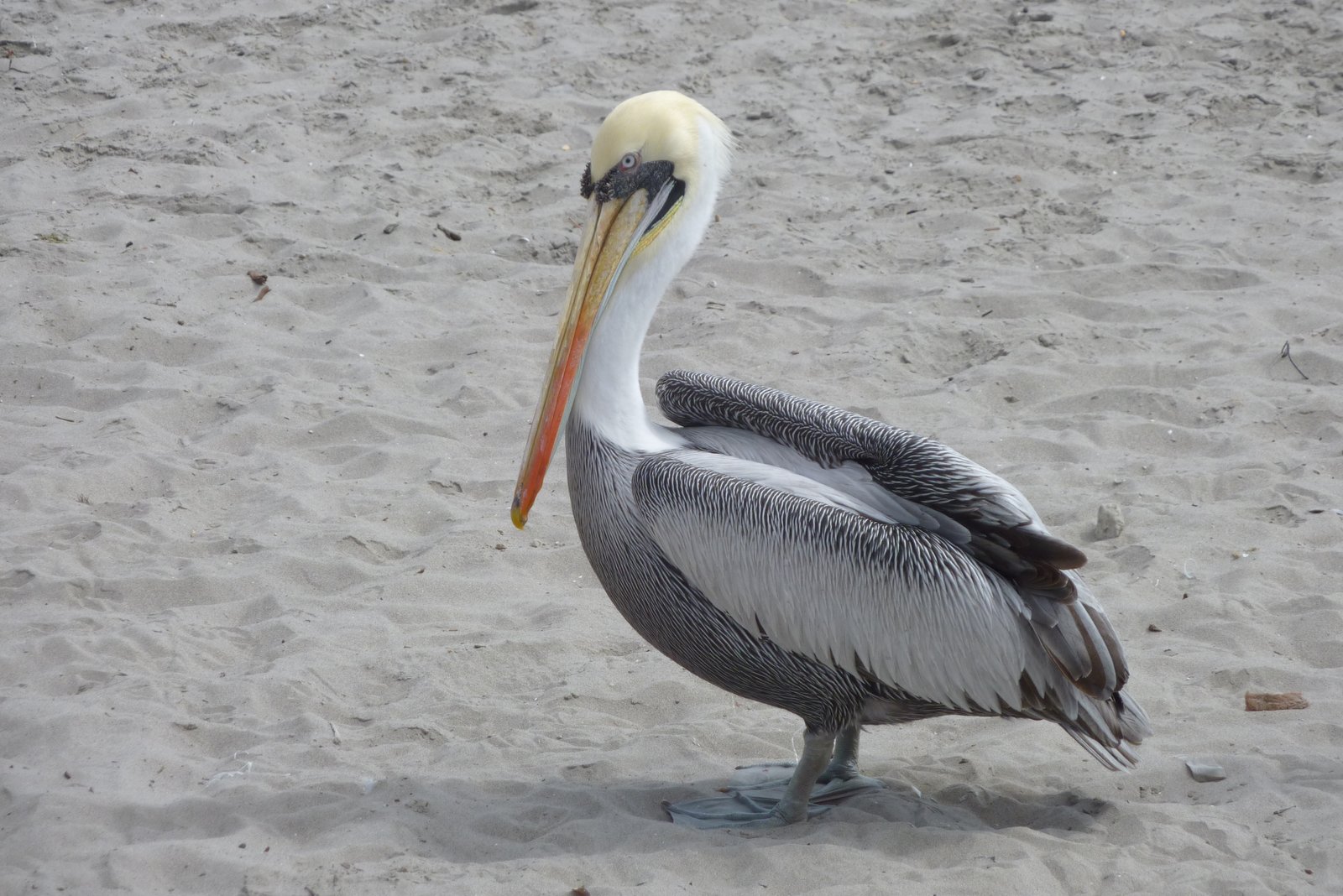
137–152 cm, a massive pelican with a long bill and a large pouch. Breeding adults have a straw-yellow crest and forehead and a broad white stripe running from the bill base down the side of the dark brown neck. The upperparts are grey with pale feather fringes, giving the wing coverts in particular a silvery-grey streaked look; the underparts are dark with pale streaks. Outside the breeding season the neck is paler. Juveniles are plain grey-brown with a paler belly. The sexes are alike; males are larger on average.
Confusion species
Brown Pelican Pelecanus occidentalis is clearly smaller and slimmer, with less silvery grey on the wing coverts; both species occur together in northern Peru and Ecuador, where juveniles are best told by size. Other large seabirds along this coast, such as Guanay Cormorant Leucocarbo bougainvilliorum and Peruvian Booby Sula variegata, lack the long bill with a pouch.
Habitat
Cold, productive inshore waters over the Humboldt Current, rocky shores, sandy beaches, bays and lagoons. It rests on beaches, cliffs and in fishing harbours, where it comes to fish scraps. It fishes mainly by plunge-diving from flight, often in flocks over anchovy shoals. It breeds in dense colonies on bare islands and headlands, with the nest on the ground.
Where the bird is most at home, classified by the vegetation units of the Andes and the west coast.


Range and movements
Along almost the entire coast of Peru, with the largest colonies on the guano islands. In Ecuador scarce to rare in the south-west, mainly when food conditions in Peru are poor. Absent from Colombia, Bolivia and the Galápagos. Outside the guide area south along the coast of Chile.
- Resident
- dark = core range, pale = thinly spread
How and when to look
On boat trips to the Ballestas Islands off Paracas large numbers can be seen, together with Guanay Cormorants and Peruvian Boobies. Fishing harbours such as Paita, Chimbote and Callao attract flocks waiting at close range for fish scraps.
Conservation status
Near Threatened. The species depends on anchovy and suffers heavy losses during El Niño events, when the cold water fails. Disturbance of colonies during guano harvesting, overfishing and drowning in fishing nets are further threats.
Scientific name
Pelecanus thagus | Molina, 1782
Molina described the species in 1782 and placed it straight away in the genus where it still stands. The genus Pelecanus was introduced in 1758 by Linnaeus. The genus name comes from Greek pelekan, 'pelican', related to pelekus, 'axe'. The species name comes from the Chilean name tagua for a coot (Fulica), mistakenly applied to the Peruvian Pelican. The specimen the first description was based on came from Chile.