All species › Pelicans, herons and ibises › Ibises and spoonbills › Roseate Spoonbill
Roseate Spoonbill | Platalea ajaja
Rode lepelaar | Espátula rosada | Colhereiro
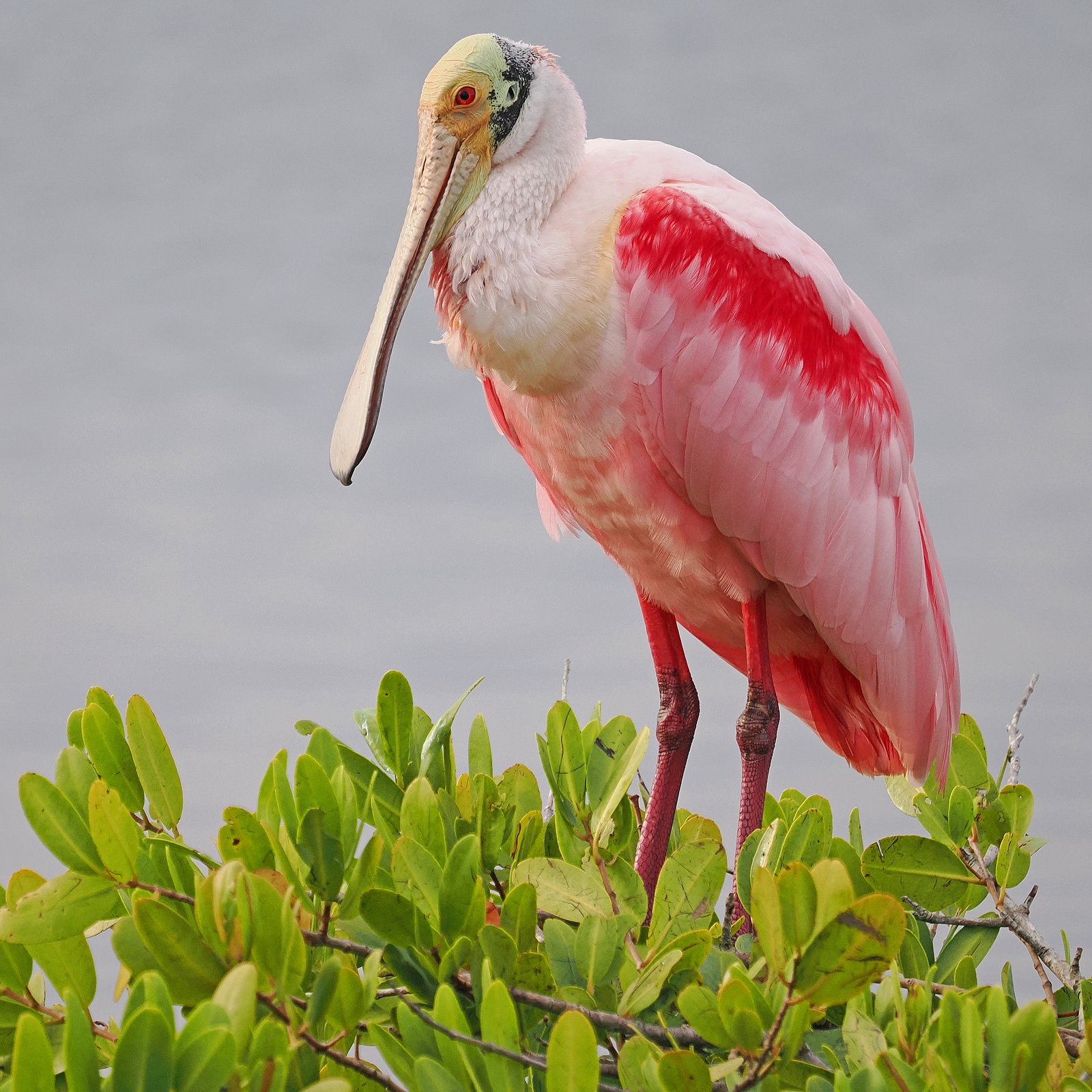
The Roseate Spoonbill is the only spoonbill of the Americas and the only pink spoonbill in the world. The pink colour comes from carotenoids in its diet of crustaceans and other aquatic animals. Sweeping its head from side to side, it sieves shallow water with its flat, spoon-shaped bill.
Voice
Usually silent. In colonies and when flushed a low, hoarse grunting or growling.
Recording: Paul Marvin — CC BY-NC-SA 4.0 · xeno-canto
Identification
70–85 cm, with a long, straight bill widened at the tip into a flat spoon, a fairly long neck and long legs. Adults are pink, with a white neck and mantle, bright red shoulders and upperwing coverts and an orangey tail. The head is bare and greenish grey, the bill grey and the legs pink to red. In flight the neck and legs are held outstretched. The sexes are alike. Juveniles are whitish with a pale pink wash and a feathered head, and become fully pink in about three years.
Confusion species
American Flamingo Phoenicopterus ruber, which occurs on the Caribbean coast of Colombia, is much larger, with a very long neck and legs and a bent bill. Scarlet Ibis Eudocimus ruber is uniformly scarlet, with a decurved bill and black wingtips. At a distance young, whitish birds can recall egrets, but the spoon-shaped bill and feeding action are distinctive.
Habitat
Shallow fresh, brackish and salt water: lagoons, estuaries and tidal flats on the coast, mangroves, marshes, flooded savanna and edges of lakes and rivers in the lowlands. It sweeps its bill and head through shallow water for small fish, shrimps, insects and other aquatic animals. It breeds in colonies, often with herons and ibises, with a stick nest in mangroves or trees over water.
Where the bird is most at home, classified by the vegetation units of the Andes and the west coast.


Range and movements
In Colombia on the Caribbean coast, in the Magdalena Valley and the llanos, locally also in Amazonia and on the Pacific coast. In Ecuador mainly on the coast around the Gulf of Guayaquil, scarce in the eastern lowlands. In Peru in the Amazonian lowlands and on the coast in the far north-west. In Bolivia in the savannas and marshes of the north and east. Absent from the Galápagos. Outside the guide area from the southern United States, Mexico and the Caribbean to northern Argentina.
- Resident
- dark = core range, pale = thinly spread
How and when to look
Search flooded plains and shallow pools in the llanos of Colombia and the Beni savannas of Bolivia, or the mangroves and lagoons around the Gulf of Guayaquil in Ecuador. Flocks often feed together with herons and ibises.
Conservation status
Least Concern. Formerly the species was heavily hunted for its feathers; locally loss of mangroves and marshes and disturbance of breeding colonies are threats.
Scientific name
Platalea ajaja | Linnaeus, 1758
Linnaeus described the species in 1758 and placed it straight away in the genus where it still stands. He introduced the genus Platalea in that same work. The genus name is Latin platalea, the classical name for the spoonbill, related to Greek platus, 'broad', after the broad bill. The species name comes from the bird's Tupi name, as recorded by the German naturalist Georg Marcgrave (1610–1644) in Historia Naturalis Brasiliae (1648). The specimen the first description was based on came from Rio São Francisco, eastern Brazil.