All species › Pelicans, herons and ibises › Ibises and spoonbills › Puna Ibis
Puna Ibis | Plegadis ridgwayi
Puna-ibis | Ibis de la puna | Íbis-da-puna
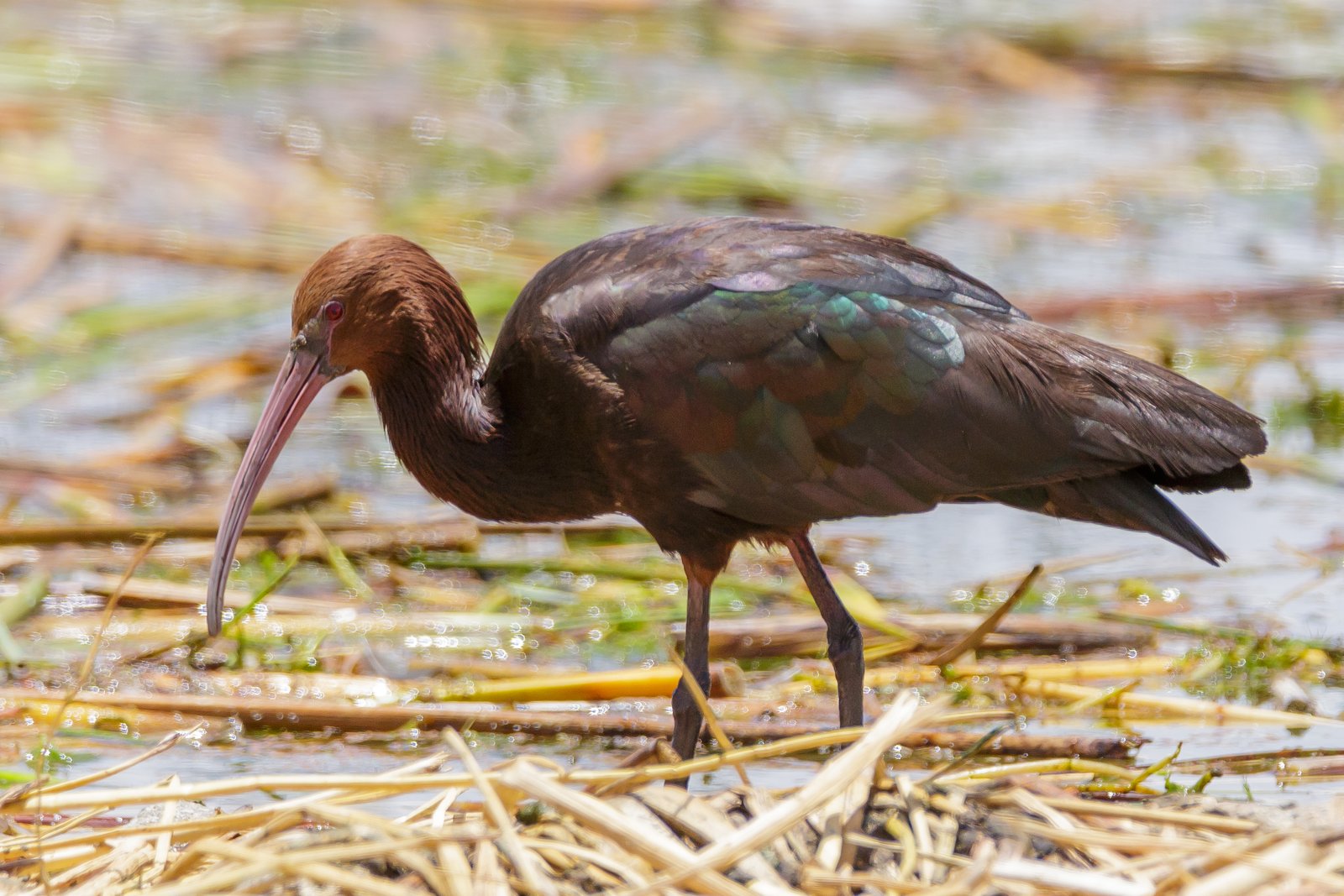
The Puna Ibis is the ibis of the high plateaus of the central Andes. Flocks feed in wet bogs, on lake shores and among grazing llamas and alpacas, to above 4500 m. In recent decades it has also become increasingly frequent in wetlands and rice fields on the coast of Peru.
Voice
Usually silent. In flocks and when flushed a low, hoarse, croaking kurr-kurr or kek-kek.
Recording: Ross Gallardy — CC BY-NC-SA 4.0 · xeno-canto
Identification
56–61 cm, rather heavily built, with a long, decurved bill and long legs. In breeding plumage the head and neck are dark purplish chestnut and the back, wings and tail dark with a strong green and purple gloss. The bill is dark reddish brown to maroon, the bare lores are dark and the legs are dark red to blackish. There are no white or pale blue lines around the face. In non-breeding plumage the head and neck are finely streaked white. In flight the neck and legs project well. The sexes are alike.
Confusion species
White-faced Ibis Plegadis chihi is smaller and slimmer, with a grey bill, a red eye and in breeding plumage a white border around the face; it lives mainly in the lowlands of Bolivia. Glossy Ibis Plegadis falcinellus has pale blue lines along the lores and an olive-brown bill. Black-faced Ibis Theristicus melanopis is much larger, with a pale buff neck and grey wings with white wing coverts.
Habitat
Lake shores, bofedales and wet puna, flooded grassland and damp fields on the high plateaus, roughly between 3500 and 4800 m; on the coast of Peru also in reed marshes, rice fields and lagoons down to sea level. It feeds in flocks, probing mud and shallow water for insect larvae, worms, small crustaceans and snails. It breeds in colonies in totora reedbeds of lakes, with a nest of reeds.
Where the bird is most at home, classified by the vegetation units of the Andes and the west coast.


Range and movements
In Peru in the Andes of the centre and south, with large numbers around Lake Titicaca, and increasingly in coastal wetlands, mainly in the south. In Bolivia on the altiplano and in the high Andes. Absent from Colombia, Ecuador and the Galápagos. Outside the guide area in northern Chile and north-western Argentina.
- Resident
- dark = core range, pale = thinly spread
How and when to look
Around Lake Titicaca and on the bofedales of the altiplano, flocks among grazing livestock. On the coast of Peru at the Pantanos de Villa near Lima and in the rice fields and lagoons of the south.
Conservation status
Least Concern. The species is numerous on the altiplano and is spreading along the coast; disturbance of colonies, harvesting of totora reeds and drainage of bogs are local threats.
Scientific name
Plegadis ridgwayi | (Allen, 1876)
Allen described the species in 1876 as Falcinellus Ridgwayi; because it was later moved to another genus, the author and year stand in brackets. The genus Plegadis was introduced in 1829 by Kaup. The genus name comes from Greek plēgados, 'sickle', after the curved bill. The species name honours Robert Ridgway (1850–1929), American ornithologist and curator of birds at the Smithsonian. The specimen the first description was based on came from Lake Titicaca, Peru/Bolivia.