All species › Pelicans, herons and ibises › Ibises and spoonbills › White-faced Ibis
White-faced Ibis | Plegadis chihi
Witmaskeribis | Morito cariblanco | Caraúna
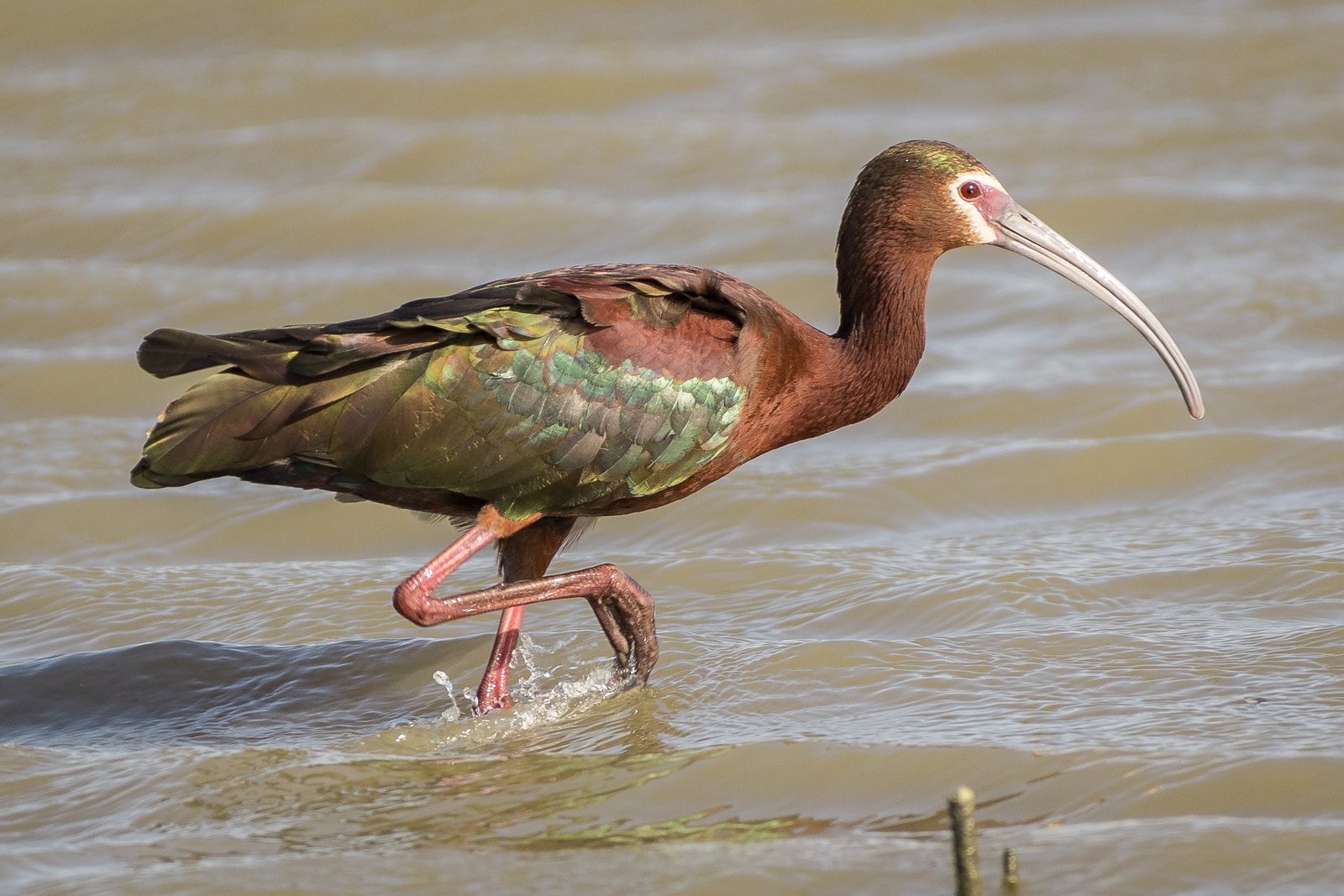
The White-faced Ibis is the American counterpart of the Glossy Ibis, with one breeding range in western North America and another in southern South America. In the guide area it occurs mainly in the lowlands of Bolivia. In breeding plumage a white feathered border encloses the bare red face.
Voice
Usually silent. In flocks and colonies low, nasal grunts and a short, hoarse graa.
Recording: Franco Vushurovich — CC BY-NC-SA 4.0 · xeno-canto
Identification
46–56 cm, slender, with a long, decurved bill and long legs. In breeding plumage the head, neck and underparts are deep chestnut and the back and wings dark with a green and purple gloss. The bare face is pink to red and is enclosed by a broad border of white feathers that continues behind the eye and under the chin. The eye is red, the bill grey to horn-coloured and the legs reddish. In non-breeding plumage the head and neck are duller brown with fine white streaks and the white border is lacking, but the eye remains red. The sexes are alike. Juveniles have a brown eye.
Confusion species
Glossy Ibis Plegadis falcinellus has a dark eye, greyish-brown legs and dark bluish-grey lores with narrow pale blue lines that do not enclose the eye. Puna Ibis Plegadis ridgwayi is larger and heavier, with a dark reddish-brown bill, no white facial border, and lives in the high Andes and on the coast of Peru. Bare-faced Ibis Phimosus infuscatus is smaller and stockier, with a pink bill and shorter legs.
Habitat
Freshwater marshes, flooded grassland, edges of shallow lakes and lagoons, savanna and rice fields, mainly in the lowlands, locally also in valleys and on highland lakes. It feeds in flocks, probing mud and shallow water for insect larvae, worms, snails and crustaceans. It breeds in colonies in reedbeds or low scrub over water, with a nest of reeds and plant material.
Where the bird is most at home, classified by the vegetation units of the Andes and the west coast.


Range and movements
In Bolivia mainly in the lowlands of the east and south, partly as a breeding bird and partly as a migrant from the south outside the breeding season; locally also in the highlands. In Peru scarce and local in the south. In Colombia and Ecuador only rare vagrants. Absent from the Galápagos. Outside the guide area in the western United States and Mexico, and from southern Brazil and Paraguay to Argentina and Chile.
- Resident
- dark = core range, pale = thinly spread
How and when to look
Search the marshes and flooded grassland of lowland Bolivia around Santa Cruz and in the Beni among flocks of other waterbirds. The red eye is the best feature outside the breeding season too.
Conservation status
Least Concern. The population is large and increased in parts of North and South America after certain pesticides were banned; drainage of marshes is a local threat.
Scientific name
Plegadis chihi | (Vieillot, 1817)
Vieillot described the species in 1817 as Numenius chihi; because it was later moved to another genus, the author and year stand in brackets. The genus Plegadis was introduced in 1829 by Kaup. The genus name comes from Greek plēgados, 'sickle', after the curved bill. The species name is an onomatopoeic French name, Chihi, given by Vieillot in 1817; he based the species on Félix de Azara's Curucáu cuello jaspeado. The specimen the first description was based on came from Paraguay and Buenos Aires, Argentina.