All species › Pelicans, herons and ibises › Ibises and spoonbills › Glossy Ibis
Glossy Ibis | Plegadis falcinellus
Zwarte ibis | Morito común | Caraúna-escura
The Glossy Ibis is the most widespread ibis in the world, breeding on five continents. It probably colonised the Americas from Africa across the Atlantic in the 19th century. In the guide area it occurs mainly in northern Colombia, where it lives in marshes and rice fields.
Voice
Usually silent away from the colony. When flushed and in colonies a hoarse, nasal grunting or bleating grrr.
Recording: Xavier Riera — CC BY-NC-SA 4.0 · xeno-canto
Identification
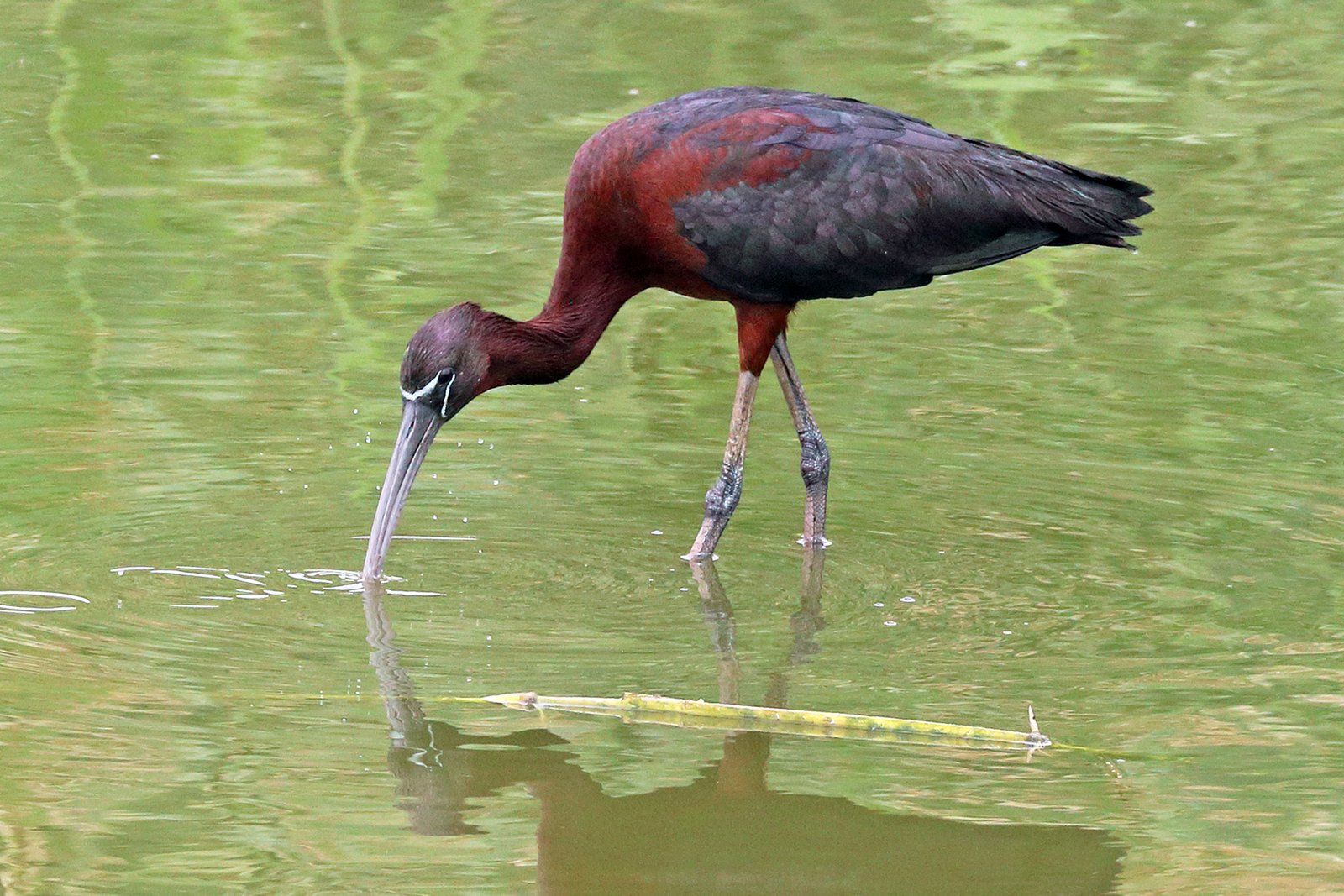
55–65 cm, slender, with a long, decurved bill and long legs. In breeding plumage the head, neck and underparts are deep chestnut, and the back and wings dark with a green and purple gloss. The bare lores are dark bluish grey, bordered above and below by a narrow, pale blue line that does not continue behind the eye. The eye is dark, the bill olive-brown and the legs greyish brown. In non-breeding plumage the head and neck are duller brown with fine white streaks. In flight the neck and legs project well. The sexes are alike.
Confusion species
White-faced Ibis Plegadis chihi in breeding plumage has a broad white feathered border enclosing the whole bare face, a red eye and red legs; in non-breeding plumage the red eye is the best feature. Puna Ibis Plegadis ridgwayi lives in the high Andes and on the coast of Peru, has a dark reddish-brown bill and lacks the pale facial lines. Bare-faced Ibis Phimosus infuscatus is smaller, with a pink bill and a bare pink face. Green Ibis Mesembrinibis cayennensis is stockier, with short legs, and lives in forested swamps.
Habitat
Freshwater and brackish marshes, flooded grassland, edges of shallow lakes, rice fields, lagoons and salt marsh, mainly in the lowlands. It feeds in flocks, probing mud and shallow water for insect larvae, worms, snails, crustaceans and sometimes small fish. It breeds in colonies, often with herons, with a nest of sticks and reeds in shrubs, trees or reedbeds.
Where the bird is most at home, classified by the vegetation units of the Andes and the west coast.


Range and movements
In Colombia in the Caribbean lowlands and the Magdalena Valley, locally also in other parts of the country. In Ecuador and Peru a rare visitor. In Bolivia barely known. Absent from the Galápagos. Outside the guide area in Venezuela, the Caribbean and eastern North America, and further in Europe, Africa, Asia and Australia.
- Resident
- dark = core range, pale = thinly spread
How and when to look
Search the marshes and rice fields of the Caribbean lowlands of Colombia among flocks of herons and other ibises. Check eye and leg colour and the facial lines to separate it from White-faced Ibis.
Conservation status
Least Concern. The species is widespread; locally marshes are lost to drainage and pollution, while rice farming also creates new feeding habitat.
Scientific name
Plegadis falcinellus | (Linnaeus, 1766)
Linnaeus described the species in 1766 as Tantalus Falcinellus; because it was later moved to another genus, the author and year stand in brackets. The genus Plegadis was introduced in 1829 by Kaup. The genus name comes from Greek plēgados, 'sickle', after the curved bill. The species name is a Latin diminutive of falx, 'sickle': 'little sickle', after the curved bill. The specimen the first description was based on came from Java and Sulawesi, Indonesia.