All species › Pelicans, herons and ibises › Ibises and spoonbills › Bare-faced Ibis
Bare-faced Ibis | Phimosus infuscatus
Maskeribis | Ibis afeitado | Tapicuru
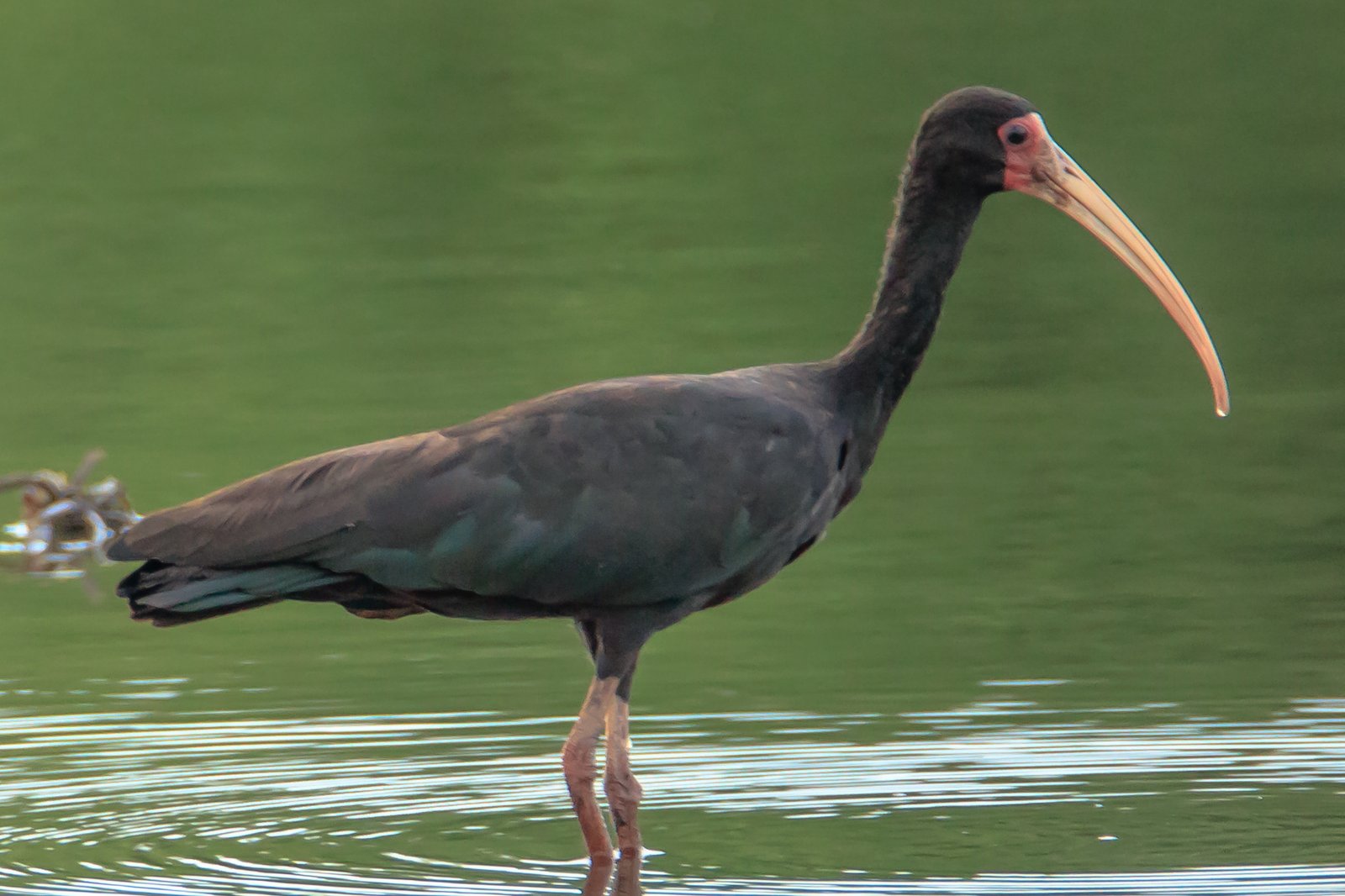
The Bare-faced Ibis is a small, dark ibis with a bare pink face and a pink bill. It lives in flocks on wet grassland, rice fields and flooded pastures and flies in lines or loose V's between feeding and roosting sites. In parts of Colombia it is expanding, also into higher valleys.
Voice
Usually silent. In flocks and when flushed, soft, nasal grunts and growling notes.
Recording: Smily Varon — CC BY-NC-SA 4.0 · xeno-canto
Identification
46–54 cm, with a rather short, decurved bill and short legs. The plumage is blackish brown with a green to bronze gloss on the wings and back. The face around the eye and bill base is bare and pink to reddish; the bill is pink to orange-pink and the legs are pink to red. In flight the legs project just beyond the tail. The sexes are alike. Juveniles are duller, with a less brightly coloured face.
Confusion species
Green Ibis Mesembrinibis cayennensis is larger, with a greenish bill, a dark face and greyish-green legs, and keeps to forested swamps. Glossy Ibis Plegadis falcinellus and White-faced Ibis Plegadis chihi are larger and slimmer, with a dark bill, longer legs and a chestnut head and neck. Sharp-tailed Ibis Cercibis oxycerca is much larger, with a long tail.
Habitat
Wet grassland, marshes, flooded pastures, rice fields, edges of shallow lakes and savanna, mainly in the lowlands, but in Colombia also in valleys and high plateaus of the Andes to above 2500 m. It feeds in flocks, probing mud and shallow water for insect larvae, worms, snails and small crustaceans. It breeds in colonies, often with herons, with a stick nest in shrubs or trees over water.
Where the bird is most at home, classified by the vegetation units of the Andes and the west coast.


Range and movements
In Colombia widespread in the Caribbean lowlands, the Magdalena and Cauca valleys and the llanos, and locally in the Andes. In Ecuador and Peru scarce and local, mainly in the eastern lowlands. In Bolivia in the savannas and marshes of the north and east. Absent from the Galápagos. Outside the guide area in Venezuela, the Guianas and from Brazil to Uruguay and northern Argentina.
- Resident
- dark = core range, pale = thinly spread
How and when to look
In the llanos and in the rice-growing areas of lowland Colombia, check flooded fields and pastures; flocks feed there among cattle and herons. In the evening they fly in lines to their roosts.
Conservation status
Least Concern. The species benefits from rice farming and grazed land and is increasing in parts of its range.
Scientific name
Phimosus infuscatus | (Lichtenstein, 1823)
Lichtenstein described the species in 1823 as Ibis infuscata; because it was later moved to another genus, the author and year stand in brackets. The genus Phimosus was introduced in 1832 by Wagler. The genus name comes from Greek phimos, 'muzzle' (from phimoō, 'to silence'). The species name is Latin infuscatus, 'darkened', after the dark plumage. The specimen the first description was based on came from Brazil.