All species › Pelicans, herons and ibises › Ibises and spoonbills › Green Ibis
Green Ibis | Mesembrinibis cayennensis
Groene ibis | Ibis verde | Coró-coró
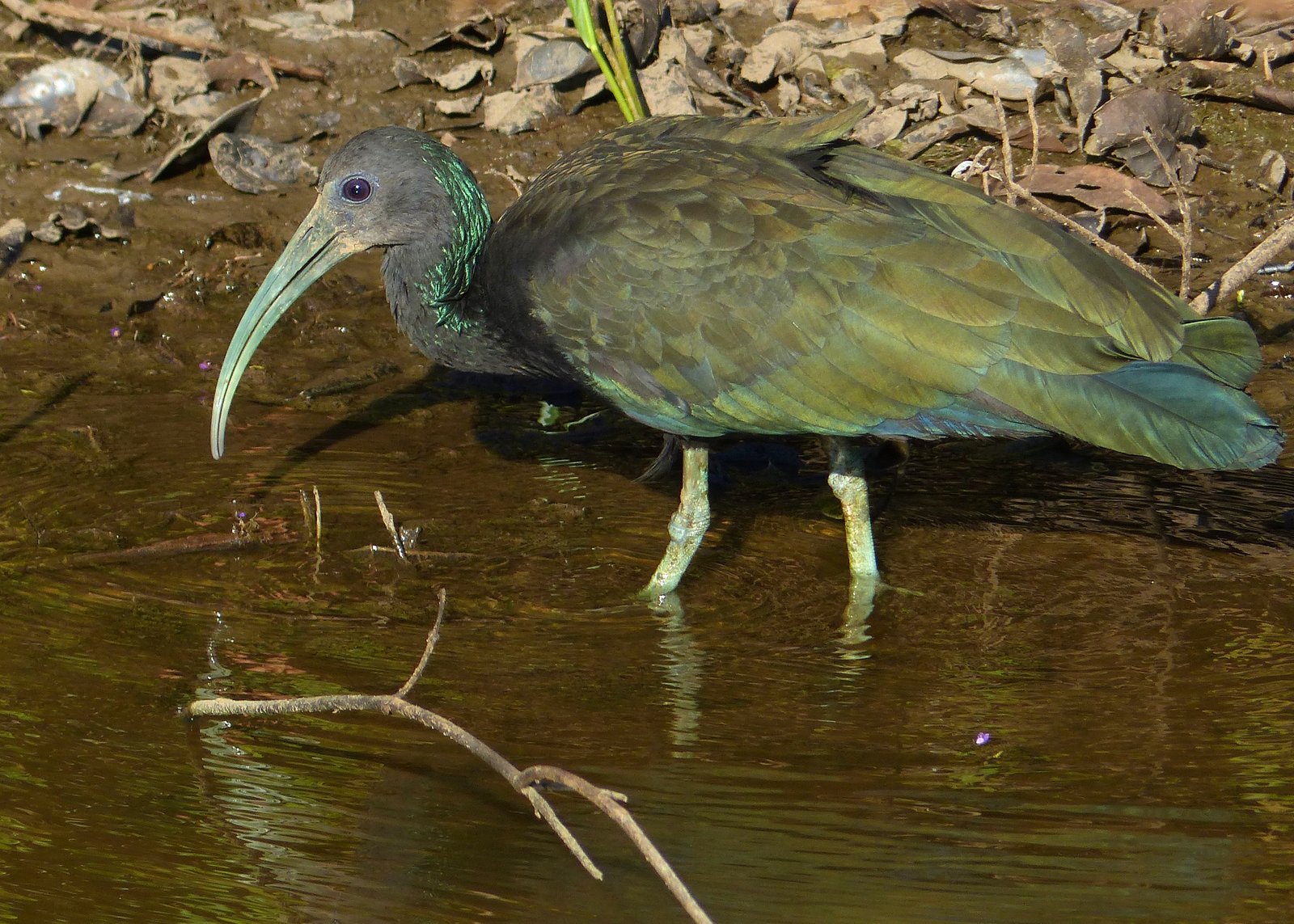
The Green Ibis is a dark, stocky ibis of forested swamps and riverbanks in the tropical lowlands. Unlike most ibises it usually lives alone or in pairs and keeps to the cover of trees. Its loud, rolling call is heard mainly at dawn and dusk.
Voice
A loud, rolling kloo-kloo-kloo or kurr-kurr-kurr, often in quick series and in duet, mainly at dawn and dusk, also in flight.
Recording: JAYRSON ARAUJO DE OLIVEIRA — CC BY-NC-SA 4.0 · xeno-canto
Identification
48–58 cm, with a long, decurved bill, rather short legs and a fairly long tail. At a distance the plumage looks blackish, but close up it has a dark green to bronze gloss, strongest on the mantle and wings. The feathers of the hindneck are elongated, forming a short, shaggy mane. The bill is greenish grey, the bare skin around the eye dark bluish grey and the legs greyish green. In flight the broad wings and short legs, barely projecting beyond the tail, stand out. The sexes are alike. Juveniles are duller, with less gloss.
Confusion species
Bare-faced Ibis Phimosus infuscatus is smaller, with a pink to red bill, a pink bare face and red legs, and lives in open, wet grassland. Glossy Ibis Plegadis falcinellus has longer legs, a slimmer build and a chestnut head and neck, and feeds in open marsh. Sharp-tailed Ibis Cercibis oxycerca is larger, with a long tail, a red bill base and red legs, and lives in open savanna.
Habitat
Swamp forest, várzea, banks of forest rivers, meanders and oxbow lakes, palm swamps and wet places in forest, in the lowlands up to about 500 m, locally higher. It probes muddy ground and shallow water for worms, insect larvae, snails and other invertebrates. The nest is a platform of sticks in a tree, usually over or near water.
Where the bird is most at home, classified by the vegetation units of the Andes and the west coast.


Range and movements
In Colombia in the lowlands north and east of the Andes, including the Magdalena Valley and Amazonia. In Ecuador in the eastern lowlands. In Peru in the Amazonian lowlands. In Bolivia in the lowlands of the north and east. Absent from the Galápagos. Outside the guide area from Honduras through Venezuela, the Guianas and Brazil to Paraguay and north-eastern Argentina.
- Resident
- dark = core range, pale = thinly spread
How and when to look
Travel by boat at dawn or dusk along forested riverbanks and oxbow lakes in the Amazonian lowlands; the call usually gives the birds away before they are seen. By day they often sit still on a branch over the water or walk across the mud in the shade.
Conservation status
Least Concern. The species is widespread in the Amazonian lowlands; locally habitat is lost to deforestation and the draining of swamps.
Scientific name
Mesembrinibis cayennensis | (Gmelin, 1789)
Gmelin described the species in 1789 as Tantalus cayennensis; because it was later moved to another genus, the author and year stand in brackets. The genus Mesembrinibis was introduced in 1930 by Peters. The genus name combines Greek mesēmbrinos, 'southern', with ibis: a southern ibis. The species name refers to Cayenne in French Guiana. The specimen the first description was based on came from Cayenne, French Guiana.