All species › Passerines › Ovenbirds and woodcreepers › Brown-rumped Foliage-Gleaner
Brown-rumped Foliage-Gleaner | Automolus melanopezus
Bruinstuitbladspeurder | Rascahojas lomipardo | Barranqueiro-escuro
The Brown-rumped Foliage-Gleaner is a dark foliage-gleaner of the south-western Amazon basin, closely tied to Guadua bamboo and dense tangles. The species is poorly known and occurs locally.
Voice
The song is a fast, dry series of hard notes, roughly chek-chek-chek-chek, which may run into a rattle.
Recording: José María Loaiza B. — CC BY-NC-SA 4.0 · xeno-canto
Identification
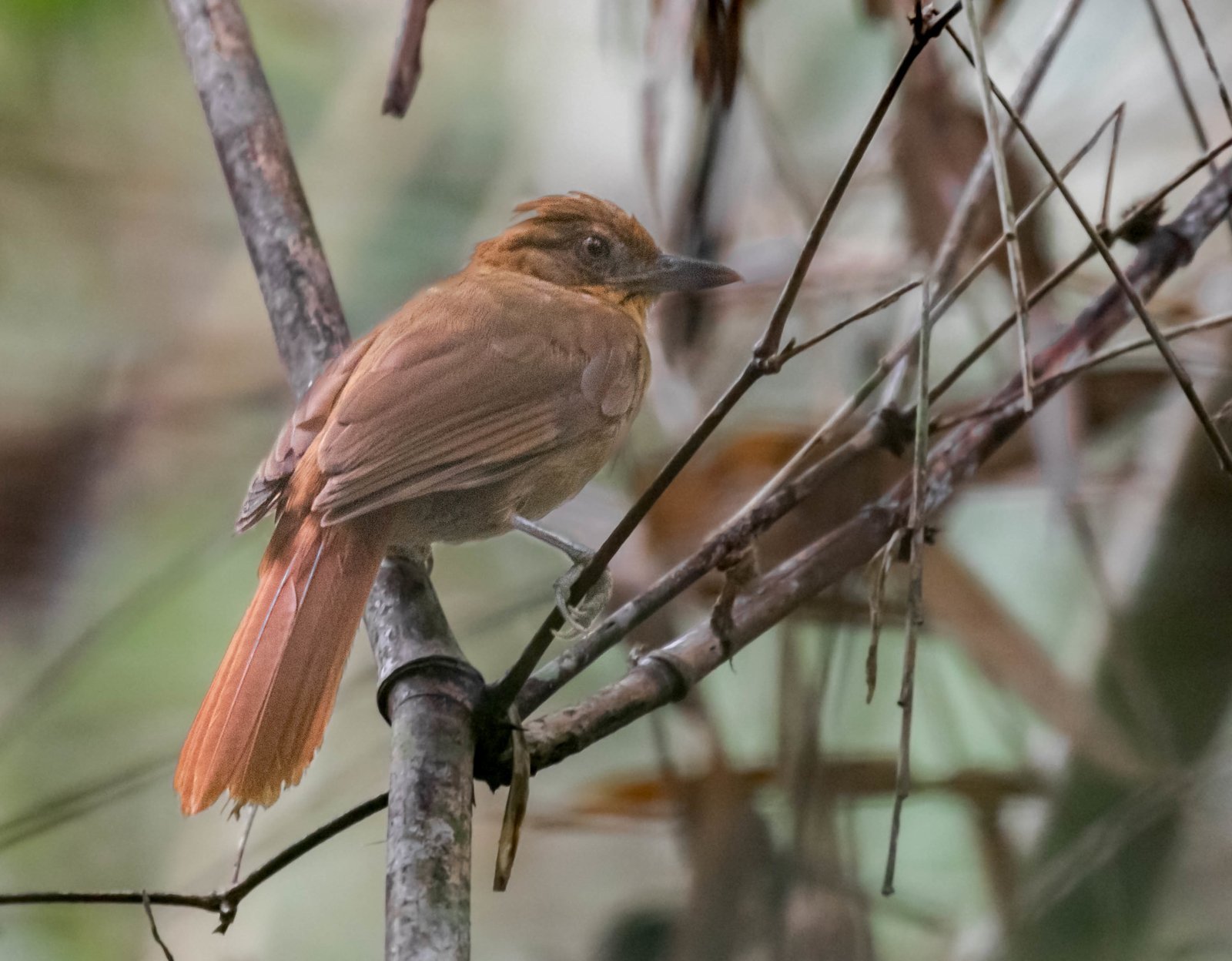
18–19 cm, with a fairly stout, straight bill. The upperparts are dark reddish brown, including the crown and rump, which contrast with the rufous tail. The iris is orange. The throat is bright buff, the breast ochre-brown and the belly darker brown. There is no distinct eyering. The sexes are alike.
Confusion species
Chestnut-crowned Foliage-Gleaner Automolus rufipileatus also has an orange eye, but a chestnut crown and a paler back, and lives mainly along rivers. Ochre-throated Foliage-Gleaner Automolus ochrolaemus has a dark eye, a buff eyering and a paler throat. Bamboo Foliage-Gleaner Anabazenops dorsalis, also a bamboo bird, has a pale eyebrow and a pale throat. Chestnut-winged Hookbill Ancistrops strigilatus is streaked and has a hook-tipped bill.
Habitat
Dense stands of Guadua bamboo and tangles in humid terra firme and transitional forest, in the lowlands and foothills up to about 1100 m. It searches dead leaves and bamboo for insects, often in mixed flocks. The nest is probably in a tunnel in an earth bank.
Where the bird is most at home, classified by the vegetation units of the Andes and the west coast.


Range and movements
In Colombia only locally in the far south of the Amazonian lowlands. In Ecuador very locally in the eastern lowlands. In Peru in the eastern lowlands, mainly in the centre and south. In Bolivia in the lowlands of the north. Absent from the Galápagos. Outside the guide area in western Brazilian Amazonia.
- Resident
- dark = core range, pale = thinly spread
How and when to look
Search large stands of bamboo in south-eastern Peru, for example around Tambopata and in lower Manu. The song from the bamboo is usually the first sign.
Conservation status
Least Concern. The species occurs locally and depends on lowland bamboo forest.
Scientific name
Automolus melanopezus | (Sclater, 1858)
Sclater described the species in 1858 as Anabates melanopezus; because it was later moved to another genus, the author and year stand in brackets. The genus Automolus was introduced in 1853 by Reichenbach. The genus name comes from Ancient Greek automolos, 'deserter'. The species name comes from Ancient Greek melas, 'black', and peza, 'foot', so 'black-footed'. The specimen the first description was based on came from Río Napo, Ecuador.