All species › Passerines › Ovenbirds and woodcreepers › Ochre-throated Foliage-Gleaner
Ochre-throated Foliage-Gleaner | Automolus ochrolaemus
Okerkeelbladspeurder | Breñero garganta pálida | Barranqueiro-camurça
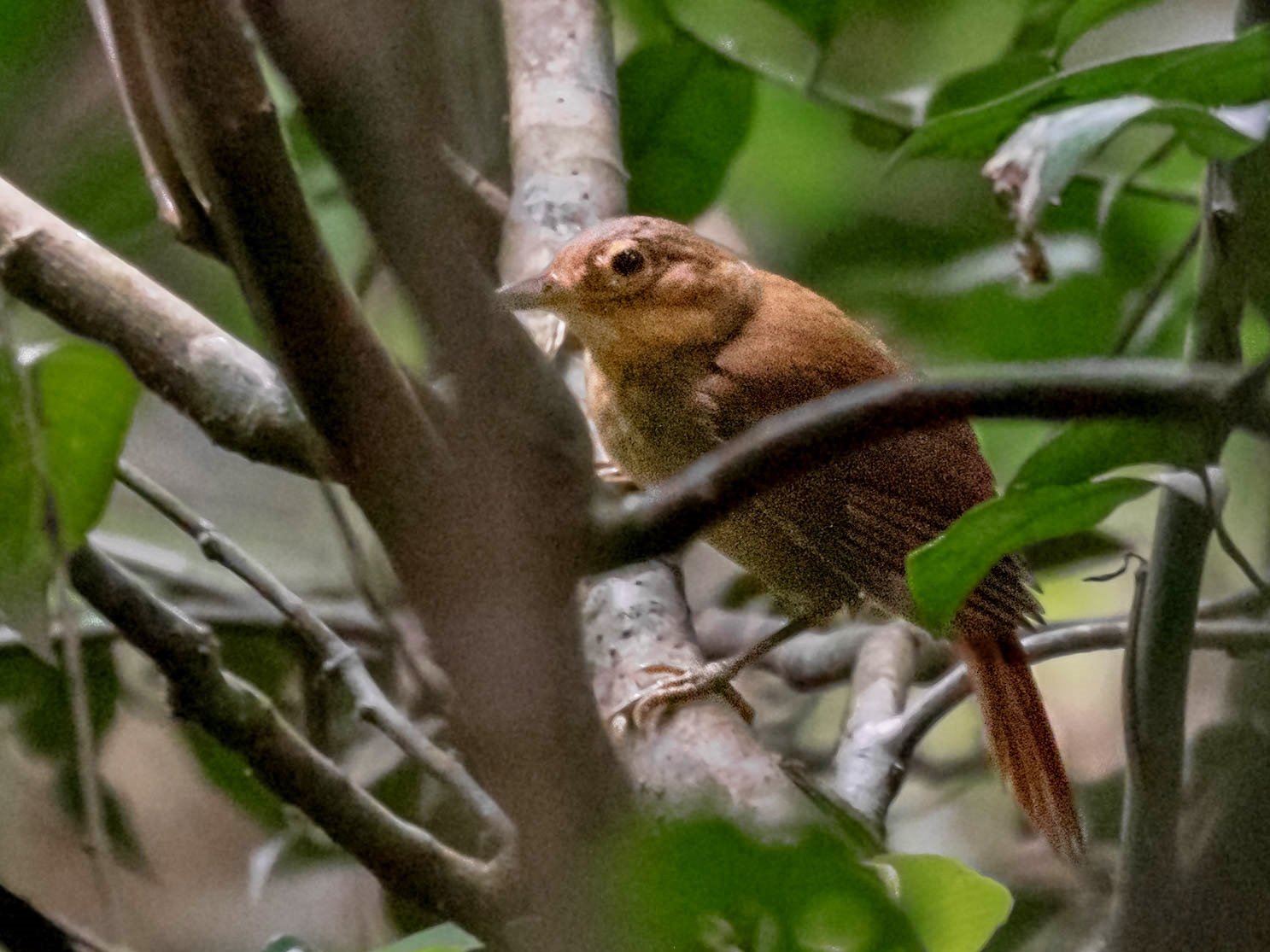
The Ochre-throated Foliage-Gleaner is a rather stocky foliage-gleaner of lowland forest on both sides of the Andes. It has a buff eyering and a pale throat and forages in the undergrowth among hanging dead leaves. Until 2023 it was treated as one species with the Central American Automolus cervinigularis.
Voice
Sings mainly at dawn and dusk: a short, descending series of hard notes, roughly keh-keh-keh-krreh. Calls include a nasal rack and a dry, downslurred kreeh.
Recording: Juan Freile — CC BY-NC-SA 4.0 · xeno-canto
Identification
18–20 cm, with a short, heavy bill. The upperparts are olive-brown and the tail dark chestnut. The face is dark brown, with a buff eyering and a buff stripe behind the eye. The throat is deep buff, the breast brown with faint pale streaks, and the belly ochre-brown. The iris is dark. The sexes are alike. The subspecies pallidigularis west of the Andes is the palest, with an almost white throat; turdinus in northern Amazonia has a paler throat than ochrolaemus in the south.
Confusion species
Olive-backed Foliage-Gleaner Automolus infuscatus has a white throat, paler underparts and no buff eyering. Chestnut-crowned Foliage-Gleaner Automolus rufipileatus and Brown-rumped Foliage-Gleaner Automolus melanopezus have an orange eye and no pale eyering. Eastern Woodhaunter Automolus subulatus is finely streaked on the head, back and breast. Ruddy Foliage-Gleaner Clibanornis rubiginosus is more uniformly rufous-brown, with no pale eyering.
Habitat
The undergrowth of humid lowland forest, especially várzea, swamp forest, transitional forest and forest edges with dense tangles, up to about 1000 m; west of the Andes mainly secondary forest up to 800 m, locally to 1400 m. It searches hanging dead leaves for insects and spiders, often in mixed flocks. The nest is a loose cup of leaf stems at the end of a tunnel in an earth bank.
Where the bird is most at home, classified by the vegetation units of the Andes and the west coast.


Range and movements
In Colombia in the Chocó and the Magdalena valley (pallidigularis) and in the lowlands east of the Andes. In Ecuador in the north-western and eastern lowlands. In Peru in the Amazonian lowlands. In Bolivia in the lowlands of the north and centre. Absent from the Galápagos. Outside the guide area in eastern Panama, Venezuela, the Guianas and Brazilian Amazonia.
- Resident
- dark = core range, pale = thinly spread
How and when to look
Search forest trails with many vines and dead leaves, or along streams in lowland forest; the bird often joins mixed understorey flocks. At dawn the song is a good clue.
Conservation status
Least Concern; not yet assessed separately since the split. Its numbers are thought to be declining through deforestation, but the species is widespread and locally common.
Scientific name
Automolus ochrolaemus | (Tschudi, 1844)
Tschudi described the species in 1844 as Anabates ochrolaemus; because it was later moved to another genus, the author and year stand in brackets. The genus Automolus was introduced in 1853 by Reichenbach. The genus name comes from Ancient Greek automolos, 'deserter'. The species name comes from Ancient Greek ōkhros, 'ochre', and laimos, 'throat'. The specimen the first description was based on came from Peru.