All species › Passerines › Ovenbirds and woodcreepers › Eastern Woodhaunter
Eastern Woodhaunter | Automolus subulatus
Oostelijke bosbladspeurder | Rondamusgos oriental | Limpa-folha-riscado
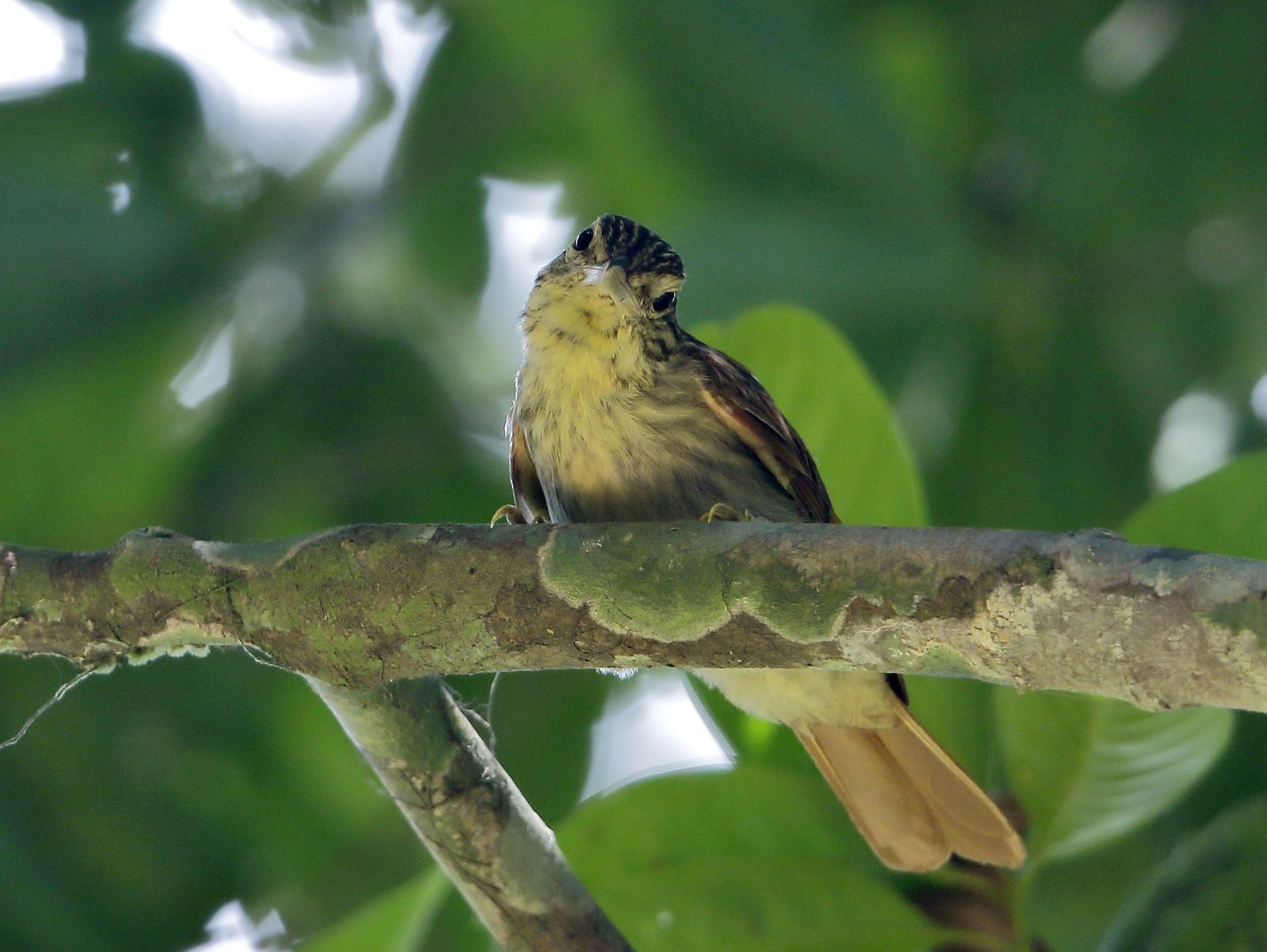
The Eastern Woodhaunter is a dark, finely streaked ovenbird of the lowlands and foothills east of the Andes. It forages at mid-levels among epiphytes and dead leaves and reveals itself by its harsh, nasal song. The form west of the Andes is now treated as a separate species, Western Woodhaunter Automolus virgatus.
Voice
The song is a series of two to four harsh, nasal notes, roughly kweek-kweek or chek-chek-chek, often in the early morning.
Recording: Jacob Wijpkema — CC BY-NC-SA 4.0 · xeno-canto
Identification
17–18 cm, with a fairly long, straight bill. The upperparts are dark olive-brown, with fine buff streaks on the crown, nape and upper back; the tail is rufous. The throat is buff with dark edges, the breast olive-brown with narrow buff streaks, and the belly almost plain. The sexes are alike.
Confusion species
Ochre-throated Foliage-Gleaner Automolus ochrolaemus has an unstreaked back and a buff eyering. Lineated Foliage-Gleaner Syndactyla subalaris is very similar but has a pale eyebrow and more sharply defined streaks, and lives higher in the Andes. Black-billed Treehunter Thripadectes melanorhynchus is larger, with a heavy, black bill. Chestnut-winged Hookbill Ancistrops strigilatus has a hook-tipped bill and pale yellowish streaks on the breast.
Habitat
Humid terra firme forest in the lowlands and foothills, especially in hilly country and on slopes, mostly below 1300 m. It searches epiphytes, moss and hanging dead leaves at mid-levels for insects, often in mixed flocks. The nest is in a tunnel in an earth bank.
Where the bird is most at home, classified by the vegetation units of the Andes and the west coast.


Range and movements
In Colombia in the lowlands and foothills east of the Andes. In Ecuador in the eastern lowlands and foothills. In Peru in the Amazonian lowlands and on the lower eastern slope. In Bolivia in the north and in the Andean foothills. Absent from the Galápagos. Outside the guide area in southern Venezuela and western Brazilian Amazonia.
- Resident
- dark = core range, pale = thinly spread
How and when to look
Search the foothills of the eastern slope, for example around Sumaco in Ecuador or in lower Manu in Peru, along trails with many epiphytes. Follow mixed flocks at mid-levels.
Conservation status
Least Concern. The species has a large range but depends on undisturbed forest.
Scientific name
Automolus subulatus | (Spix, 1824) (GBIF: Hyloctistes subulatus)
Spix described the species in 1824 as Sphenura subulata; because it was later moved to another genus, the author and year stand in brackets. The genus Automolus was introduced in 1853 by Reichenbach. The genus name comes from Ancient Greek automolos, 'deserter'. The species name comes from Latin subulatus, 'awl-shaped' (from subula, 'awl'). The specimen the first description was based on came from Amazon River, Brazil.