All species › Passerines › Ovenbirds and woodcreepers › Olive-backed Foliage-Gleaner
Olive-backed Foliage-Gleaner | Automolus infuscatus
Olijfrugbladspeurder | Rascahojas dorsioliva | Barranqueiro-pardo
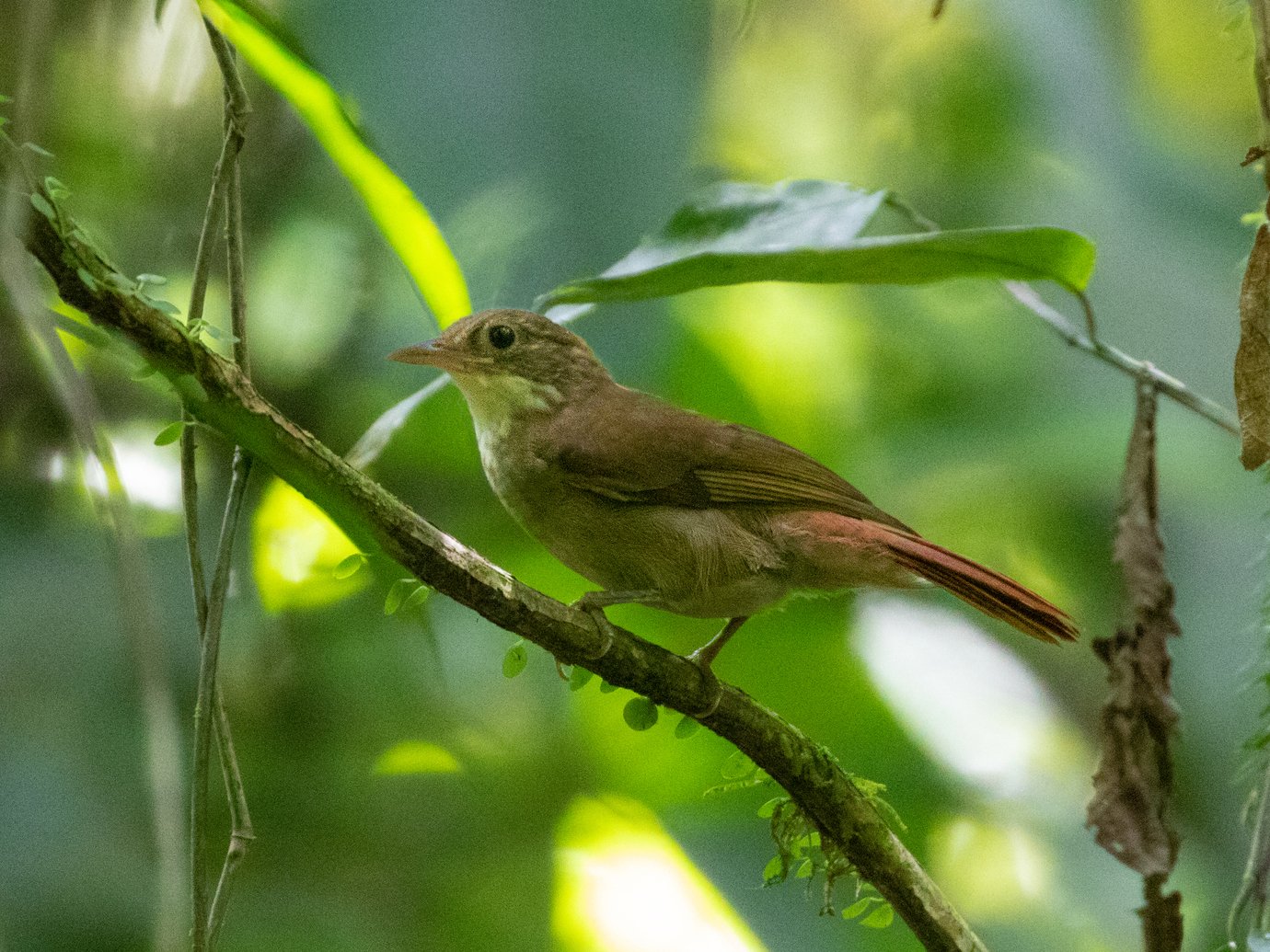
The Olive-backed Foliage-Gleaner is a medium-sized, plain foliage-gleaner of the understorey of Amazonian lowland forest. It searches curled dead leaves and clusters of dead foliage for insects and often joins mixed flocks. Its dry, rattling song is one of the regular sounds of the lowland forest in the east of the guide area.
Voice
The song is a loud, dry rattle of rapidly repeated harsh notes, chrrrrrr, which can last several seconds. Also gives a sharp chek.
Recording: JAYRSON ARAUJO DE OLIVEIRA — CC BY-NC-SA 4.0 · xeno-canto
Identification
19 cm, with a fairly strong, straight bill. The upperparts are olive-brown, the rump slightly warmer brown and the tail bright rufous. A narrow, dull eye-ring and a faint pale supercilium. The throat is white and contrasts with the greyish, olive-washed breast and belly. The sexes are alike; juveniles resemble adults.
Confusion species
Ochre-throated Foliage-Gleaner Automolus ochrolaemus is warmer brown, with a buff throat and an obvious buff eye-ring. Brown-rumped Foliage-Gleaner Automolus melanopezus is darker brown, with a rufous-brown rump and an orange eye, and lives mainly in bamboo. Chestnut-crowned Foliage-Gleaner Automolus rufipileatus has a chestnut crown and an orange eye and lives in riverine forest and on river islands. Eastern Woodhaunter Automolus subulatus has a finely streaked head and mantle and a scaly buff throat.
Habitat
Understorey and middle storey of humid terra firme lowland forest, locally also old secondary forest and the edges of flooded forest, from the lowlands up to about 1000 m. It searches clusters of dead leaves, curled leaves and epiphytes for insects and spiders, often in mixed flocks. The nest is at the end of a self-dug tunnel in a steep bank or ditch side.
Where the bird is most at home, classified by the vegetation units of the Andes and the west coast.


Range and movements
Colombia: in the Amazonian lowlands east of the Andes. Ecuador: in the eastern lowlands and low foothills. Peru: throughout the Amazonian lowlands. Bolivia: in the north and north-west, in Pando, Beni and northern La Paz. Absent from the Galápagos. Outside the guide area in southern Venezuela, the Guianas and Amazonian Brazil.
- Resident
- dark = core range, pale = thinly spread
How and when to look
Watch for mixed flocks in the understorey of Amazonian forest and listen for the dry rattle. The bird often disappears for minutes into a cluster of dead leaves; wait until it comes out again.
Conservation status
Least Concern. The species is common in undisturbed lowland forest, but disappears where the forest is cleared.
Scientific name
Automolus infuscatus | (Sclater, 1856)
Sclater described the species in 1856 as Anabates infuscatus; because it was later moved to another genus, the author and year stand in brackets. The genus Automolus was introduced in 1853 by Reichenbach. The genus name comes from Ancient Greek automolos, 'deserter'. The species name comes from Latin infuscatus, 'darkened' or 'dusky'. The specimen the first description was based on came from eastern Peru.