All species › Passerines › New World warblers › Buff-rumped Warbler
Buff-rumped Warbler | Myiothlypis fulvicauda
Zeemstuitzanger | Reinita culiparda | Pula-pula-de-uropígio-claro
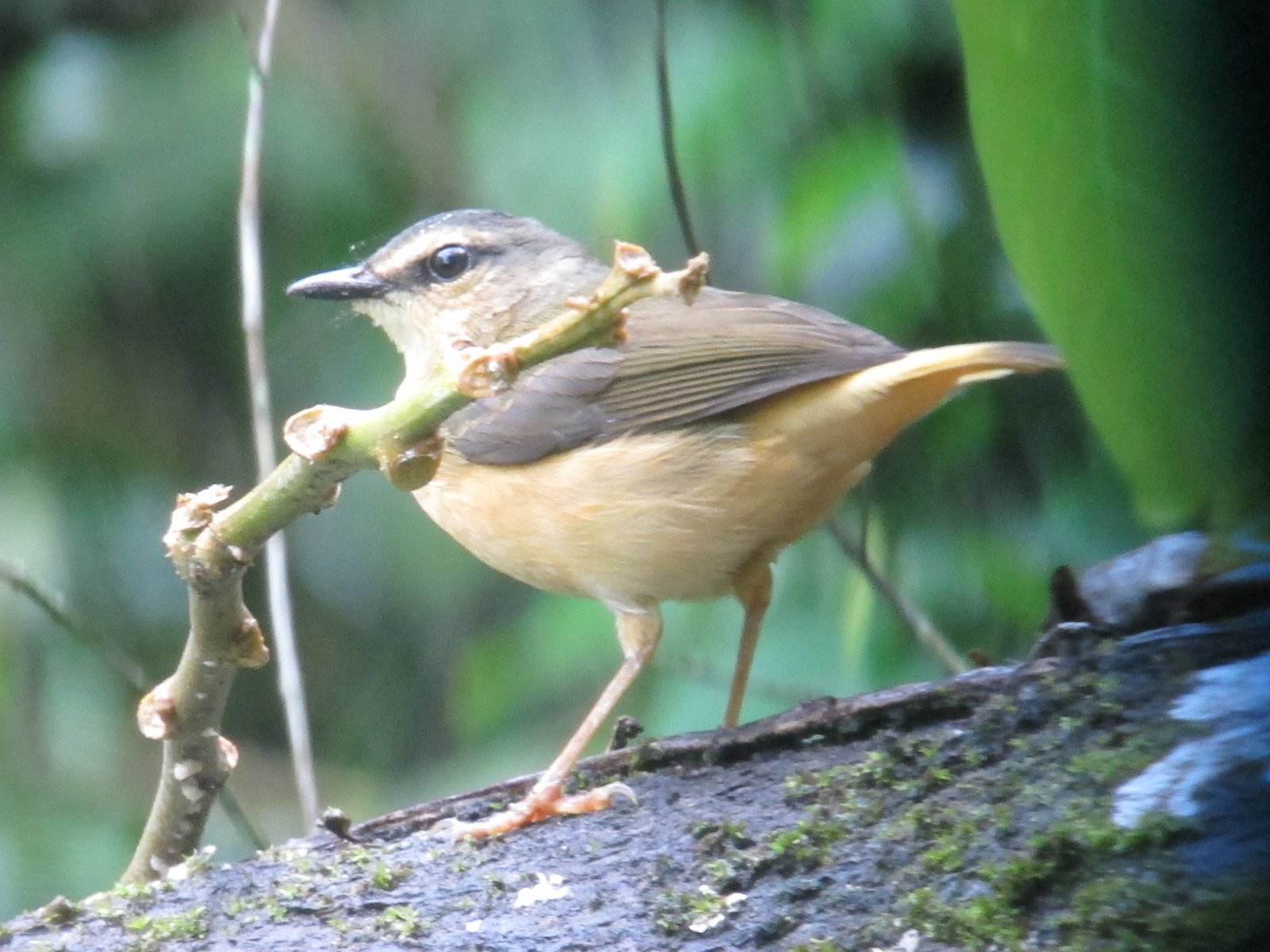
The Buff-rumped Warbler is a brownish warbler of streams and small rivers in humid forest, from Honduras to south-eastern Peru. It walks over stones and roots just above the water, constantly swinging its tail from side to side and showing its pale rump and tail base. Its loud song carries over the sound of the water.
Voice
The song is a loud, rising series of clear notes that swells and accelerates, chi-chi-chu-chu-chew-chew. The call is a sharp chik.
Recording: Jacob Wijpkema — CC BY-NC-SA 4.0 · xeno-canto
Identification
13–14 cm. The upperparts are dark olive-brown; the rump and tail base are pale buff and contrast with the blackish distal half of the tail. There is a pale buff supercilium and a dark eye-stripe. The underparts are whitish to pale buff, warmer on the breast and flanks. The legs are pale. The sexes are alike. Young birds are duller.
Confusion species
Riverbank Warbler Myiothlypis rivularis, in the guide area mainly in Bolivia, lacks the contrasting pale rump and has a more uniformly coloured tail. Northern Waterthrush Parkesia noveboracensis and Louisiana Waterthrush Parkesia motacilla, winter visitors from North America, also walk along water, but have streaked underparts, bob the rear body and lack a pale rump.
Habitat
Banks of fast-flowing streams and small rivers in humid forest, especially rocky foothill streams, also along forest trails and in humid ravines; from sea level to about 1500 m. It forages for insects on stones, sandbars and roots. The nest is a domed structure in a bank or among roots close to the water.
Where the bird is most at home, classified by the vegetation units of the Andes and the west coast.


Range and movements
In Colombia in the Pacific lowlands, the lower parts of the Andean valleys and along the eastern base of the Andes. In Ecuador in the west and along the eastern base of the Andes. In Peru along the eastern base of the Andes from the north to the south-east. In Bolivia at most in the extreme north-west; the boundary with Riverbank Warbler there is not well known. Absent from the Galápagos. Outside the guide area from Honduras to Panama and in western Brazil.
- Resident
- dark = core range, pale = thinly spread
How and when to look
Walk slowly along rocky streams in foothill forest and listen for the loud song over the water; birds often walk just ahead of you over the stones and then show the pale rump.
Conservation status
Least Concern. Dependent on forest streams; habitat is lost locally to clearing and stream pollution.
Scientific name
Myiothlypis fulvicauda | (Spix, 1825)
Spix described the species in 1825 as Muscicapa fulvicauda; because it was later moved to another genus, the author and year stand in brackets. The genus Myiothlypis was introduced in 1851 by Cabanis. The genus name combines Greek muia, 'fly', with thlupis, an unidentified small bird. The species name combines Latin fulvus, 'tawny', and cauda, 'tail', after the buff rump and tail base. The specimen the first description was based on came from São Paulo de Olivença, Amazonas, Brazil.