All species › Passerines › New World warblers › Riverbank Warbler
Riverbank Warbler | Myiothlypis rivularis
Vloedboszanger | Reinita ribereña | Pula-pula-ribeirinho
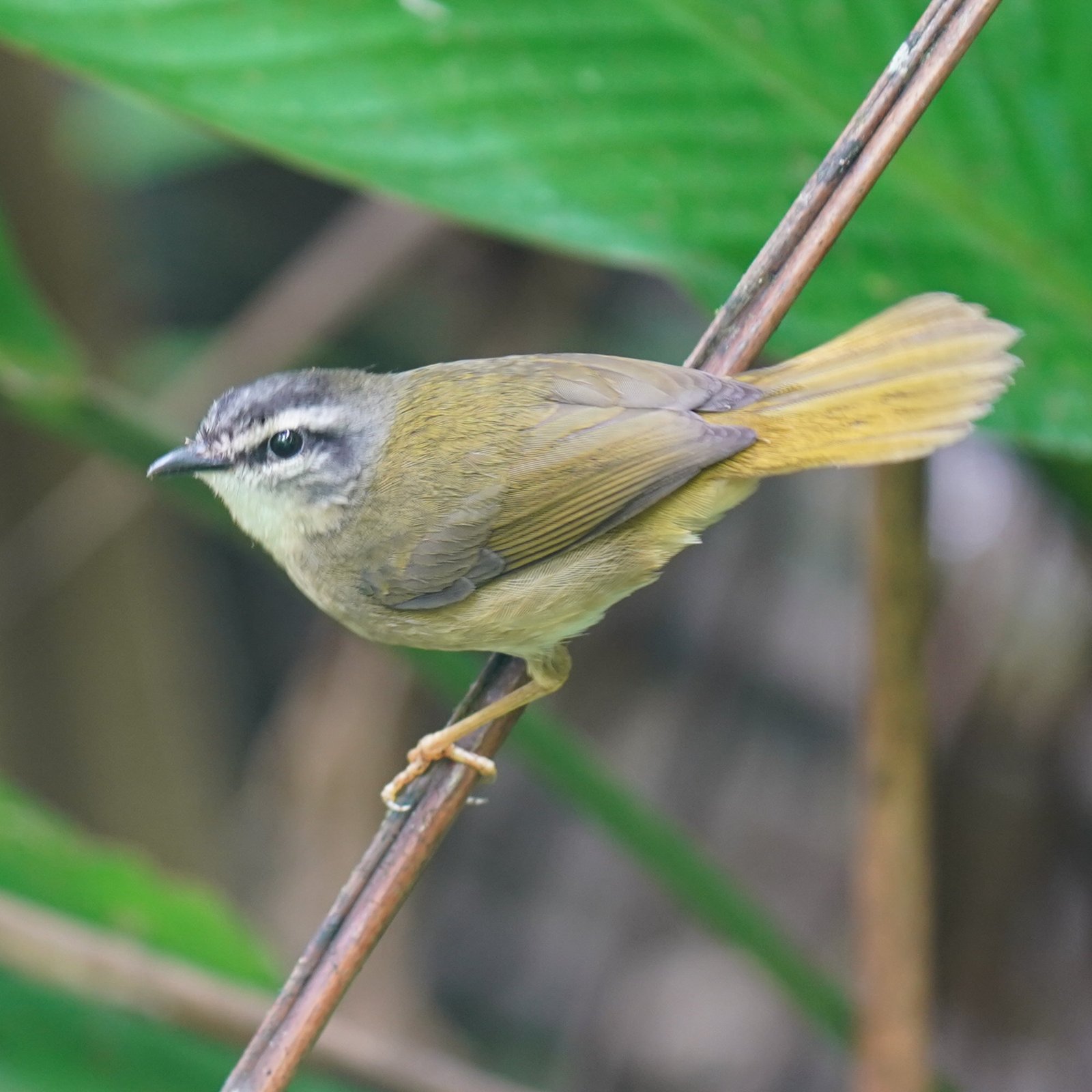
The Riverbank Warbler is a brownish warbler of streams and riverbanks in forest, with three separate populations: in Amazonia east of the guide area, in the Atlantic Forest and in the Yungas of Bolivia. In the guide area it is the Bolivian population that occurs. Like the related Buff-rumped Warbler, it walks over stones and roots and swings its tail.
Voice
The song is a loud, rising series of clear notes, similar to that of Buff-rumped Warbler. The call is a sharp chik.
Recording: Jose Martin — CC BY-NC-SA 4.0 · xeno-canto
Identification
13–14 cm. The upperparts are plain olive-brown, without a contrasting pale rump; the tail is uniformly brown. There is a pale buff supercilium and a dark eye-stripe. The underparts are whitish to buff, browner on the flanks. The legs are pale. The sexes are alike. Young birds are duller.
Confusion species
Buff-rumped Warbler Myiothlypis fulvicauda, further north along the eastern base of the Andes, has a pale buff rump and tail base contrasting with the blackish distal half of the tail. Waterthrushes Parkesia have streaked underparts and barely occur in Bolivia.
Habitat
Banks of streams and small rivers in humid foothill forest and lower montane forest, in Bolivia roughly between 400 and 1500 m; elsewhere also in swampy riverine forest in the lowlands. It forages for insects on stones, muddy banks and roots. The nest is a domed structure in a bank or among roots close to the water.
Where the bird is most at home, classified by the vegetation units of the Andes and the west coast.


Range and movements
In Bolivia along the eastern base of the Andes and in the lower Yungas, from La Paz through Cochabamba to Santa Cruz. In Peru at most in the extreme south-east. Absent from Colombia, Ecuador and the Galápagos. Outside the guide area in Amazonian Venezuela, the Guianas and Brazil, and in the Atlantic Forest of south-eastern Brazil, Paraguay and north-eastern Argentina.
- Resident
- dark = core range, pale = thinly spread
How and when to look
In Bolivia, walk along forest streams in the foothills, for example around Villa Tunari in Cochabamba, and listen for the loud song over the water.
Conservation status
Not Evaluated in its current species limits; together with Buff-rumped Warbler it was previously assessed as a single species of Least Concern. Dependent on forest streams; clearing and stream pollution are local threats.
Scientific name
Myiothlypis rivularis | (Wied-Neuwied, 1821)
Wied-Neuwied described the species in 1821 as Muscicapa rivularis; because it was later moved to another genus, the author and year stand in brackets. The genus Myiothlypis was introduced in 1851 by Cabanis. The genus name combines Greek muia, 'fly', with thlupis, an unidentified small bird. The species name comes from Latin rivularis, 'of brooks', from rivulus, 'streamlet', after its habitat along running water. The specimen the first description was based on came from Ilhéus, Bahia, Brazil.