All species › Passerines › New World warblers › Two-banded Warbler
Two-banded Warbler | Myiothlypis bivittata
Dubbelbandzanger | Reinita bandeada | Pula-pula-de-duas-fitas
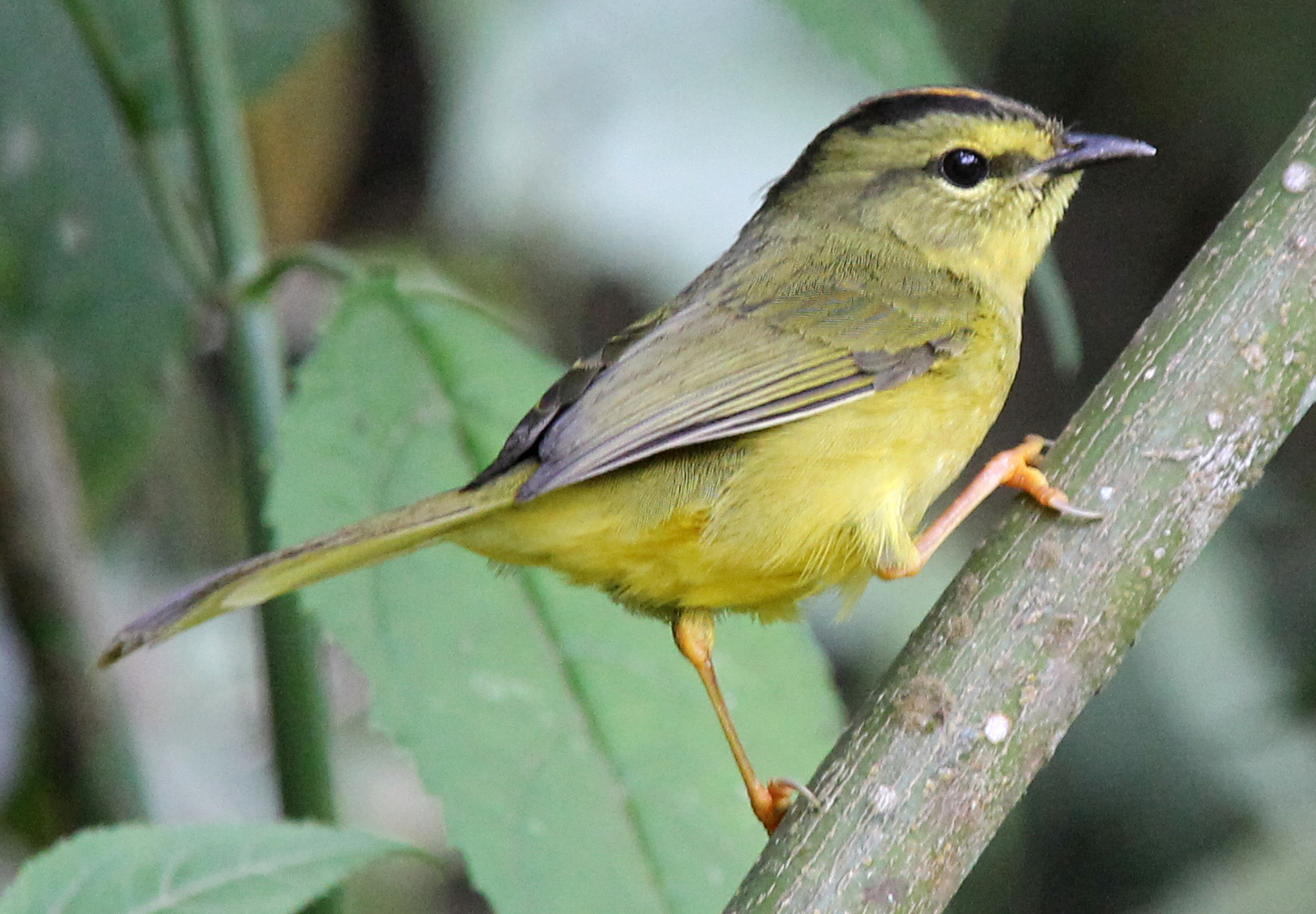
The Two-banded Warbler is an olive-green and yellow warbler of the understorey of humid montane forest on the eastern slope of the Andes in southern Peru and Bolivia. The name refers to the two black bands on either side of the crown. The birds of the tepuis of southern Venezuela and northern Brazil are often treated as a separate species.
Voice
The song is a long, fast series of bright, chipping notes that accelerates and increases in volume; pairs sometimes sing in duet. The call is a dry tchek.
Recording: Richard E. Webster — CC BY-NC-SA 4.0 · xeno-canto
Identification
13.5–14 cm, with a fairly long tail. The upperparts are olive-green. The crown has an ochre-yellow to orange-yellow central stripe, bordered on each side by a broad black band. Below this run an olive-yellow supercilium and a dark eyestripe; the cheeks are olive. The underparts are bright yellow, with olive flanks. The sexes are alike. Young birds are duller and browner olive, with fainter head stripes.
Confusion species
Cuzco Warbler Myiothlypis chrysogaster is smaller, with narrower and less contrasting dark crown bands, and in south-eastern Peru usually lives lower on the slope. Pale-legged Warbler Myiothlypis signata lacks the black crown bands and has a yellow supraloral stripe and pale legs. Yungas Warbler Basileuterus punctipectus has pale and black head stripes, a dark ear patch and duller yellow underparts. Russet-crowned Warbler Myiothlypis coronata has a grey head with a rufous crown stripe and lives higher.
Habitat
Understorey and lower strata of humid foothill and montane forest, often in dense scrub and bamboo along forest edges, stream valleys and ravines, roughly between 800 and 2200 m. It forages in pairs or family groups, often with mixed flocks, for insects on and just above the ground. The nest, as in related species, is a domed nest on the ground or in a bank.
Where the bird is most at home, classified by the vegetation units of the Andes and the west coast.


Range and movements
Peru: eastern slope of the Andes in the south-east, mainly in Puno and possibly in adjacent Cuzco. Bolivia: along the eastern slope of the Andes, in the Yungas of La Paz and Cochabamba and south through the montane forests of Santa Cruz, Chuquisaca and Tarija. Absent from Colombia, Ecuador and the Galápagos. Outside the guide area in north-western Argentina; the related tepui birds in southern Venezuela and adjacent Brazil and Guyana.
- Resident
- dark = core range, pale = thinly spread
How and when to look
Along roads and trails through the Yungas, watch for pairs foraging low in the scrub of the forest edge. They give themselves away with the fast, swelling song and then often come briefly to the edge of the vegetation.
Conservation status
Not evaluated in this circumscription. In the guide area the species is locally fairly common in suitable forest; it tolerates forest edges and secondary growth, but disappears where the forest is cleared completely.
Scientific name
Myiothlypis bivittata | (d'Orbigny, ACVMD & de Lafresnaye, 1837)
D'Orbigny, ACVMD & de Lafresnaye described the species in 1837 as Muscicapa bivittata; because it was later moved to another genus, the author and year stand in brackets. The genus Myiothlypis was introduced in 1851 by Cabanis. The genus name combines Greek muia, 'fly', with thlupis, an unidentified small bird. The species name combines Latin bi-, 'two-', and vittatus, 'banded, striped', after the two black crown stripes. The specimen the first description was based on came from Yungas, Bolivia.