All species › Passerines › New World warblers › Choco Warbler
Choco Warbler | Myiothlypis chlorophrys
Chocózanger | Reinita del Chocó | Pula-pula-do-chocó
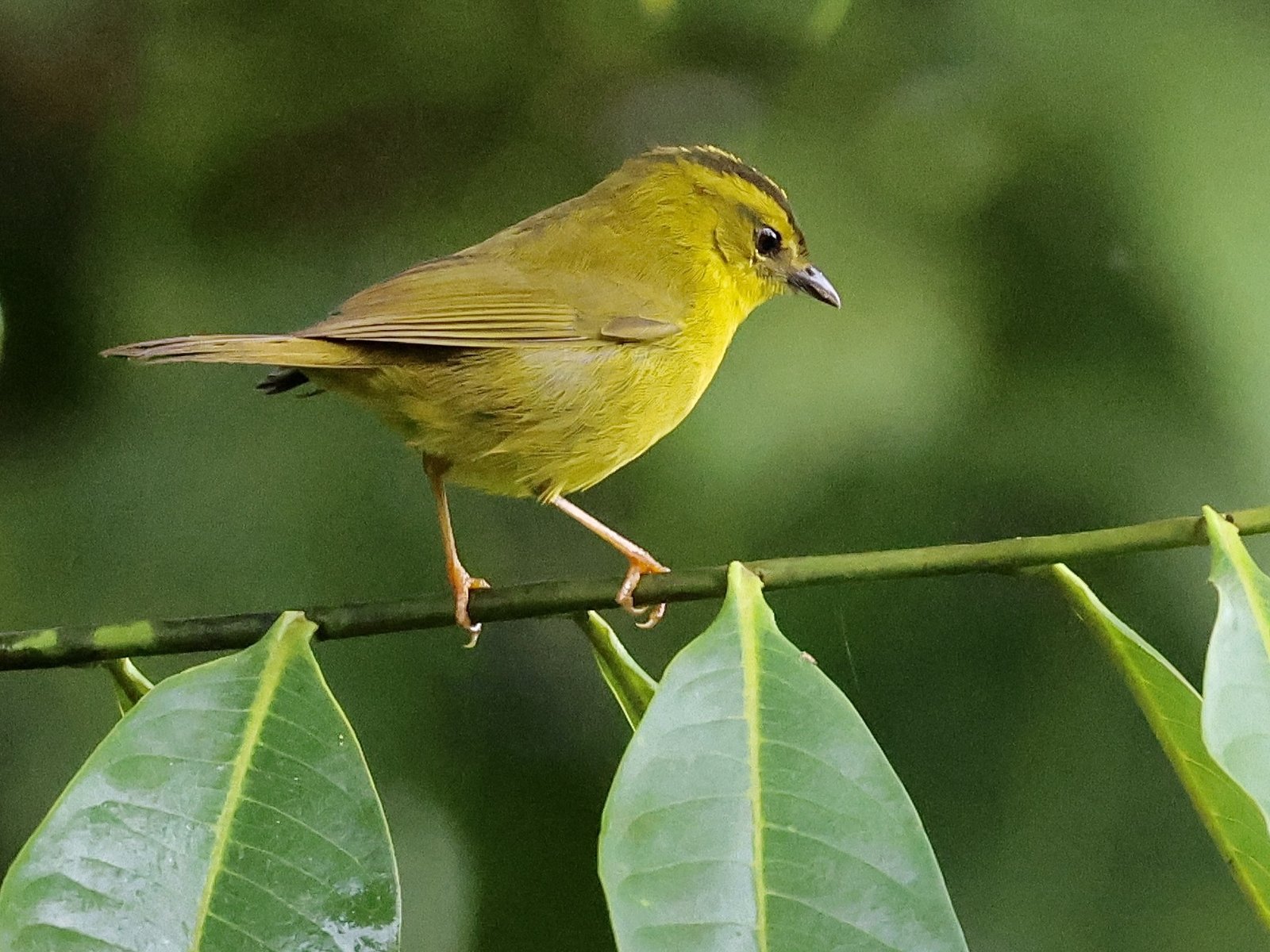
The Choco Warbler is an olive-green and yellow warbler of the understorey of the Chocó rainforest and the lower montane forests on the western slope of the Andes in Colombia and Ecuador. It was long regarded as a subspecies of Cuzco Warbler, but that species lives far from here on the eastern slope of the Andes in Peru.
Voice
The song is a short, rising series of bright notes and chips, sometimes ending in a faster trill. The call is a dry tchip.
Recording: rudy gelis — CC BY-NC-SA 4.0 · xeno-canto
Identification
13.5 cm, with a fairly short tail. The upperparts are olive-green. The crown has a yellow to ochre-yellow central stripe, bordered on each side by a blackish band. A yellow supercilium, clearest above the lores, and a dark eyestripe. The underparts are yellow, with an olive wash on the breast sides and flanks. The sexes are alike. Young birds are duller, with less distinct head stripes.
Confusion species
Buff-rumped Warbler Myiothlypis fulvicauda has a buff rump and tail base, wags its tail and lives on the ground along streams. Three-striped Warbler Basileuterus tristriatus has black and pale head stripes with a black ear patch and duller yellowish-olive underparts, and usually lives higher. Russet-crowned Warbler Myiothlypis coronata has a grey head with a rufous crown stripe and lives much higher.
Habitat
Understorey of humid lowland and hill forest and lower montane rainforest, also tall secondary forest and forest edges, from the lowlands to about 1500 m, mainly in the hills. It forages in pairs, often with mixed understorey flocks, for insects on twigs and leaves low above the ground. The nest, as in related species, is a domed nest on or near the ground.
Where the bird is most at home, classified by the vegetation units of the Andes and the west coast.


Range and movements
Colombia: Pacific lowlands and western slope of the Western Andes, mainly from Valle del Cauca south to Nariño. Ecuador: the north-west, in the lowlands and hills at the foot of the western slope of the Andes. Absent from Peru, Bolivia and the Galápagos. As far as known, it does not occur outside the guide area.
- Resident
- dark = core range, pale = thinly spread
How and when to look
In the hills of north-western Ecuador and south-western Colombia, look along forest trails and roads through humid forest for pairs moving low in the understorey with mixed flocks. The song is often the first sign.
Conservation status
Least Concern. The range is limited to the Chocó, where deforestation for agriculture, logging and oil palm reduces the habitat; in continuous forest the species is locally fairly common.
Scientific name
Myiothlypis chlorophrys | (Berlepsch, 1907)
Berlepsch described the species in 1907 as Basileuterus bivittatus chlorophrys; because it was later moved to another genus, the author and year stand in brackets. The genus Myiothlypis was introduced in 1851 by Cabanis. The genus name combines Greek muia, 'fly', with thlupis, an unidentified small bird. The species name combines Greek khlōros, 'green', and ophrus, 'eyebrow'. The specimen the first description was based on came from above Santo Domingo de los Colorados, Ecuador.