All species › Passerines › New World warblers › Cuzco Warbler
Cuzco Warbler | Myiothlypis chrysogaster
Cuzcozanger | Reinita ventridorada | Pula-pula-de-cuzco
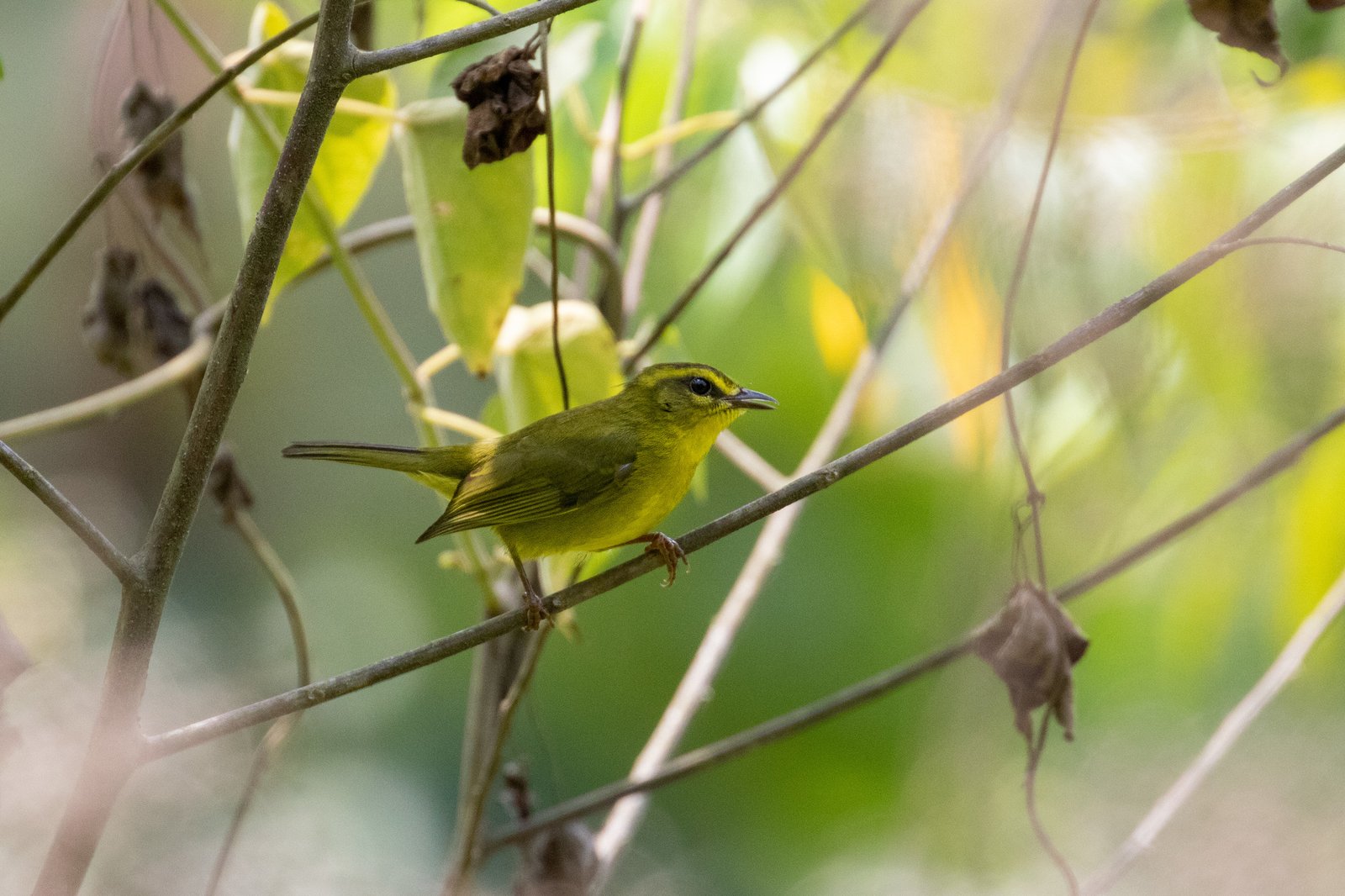
The Cuzco Warbler is an olive-green and yellow warbler of the foothill forest on the eastern slope of the Andes in south-eastern Peru, with a small range. Together with Choco Warbler of the western slope in Colombia and Ecuador it was formerly regarded as one species.
Voice
The song is a short, rising series of bright notes ending in an accelerating trill. The call is a dry tchip.
Recording: Rolf A. de By — CC BY-NC-SA 4.0 · xeno-canto
Identification
13 cm, slender, with a fairly long tail. The upperparts are olive-green. The crown has a yellow to orange-yellow central stripe between two narrow blackish bands. A yellow supercilium and a dark eyestripe. The underparts are bright yellow, with olive flanks. The sexes are alike. Young birds are duller, with fainter head stripes.
Confusion species
Two-banded Warbler Myiothlypis bivittata is larger, with broader black crown bands, and usually lives higher on the slope. Pale-legged Warbler Myiothlypis signata lacks the black crown bands and has a yellow supraloral stripe and pale legs; it lives higher. Yungas Warbler Basileuterus punctipectus has pale and black head stripes, a dark ear patch and duller yellow underparts.
Habitat
Understorey of humid foothill and lower montane forest, also bamboo, stream valleys and forest edges, roughly between 500 and 1500 m. It forages in pairs, often with mixed flocks, for insects low in the vegetation. The nest, as in related species, is presumably a domed nest on or near the ground.
Where the bird is most at home, classified by the vegetation units of the Andes and the west coast.


Range and movements
Peru: eastern slope of the Andes in the south-east, in Cuzco and Puno. Bolivia: not confirmed; occurrence in the adjacent Yungas of La Paz is possible. Absent from Colombia, Ecuador and the Galápagos. It does not occur outside the guide area.
- Resident
- dark = core range, pale = thinly spread
How and when to look
In south-eastern Peru, look along the lower parts of the road from Cuzco to the Manu area for pairs in the understorey of foothill forest, often in mixed flocks along the forest edge.
Conservation status
Least Concern. The range is small, but lies largely in and around protected areas such as Manu National Park; outside them forest is being lost to agriculture and road building.
Scientific name
Myiothlypis chrysogaster | (Tschudi, 1844)
Tschudi described the species in 1844 as Setophaga chrysogaster; because it was later moved to another genus, the author and year stand in brackets. The genus Myiothlypis was introduced in 1851 by Cabanis. The genus name combines Greek muia, 'fly', with thlupis, an unidentified small bird. The species name combines Greek khrusos, 'gold', and gastēr, 'belly'. The specimen the first description was based on came from Chanchamayo Valley, Junín, Peru.