All species › Passerines › Tanagers and allies › Burnished-buff Tanager
Burnished-buff Tanager | Stilpnia cayana
Sabeltangare | Tangara isabel | Saíra-amarela
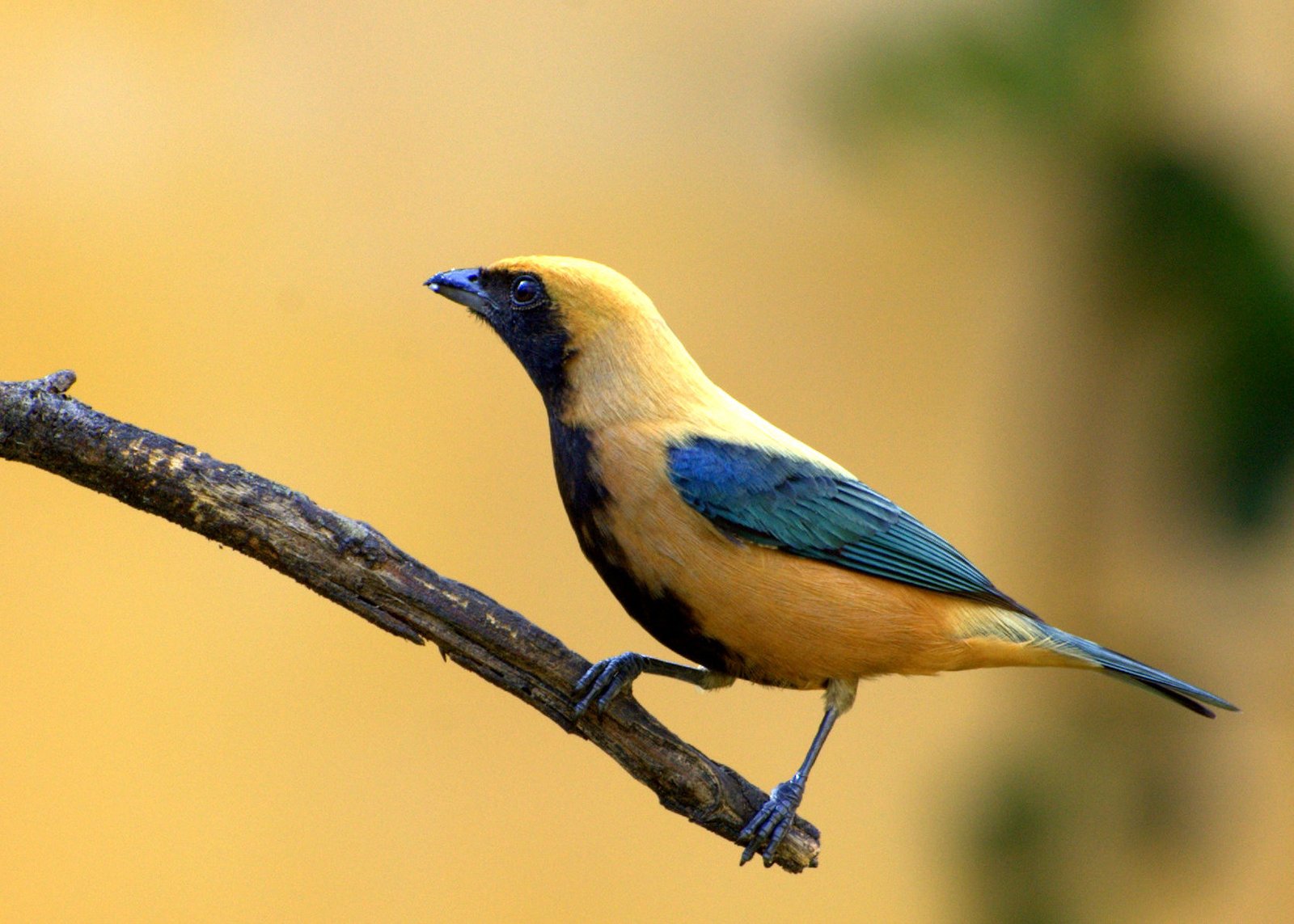
The Burnished-buff Tanager is a tanager of open, semi-arid country in northern and central South America: savanna with woodlots, cerrado, forest edges and gardens. It is mainly pale buff with a rufous crown and a black mask, and is one of the few tanagers that truly lives in open landscape.
Voice
High, sharp tseet calls and a short, dry chipping; the song is a rapid series of high, soft notes.
Recording: Robson Silva e Silva — CC BY-NC-SA 4.0 · xeno-canto
Identification
14 cm. The male has a rufous crown, a black mask and pale buff to straw-coloured back and underparts with a slight sheen, sometimes tinged blue-green on the breast. Wings and tail are blackish with green-blue edges. The female is duller, with a dull crown and a less distinct mask. In Bolivia there are forms with a darker, more blackish belly. Juveniles are greener and greyer.
Confusion species
Scrub Tanager Stilpnia vitriolina also has a rufous crown and a black mask, but is silvery green-grey and lives in the Andean valleys of Colombia and Ecuador. Green-capped Tanager Stilpnia meyerdeschauenseei has a green crown and no black mask. The female Black-capped Tanager Stilpnia heinei is greener, without a rufous crown.
Habitat
Savanna with scattered trees and woodlots, cerrado, gallery forest, dry forest, forest edges, scrub, gardens and parks, mainly below 1000 m, locally higher. It eats fruit, especially small berries, and searches branches for insects, in pairs or family groups. The cup nest is placed in a tree or shrub.
Where the bird is most at home, classified by the vegetation units of the Andes and the west coast.


Range and movements
In Colombia east of the Andes, mainly in the llanos and along the foot of the Andes. In Peru very locally in the south-east, in the savannas of the Pampas del Heath. In Bolivia in the lowland savannas and cerrado of the north and east. Does not occur in Ecuador or on the Galápagos. Outside the guide area in Venezuela, the Guianas, much of Brazil and Paraguay.
- Resident
- dark = core range, pale = thinly spread
How and when to look
Search the llanos of Colombia around ranches, woodlots and gallery forest, and in Bolivia the edges of savanna woodlots; the birds often perch in scattered trees in open country.
Conservation status
Not evaluated in this circumscription. The species has a large range and tolerates semi-open and human-modified landscape well.
Scientific name
Stilpnia cayana | (Linnaeus, 1766)
Linnaeus described the species in 1766 as Tanagra cayana; because it was later moved to another genus, the author and year stand in brackets. The genus Stilpnia was introduced in 2016 by Burns, Unitt & Mason. The genus name comes from Greek stilpnos, 'glittering' or 'glistening'. The specific name refers to Cayenne in French Guiana. The specimen the first description was based on came from Cayenne, French Guiana.